Customer Disputes Your Invoice: How to Reply (6 Templates)
Published 2 September 2026 · 8 minute read · The ReciteMail Blog
"I don't think this is right." Four words that make the money you have already earned feel suddenly negotiable. Most disputed invoices are not refusals to pay. They are a customer who cannot see where a number came from, asking in the only way an invoice lets them. Reply as if you are being accused and you get a standoff. Reply as if you have been asked a fair question and you usually get paid within the week. Here is the shape of that reply, the mistakes that turn a query into a fight, plus six copy-paste templates for the disputes that actually land in a small business inbox.
A dispute is a question with a deadline attached
Late and disputed invoices are the quiet drain on small firms. Around 62 percent of UK small businesses are carrying overdue invoices at any moment, US surveys put the average amount owed to an affected business at roughly $17,500 and businesses report spending hours every week chasing money they have already earned. A dispute is the sharp end of that: an invoice that has stopped moving because the customer has a question about it.
The framing matters more than anything else in the reply. Someone who queries a line item is, almost always, a customer who intends to pay and wants to understand the number first. Treat that as an insult and you have manufactured a second problem on top of the first. Treat it as a fair question, answer it plainly and the money nearly always follows. This is the same instinct behind a good late payment reminder: assume the reasonable explanation out loud and let the paperwork do the firm part.
The shape of an invoice dispute reply
Every good version runs the same five moves, whether you fit kitchens or file tax returns.
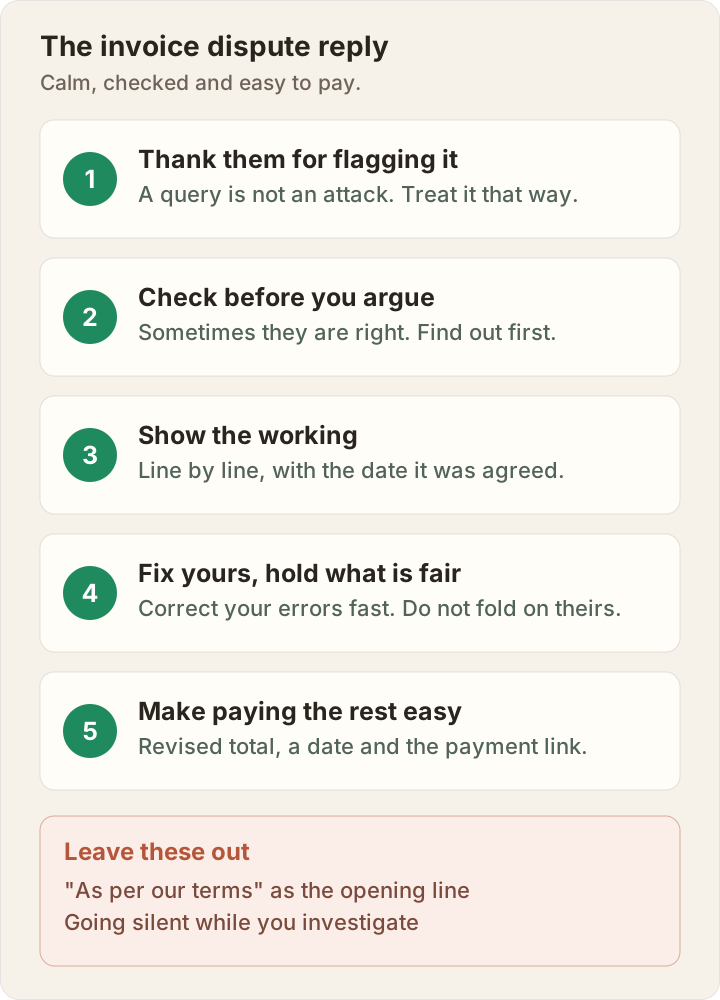
- Thank them for flagging it. One sentence. It costs nothing and it sets the whole temperature of what follows. The customer hears a partner, not a debt collector.
- Check before you argue. Go back to the quote, the thread, the job sheet. Sometimes they are right. A dispute answered from memory is how you end up defending a typo.
- Show the working. The disputed line, what it covers, where and when it was agreed. Line by line beats a paragraph of justification every time, because it lets the customer see the number instead of taking your word for it.
- Fix what is yours, hold what is fair. Your error gets corrected the same day with a fresh invoice and a plain apology. A correct charge gets a calm explanation, not a discount. Folding on a right number teaches people that disputing works.
- Make paying the rest easy. Revised total, a date and the payment link in the same email. A dispute reply without a clear way to pay just restarts the wait.
The mistakes that turn a query into a standoff
- Opening with "as per our terms". The customer has not read your terms and quoting them first reads as a lawyer clearing their throat. Lead with the explanation. Terms are the last resort, not the first line.
- Going quiet while you investigate. Three days of silence tells the customer their query landed in a void. Acknowledge the same day, even if the answer is "I'm checking and you'll have the detail by Thursday".
- Defending before checking. The fastest way to lose a customer is to argue confidently about a charge that turns out to be your mistake. Look first.
- Discounting to end the discomfort. A credit that buys peace on a correct invoice is a rebate on your own margin and an invitation to dispute the next one. Reserve gestures for genuinely grey lines.
- Letting the whole invoice stall over one line. Nine lines are agreed and one is disputed. Ask for the nine now. Reasonable people pay the undisputed part immediately because it is obviously fair.

Invoice dispute email templates
Six templates for the disputes that actually happen. Swap the brackets, keep the numbers exact and keep the tone of someone explaining, never someone defending.
Subject: Re: Invoice [number], the [item] line
Hi [name], thanks for flagging this, always better to ask than to pay something that looks wrong. I've gone back to the quote from [date] and the [item] line is the [description] we agreed there, at [amount], which covers [what it includes]. I've attached the quote so you can see it side by side. The rest of the invoice is as agreed so the total stands at [amount] and the easiest way to pay is [link or details]. If anything else looks off, tell me and I'll check it the same way.
[Your name], [business]
Subject: Invoice [number], corrected copy attached
Hi [name], you're right and I'm sorry. The [item] line was [what went wrong, e.g. charged twice / priced at the wrong rate]. I've issued a corrected invoice, attached, with the new total of [amount] and the old one is cancelled so please ignore it. Thank you for catching it rather than just paying it, that's the kind of customer I'd like to keep. Same payment details as before: [link or details].
[Your name], [business]
Subject: Re: Invoice [number], where the [item] came from
Hi [name], I can see why that line looked unexpected so let me point at the paper rather than my memory. On [date] you asked for [the extra] in [the email / the call / the site visit] and I confirmed it in writing the same day at [amount], which I've attached. That's the line on the invoice. I know these things get lost in a busy project, which is exactly why I confirm changes in writing. The total stands at [amount] and you can pay at [link]. If it helps, I'm happy to talk it through on the phone this week.
[Your name], [business]
Subject: Re: Invoice [number], the additional work
Hi [name], thanks for raising it. The original quote covered [scope] at [amount] and that part of the invoice matches it exactly. The [extra] came up on [date] when [what happened] and I flagged then that it would be additional at [amount] before going ahead, which is the line you're querying. I've attached both the quote and my note from that day. I'd rather settle this fairly than argue so if you'd like, we can go through the extra together on a quick call. Otherwise the total stands at [amount] and the link is [link].
[Your name], [business]
Subject: Invoice [number], a fair way to move forward
Hi [name], I understand you're not happy with the [item] line and I'm looking into it properly, you'll have my full answer by [date]. In the meantime the rest of the invoice, [amount], is work we both agree on so could I ask you to settle that part now while we sort the one line? It keeps things fair for both of us and it means the disputed piece is the only thing still open. Payment details are [link]. Thanks for working through this with me.
[Your name], [business]
Subject: Invoice [number], let's sort this properly
Hi [name], we've gone back and forth on this by email and I don't think either of us is enjoying it so let me suggest something simpler. Can we have a fifteen minute call on [day] or [day]? I'll bring the quote, the notes and the invoice and we'll go through it line by line together. My aim is a number we both think is fair, not a win. If the total is genuinely a strain right now, I'm also open to splitting it over [two or three] payments. Just tell me which day suits.
[Your name], [business]
Where disputes are really born
Almost every invoice dispute was decided weeks earlier, at the quote. A quote that lists what the price includes removes most surprises. A deposit shows commitment on both sides. A two-line email the same day whenever the scope changes turns a memory into a record, which is the whole difference between template 3 and a shouting match. And an invoice that mirrors the quote line for line gives the customer nothing to be surprised by. When the extra work is big enough to warrant its own conversation, have it before the invoice, not on it: the job will cost more than quoted guide covers that email. And if the dispute is really a cash problem in disguise, a payment plan beats a standoff every time.
The third dispute this month
One calm dispute reply is easy. The third one this month, written at 6pm about money you earned in July, with the calm still intact, is the hard part. That is when "as per our terms" creeps into the first line, not because you are unreasonable but because you are tired and the customer's tone got under your skin. The fix is the same one that works for every recurring hard email: a shape you trust and a draft that starts in your voice instead of your mood.
That is the job ReciteMail does. It learns how you write from emails you have already sent, then turns a one-line note like "Dave disputes the extra skirting line, we agreed it on the 14th by email, hold the charge, offer a call" into a warm, exact reply that sounds like you on a good day. And because it runs on your own machine and never connects to any mailbox, your customers' financial details stay exactly where they are.
Trades and accountants live this monthly. Dispute replies, payment reminders, quotes and price-change conversations are the same handful of money emails, each one easiest to get wrong when you are annoyed. ReciteMail drafts all of them in your voice, private by architecture because it never connects to a mailbox. See ReciteMail for trades and ReciteMail for accountants.
Common questions
How do you respond to a customer who disputes an invoice?
Thank them for raising it, then check before you argue. Go back to the quote, the email thread or the signed job sheet and find out whether they have a point. If you made the error, say so and issue a corrected invoice the same day. If the charge is right, show the working line by line with the date it was agreed, keep the tone of someone explaining rather than defending and make paying easy with a revised total, a date and the link. Most disputes are a misunderstanding rather than a refusal and they end the moment the customer can see where the number came from.
Should you offer a discount to settle an invoice dispute?
Not as a reflex. Folding on a correct charge teaches the customer that disputing works and you will hear from them again on the next invoice. Correct your own mistakes fully and quickly, hold the line politely on charges you can evidence and reserve a goodwill gesture for the genuinely grey cases where the paperwork is ambiguous. A small credit that settles an unclear line is fine. A discount given because someone was cross is not. The same logic sits behind declining a refund politely.
What if the customer refuses to pay any of it while the dispute is open?
Separate the disputed part from the rest. Ask them to pay the undisputed amount now, which is usually most of the invoice, while the one contested line is resolved. Reasonable customers accept this immediately because it is obviously fair and it protects your cash flow from a dispute over a single item. If they refuse to pay even the agreed part, that tells you the dispute was never really about the line item.
How do you avoid invoice disputes in the first place?
Almost every dispute is born earlier, at the quote. A quote that lists what the price includes, a deposit that shows commitment, a written note the same day whenever the scope changes and an invoice that mirrors the quote line for line remove nearly all the surprises. The dispute email is the cure. The paper trail is the prevention and it is far cheaper.
Every dispute reply, calm on the first draft
ReciteMail drafts dispute replies, payment chasers and every hard money email in your own voice, learned from mail you have already sent. It runs on your PC, never connects to your inbox and customer details never leave your machine. Free for 7 days, no card needed.
Start your free trial