How to Politely Decline a Refund: 6 Email Templates
Published 15 August 2026 · 8 minute read · The ReciteMail Blog
Most refund advice is written for the customer. This is the other side of the counter: the request is outside the window, the item came back worn or the policy was on the product page all along. You are allowed to say no. The trick is saying it so plainly and fairly that the customer stays a customer, no chargeback gets filed and the one-star review never gets written. Here is when to decline, when goodwill is cheaper than the argument, plus six copy-paste templates.
Decide first, then write
A weak refund refusal is usually a weak decision wearing bad clothes. Before any email, settle the decision itself in four steps.
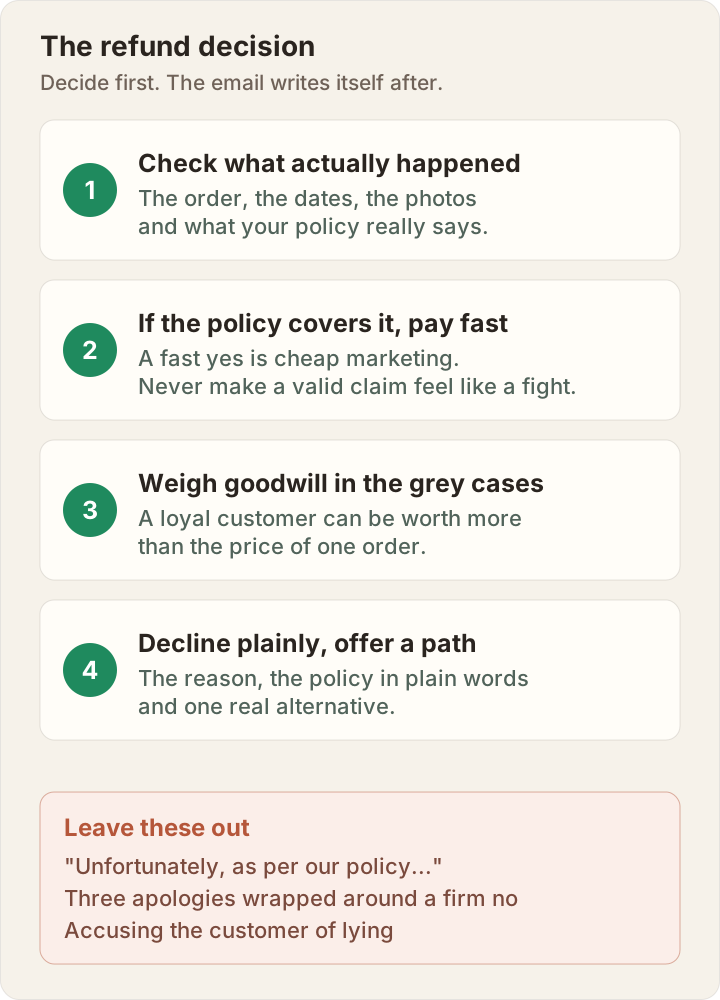
- Check what actually happened. The order, the dates, the photos, the tracking and what your policy really says. Half of refund disputes are settled by the record before a word is written.
- If the policy covers it, pay fast. A fast yes is cheap marketing. This whole page is about the other cases. Never make a valid claim feel like a fight.
- Weigh goodwill in the grey cases. A three-year repeat customer one week past the window is not the hill to die on. A loyal customer can be worth more than the price of one order.
- Decline plainly, offer a path. The decision early, the one honest reason, the policy in plain words and one real alternative: exchange, credit, repair or a discount on the fix.
One boundary matters more than any template: this is for change-of-mind cases and policy cases. Faulty, misdescribed or never-delivered goods carry statutory rights in the UK, the EU, Australia and most other places. No store policy overrides those. Never use a decline template on a genuine fault claim.

The shape of a polite no
Once the decision is made, the email is short. Thank them for getting in touch. Give the decision within the first two sentences, because a no buried under four paragraphs of warm-up reads as evasive. Give the one honest reason in plain words rather than policy language: "the return window closed on 14 May" beats "as per our returns policy". Offer the alternative you can genuinely stand behind. Close warmly without re-apologising, because three apologies wrapped around a firm no just teaches the customer that pushing harder might work.
Keep the whole thing to five or six sentences. A long refusal reads as a guilty one.
Refund decline templates
Six templates for the common cases. Swap the brackets, attach the evidence where it exists and always name the alternative honestly. If there is no alternative you would stand behind, leave that line out rather than inventing one.
Subject: Re: [their subject]
Hi [name], thank you for getting in touch. I have looked at your order and I am not able to offer a refund on this one: the return window for order [number] closed on [date] and the request reached us on [date]. What I can do is offer [an exchange / store credit of amount] if the [product] is unused, which I hope softens it a little. If you would like to take that up, just reply and I will sort it the same day.
[Your name], [company]
Subject: Your return for order [number]
Hi [name], thank you for sending the [product] back. We have inspected it and I am sorry to say we cannot refund it: it arrived [worn / marked / missing parts], which falls outside our returns condition. I have attached photos from the inspection so you can see what we see. We can return it to you at no charge or, if you prefer, [alternative such as a partial credit]. Let me know which you would like.
[Your name], [company]
Subject: Re: [their subject]
Hi [name], thank you for the message. The [product] was part of our final-sale range, which is sold at that price on the basis that it cannot be returned. That was shown on the product page and at checkout, which means I am not able to refund it. If the sizing or colour is the issue, I can offer [alternative, e.g. 15 percent off a full-price replacement] as a middle path. I realise this is not the answer you hoped for and I appreciate you asking rather than assuming.
[Your name], [company]
Subject: Re: [their subject]
Hi [name], thank you for reaching out. Because the [download / course / licence] was delivered and accessed on [date], it falls outside our refund terms, which were shown at purchase. I am not able to refund it. What I can do is help you get value from it: if something is not working or is unclear, tell me where you are stuck and I will personally make sure you get [support / a walkthrough / the missing piece]. That offer stands whenever you want it.
[Your name], [company]
Subject: Re: [their subject]
Hi [name], thank you for the note and I am sorry the result was not what you pictured. Because the work on [date] was completed as agreed in [the brief / quote], I am not able to refund it. I do want you happy with the outcome. Here is what I can offer: [a specific remedy, e.g. one round of adjustments at no charge]. That usually closes the gap between the brief and the picture in someone's head. Shall I book it in?
[Your name], [company]
Subject: Re: [their subject]
Hi [name], thank you for getting in touch. Strictly speaking this sits outside our returns window, which closed on [date]. But you have been ordering from us for [time] and that matters to us more than the calendar. I am going to make an exception this once and refund the [amount] in full. The only thing I ask is that future returns land inside the [X-day] window, since this is one we will not always be able to repeat. Thank you for being the kind of customer who makes the exception easy.
[Your name], [company]
Threats, chargebacks and the maths
Some declines come back with a threat: a chargeback, a one-star review, a post tagging your brand. Do not reverse a fair decision purely under threat. Reply once, calmly, restating the decision and attaching the evidence: the policy as displayed, the dates, the photos. That document is exactly what wins the dispute if the chargeback is filed and it reads as reasonable to anyone the customer shows it to.
Then run the maths without pride. A chargeback carries a fee and an hour of paperwork. On a small order, a goodwill credit can be cheaper than winning. Make that call on cost rather than on fear, because a store that folds to every threat trains its customers to threaten. If the review lands anyway, answer it publicly with the same calm: how to respond to a negative review.

The same email, twenty times a month
If you run a store, refund declines are not a rare crisis. They are Tuesday. The same window-closed case, the same worn-item case, each one needing the same careful balance of firm and warm, each one written from scratch because pasting yesterday's refusal feels risky. Get the wording slightly wrong once and a routine no becomes a public argument.
That is the job ReciteMail does. It learns how you write from emails you have already sent, then turns a one-line note like "decline refund order 2209, window closed 3rd, offer exchange" into a firm, warm refusal that sounds like you rather than a legal department. Your templates stay yours and adapt to each customer instead of reading like a paste. And because it runs on your own machine with no connection to any mailbox, order details and customer names never leave your desk.
Sellers on every platform hit this daily. Refund declines, WISMO replies, complaint responses and review replies are the same dozen emails at volume. ReciteMail drafts all of them in your voice, private by architecture because it never connects to a mailbox. See ReciteMail for online stores.
And if you are on the other side of this email, asking for your money back rather than guarding it, the mirror-image guide is here: refund request email templates.
Common questions
Can you legally refuse a refund?
It depends on the reason and where you sell. In most places a customer who simply changed their mind has whatever rights your published policy gives them, which is why the policy matters. Faulty, misdescribed or undelivered goods are different: consumer law in the UK, the EU, Australia and elsewhere gives statutory rights that no store policy can remove. Decline change-of-mind requests when your policy supports it. Never decline a genuine faulty-goods claim. Check the rules where you trade before leaning on any template.
How do you decline a refund without losing the customer?
Thank them, give the decision early in plain words, give the one honest reason behind it and offer a real alternative such as an exchange, store credit or a repair. Skip the corporate phrasing and never stack apologies around the no. Most customers can accept a clear no with a reason. What they cannot accept is a no that hides behind policy language or arrives after a week of silence.
What if a customer threatens a chargeback or a bad review?
Stay calm and put your evidence in writing: the policy as displayed at purchase, the dates, photos and any tracking. A polite, documented refusal is exactly what wins a chargeback dispute if one is filed. Do not reverse a fair decision purely under threat, because word gets around. That said, run the maths first. If the order value is small and the dispute fee plus your time is large, a goodwill gesture can be the cheaper outcome.
Should you ever refund outside your own policy?
Yes, when the customer is worth more than the order. A loyal repeat buyer one week past the return window is not the case to die on. Make the exception explicitly: say the policy, say you are stepping outside it for them this once and why. That turns a cost into loyalty. Save the firm no for clear misuse, one-off buyers gaming the policy and claims the evidence contradicts.
Firm and warm, every time
ReciteMail drafts refund declines, complaint replies and every hard customer email in your own voice, learned from mail you have already sent. It runs on your PC, never connects to your inbox and customer details never leave your machine. Free for 7 days, no card needed.
Start your free trial