How to Ask a Client for a Deposit Without It Feeling Awkward (5 Templates)
Published 22 August 2026 · 7 minute read · The ReciteMail Blog
Asking for money before the work exists feels presumptuous the first fifty times you do it. Then a client cancels the night before a job you bought materials for or a finished project turns into a three-month chase for the invoice, at which point the awkwardness evaporates for good. A deposit is not an imposition. It is how serious businesses in every trade separate the committed from the curious. Here is when to ask, how much, how to word it so nobody flinches and five copy-paste templates for the moments the ask actually happens.
Why the deposit is doing you both a favour
Start with the reframe, because the wording follows from it. A deposit is not you distrusting the client. It is a commitment exchanged in both directions: they commit money, you commit a date in the diary, materials on order and hours nobody else can book. Hotels take card numbers, venues take booking fees and wedding photographers have asked for deposits since photography was invented. Nobody calls any of that rude. The awkwardness lives entirely in the head of the business owner who has not yet decided it is policy.
And the client gets something real too. A business that asks for a deposit runs like a business: it has terms, it books properly and it will still exist when the balance is due. The deposit also caps their risk of the opposite failure, the supplier who takes full payment upfront and goes quiet. Half now, half on completion protects both ends of the deal, which is exactly why it became the standard.

How much to ask for and when to bring it up
The working range is 25 to 50 percent and the right point in it tracks your exposure. Ask yourself what you lose if this client disappears the day before the job. Heavy materials, made-to-order pieces or a fully blocked calendar push you toward 50. A service with little upfront cost sits comfortably at 25 to 30 or at a flat booking fee for smaller jobs. One caveat worth checking: some places regulate deposits for certain trades. California, for instance, caps home improvement deposits at 10 percent or 1,000 dollars, whichever is less. Know the rule where you work before you set the policy.
When to mention it is easier: in the quote, always. The deposit belongs in the same breath as the price, part of the terms the client says yes to, exactly like the scope and validity date in a proper quote email. A deposit that surfaces at booking time, after the yes, feels like a bait and switch even when it is not. Clients accept almost any reasonable structure stated upfront and resent almost any structure sprung late. And once it is policy, apply it to everyone. The moment you waive it for charming clients and enforce it on new ones, it stops being terms and starts being a judgement.
The shape of the ask
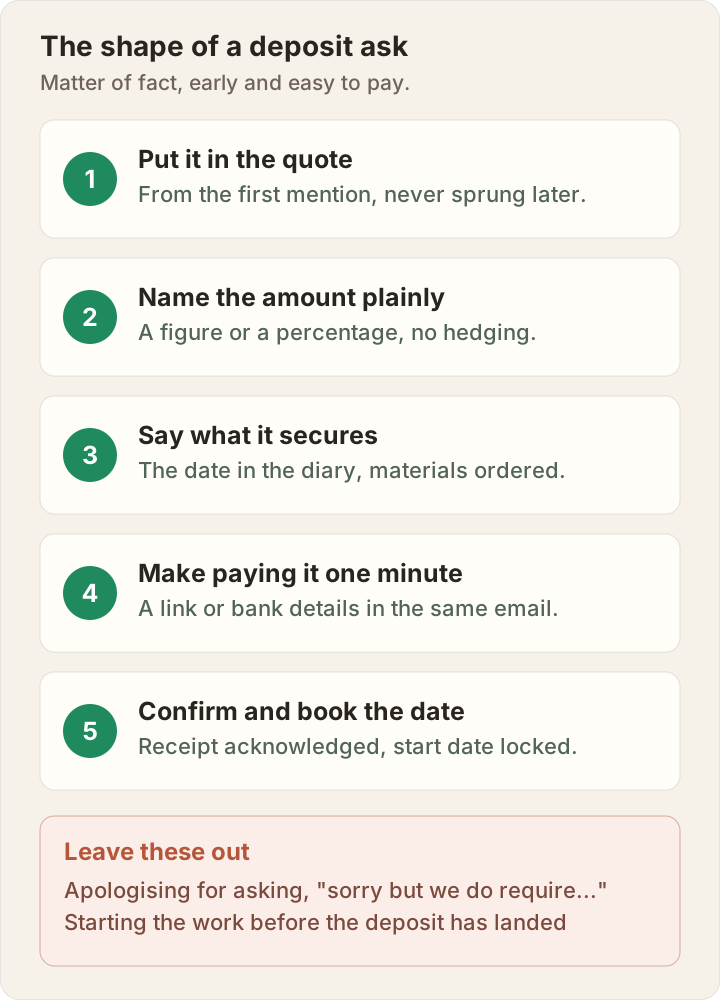
The whole craft is tone. The ask should sound like a fact of how you work, never a request for a favour. Compare "sorry but we do unfortunately require a deposit" with "to book the job in, the deposit is 400, payable by the link below". The first begs permission and invites negotiation. The second is just how Tuesdays work. Say what the deposit does, secures the date, covers the materials. Then make paying it a one-minute job with a payment link or bank details in the same email. Friction between the yes and the payment is where deposits quietly die.
Deposit request templates
Five templates for the moments the ask happens. Swap the brackets and keep the tone matter of fact throughout.
Subject: Quote for [the job], valid until [date]
Hi [name], thanks again for the details. The full price for [the job] is [total], which covers [what is included]. To confirm the booking we take a [percentage] deposit of [amount], with the balance due [when, e.g. on completion]. The deposit locks your dates in the diary and covers the materials order. Payment details are below and the quote stands until [date]. Any questions at all, just reply.
[Your name], [business]
Subject: Booking [the job], one step left
Hi [name], great news, delighted to be doing this one. I have pencilled in [dates] for you. To make that firm, the deposit is [amount], payable by [link or bank details]. As soon as it lands you will get a confirmation from me and the dates are yours, nobody else can book them. If anything about the timing needs to move, tell me now and we will sort it before the diary fills.
[Your name], [business]
Subject: Deposit received, you are booked in
Hi [name], the deposit has arrived, thank you. You are confirmed for [dates] and I have ordered [the materials or the first step] today. Between now and then I will [what happens next, e.g. send a reminder the week before / drop off the materials on the Friday]. The remaining balance of [amount] is due [when]. Looking forward to it.
[Your name], [business]
Subject: Re: Booking [the job]
Hi [name], quick one from me. The deposit for [the job] has not appeared yet and I suspect it just slipped down the list, it happens to all of us. The details again: [amount] to [link or bank details]. I am holding [dates] for you until [day], after that I have to release them to the next booking, which I would rather not do. One minute now saves the slot. Anything in the way, tell me and we will fix it.
[Your name], [business]
Subject: Re: [their subject]
Hi [name], fair question and happy to explain. The deposit is standard for all our bookings, it holds your dates so nobody else can take them and covers the materials we order before day one. It is not about trust in either direction, it simply means both of us are committed before costs start. It comes straight off the final bill, meaning the total never changes. If a [percentage] deposit is genuinely difficult, I can offer [the alternative, e.g. a smaller booking fee of X with the balance split in two]. Either way I would love to do the job.
[Your name], [business]

When they say no
Explain once, warmly, using template five. Genuine confusion, the client who has simply never been asked before, dissolves with one plain explanation. What remains after that is information. A client who refuses to commit a modest sum before the work is telling you something about how the invoice conversation will go later. The businesses with the worst late payment problems are usually the ones that never filtered at this step. You can offer a smaller booking fee as a middle path. You can also politely pass. Both beat working a week for a stranger who refused the standard terms.
After the deposit
The deposit is the start of a paper trail, not the end of one. Confirm receipt the same day with template three, because a client who has just sent money and hears nothing starts to worry within hours. When the work wraps, the balance invoice goes out with the same clarity, amount, due date and payment details in the email body, the routine covered in the invoice email guide. Should the job itself grow mid-way, hidden rot, added extras, the extra cost email keeps the paper trail unbroken. And if the balance drifts past due, the reminder ladder is already written for you in the late payment guide. Businesses that take deposits chase far fewer invoices. Far fewer is not none.
The same ask, the tenth time this month
None of these emails is hard to write once. The grind is that the deposit ask repeats with every quote, every booking and every nudge, each needing the same unapologetic warmth with different names, amounts and dates. Rewrite it tired at 7pm and the apologies creep back in. That is the job ReciteMail does: it learns your voice from emails you have already sent, then turns "booking confirmation for Sarah, deposit is 400, dates 12th to 14th, link included" into the finished email in seconds. It runs on your PC, never connects to your inbox and your client details stay on your machine. See who ReciteMail is for.
The deposit is a filter, not a fee. Its quiet job is sorting committed clients from browsers before your calendar and your materials budget get involved. Every no it produces was a cancellation or an unpaid invoice that never got the chance to happen.
Common questions
How much deposit should a small business ask for?
The common range is 25 to 50 percent and the right number tracks your exposure: what you would lose if the client vanished the day before the job. Heavy materials or a blocked-out calendar justify 50 percent. A service with little upfront cost sits comfortably at 25 to 30. Some trades are also capped by local rules, California for instance limits home improvement deposits to 10 percent or 1,000 dollars. Check what applies where you work. Whatever you pick, apply it to everyone. A deposit that varies by customer stops being policy and starts being an insult.
When should you mention the deposit to a client?
In the quote, from the first mention of price. A deposit that appears at booking time, after the client said yes to a number that never mentioned it, feels like a bait and switch even when it is not. In the quote it is simply part of the terms: the price, what it includes and how payment works. Clients accept almost any reasonable structure that is stated upfront and resent almost any structure that is sprung late.
What do you do when a client refuses to pay a deposit?
First explain what it is for, once and warmly: it books the date, covers the materials and protects both sides. Genuine confusion usually dissolves there. If they still refuse, treat it as information. A client who will not commit a modest sum before the work is a meaningful risk signal for the invoice afterwards. You can offer a smaller commitment, a booking fee rather than a percentage. Or you can politely pass. Working deposit-free for a stranger who refused the standard terms is how unpaid invoices are born.
Should you start work before the deposit has been paid?
No. The deposit is the commitment and starting without it deletes the reason it exists. Hold the start date until the money lands and say so in the booking email: the date is confirmed once the deposit arrives. This is not distrust, it is the same logic as a hotel taking a card number. If a promised deposit has not arrived by the agreed day, send one friendly nudge with the payment details again. It is a diary problem far more often than a warning sign.
The unapologetic ask, written for you
ReciteMail drafts deposit requests, quotes, invoices and every repeating client email in your own voice, learned from mail you have already sent. It runs on your PC, never connects to your inbox and your client details never leave your machine. Free for 7 days, no card needed.
Start your free trial