How to Send a Quote by Email: 7 Templates That Win the Job
Published 16 August 2026 · 8 minute read · The ReciteMail Blog
Most quotes are lost before the price is even read. They arrive two days after a competitor's, bury the number in an attachment or answer a different job than the one described. The email around the quote does as much deciding as the figure inside it, because the customer is not only buying the work. They are auditioning how you communicate. Here is the shape of a quote email that gets accepted, the follow-up that wins the quiet ones, plus seven copy-paste templates from first enquiry to price pushback.
Speed is half the sale
Someone requesting a quote is almost never asking only you. They are asking two or three businesses in the same afternoon and then something quietly decisive happens: whoever answers first, clearly, becomes the yardstick everyone else is measured against. Arriving first does not win the job by itself. It does mean the customer reads every later quote while already picturing working with you.
This does not require pricing at speed. It requires answering at speed. When the ask is the casual "how much do you charge" rather than a formal request, the price enquiry guide covers that faster, looser first exchange. A same-day reply that confirms the details and promises the quote by a named day buys you the pricing time while still winning the responsiveness contest. The supplier who goes silent for four days and then sends a perfect PDF has usually already lost.

The shape of a quote email
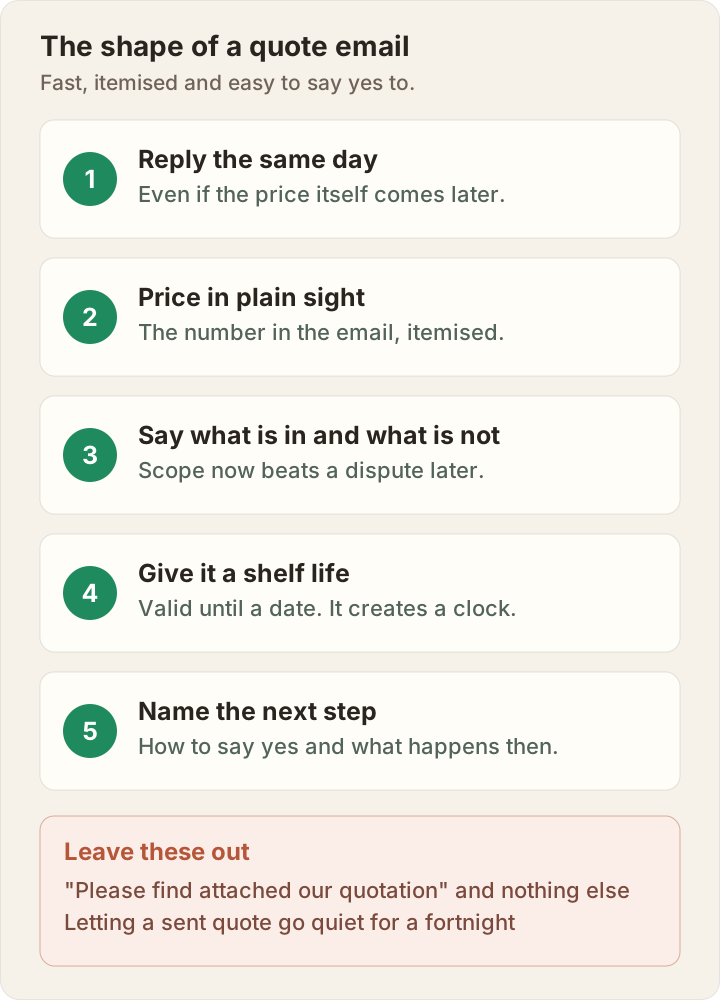
- Reply the same day, even when the price comes later. The acknowledgement is the audition.
- Price in plain sight. The number lives in the body of the email, itemised where it helps. Attach the formal PDF by all means. Never make someone open an attachment to learn what it costs.
- Say what is in and what is not. "Includes materials and two coats. Excludes scaffold hire." One honest scope line now prevents the dispute later and it also quietly explains why a cheaper rival is cheaper.
- Give it a shelf life. "Valid until 30 September." It protects you from cost changes and gives the customer a gentle clock instead of an open-ended maybe.
- Name the next step. "Reply yes and I will book you in for the week of the 8th." A quote with no next step asks the customer to invent one, which most never do.
Quote email templates
Seven templates covering the whole life of a quote. Swap the brackets and keep the numbers honest. The voice to aim for is a competent tradesperson or supplier writing between jobs: brisk, warm, specific.
Subject: Quote for [the job], [your business name]
Hi [name], thank you for the details, good to speak earlier. Here is the quote for [the job]: [total amount]. That breaks down as [item one, amount], [item two, amount] and [item three, amount]. It includes [what is included]. It does not cover [exclusion], which I mention now so there are no surprises later. The price is valid until [date] and I could start [timeframe]. If you are happy to go ahead, just reply to this email and I will confirm the date the same day. Any questions at all, ask away.
[Your name], [business]
Subject: Re: [their subject]
Hi [name], thank you for getting in touch about [the job]. I want to price this properly rather than guess. I am working through [what you are checking, e.g. materials and access] now. You will have the full quote from me by [specific day]. One thing that would help in the meantime: [one clarifying question]. Speak soon.
[Your name], [business]
Subject: Re: [their subject], a few quick questions
Hi [name], thanks for the enquiry, this is definitely something we do. To give you an accurate price rather than a wide guess, could you tell me: [question one], [question two] and [question three]? A photo of [the relevant thing] would also help if that is easy. As soon as those come back, I will have your quote over within [timeframe].
[Your name], [business]
Subject: Re: Quote for [the job]
Hi [name], just checking the quote I sent on [date] reached you safely. If any part of it needs adjusting, the scope, the timing or the spec, tell me and I will rework it, that is no trouble. A gentle heads-up that the price holds until [date] and the [start window] I mentioned is still open at the moment. Either way, a one-line reply lets me plan properly.
[Your name], [business]
Subject: Re: Quote for [the job]
Hi [name], thank you for being straight about it. Here is what sits behind the number: [the two or three real drivers, e.g. materials at cost, two people for three days, the guarantee]. I would rather not just cut the figure, because it was honest the first time. What I can do is adjust the job to the budget: [a concrete option, e.g. leaving out X or phasing Y until spring] would bring it to around [revised amount]. If [budget] is the ceiling, tell me and I will see what shape of job fits inside it.
[Your name], [business]
Subject: Re: [their subject]
Hi [name], thank you for thinking of us. I am going to be straight rather than keep you waiting: we cannot take this one on, because [honest reason, e.g. we are booked out past your date / it is outside what we do well]. Rather than leave you stuck, [a helpful pointer, e.g. a firm that handles this kind of work is X]. I would genuinely be glad to quote for you another time and I appreciate you asking.
[Your name], [business]
Subject: Updated quote for [the job]
Hi [name], thanks for the walkthrough of the changes. Here is the updated quote with [the change] included: [new total], which is [difference] more than the original because of [one plain reason]. Everything else from the first quote stands, including [unchanged element]. This version replaces the earlier one and holds until [date]. Happy to talk any of it through. If it looks right, reply yes and we are booked.
[Your name], [business]

The follow-up wins more than the quote does
Here is the uncomfortable truth about quiet quotes: most were never rejected. The customer got busy, the email sank and the job went to whoever happened to surface at the right moment. Three to five working days after sending, follow up with the short version of template four. A week later, once more with the validity date doing the gentle work. Then a final graceful note and stop. That cadence, applied to every quote rather than the ones you happen to remember, is worth more than any wording improvement. The wider rhythm is covered in the follow-up email guide. When the reply that comes back is a haggle rather than a yes, the discount request guide covers holding your number. When the yes comes, the deposit ask turns it into a real booking and the welcome email guide covers the first hour of the new relationship. If the job grows once opened up, the extra cost email handles the variation cleanly. And if the invoice later goes unpaid, the reminder ladder takes over.
Quote number thirty of the month
None of this is hard on a quiet Tuesday. It is hard on the day three enquiries land between jobs, each needing questions asked, a price built and a follow-up remembered from last week. That is when quotes go out late, bare and unchased, which is to say that is when jobs are lost. The fix is the same one that works for every repeating email: a structure you trust and a draft that starts in your voice.
That is the job ReciteMail does. It learns how you write from emails you have already sent, then turns a one-line note like "quote the Hendersons, 2400 for the deck, includes materials, excludes staining, can start the 9th" into a complete quote email that sounds like you rather than a form. The follow-ups take thirty seconds each instead of being forgotten. And because it runs on your own machine with no connection to any mailbox, your prices and your customers' details never leave your desk.
Trades, freight desks, agencies and accountants all live on quotes. The enquiry reply, the quote, the chase and the price defence are the same handful of emails at volume, each one deciding real money. ReciteMail drafts all of them in your voice, private by architecture because it never connects to a mailbox. See who ReciteMail is for, including the way freight desks run the same play on rate quotes.
Common questions
How quickly should you reply to a request for a quote?
Acknowledge it the same working day, even when the price itself needs longer. Someone asking for a quote is usually asking three businesses at once and the first professional reply frames the comparison. If pricing takes days, send a short note confirming what they need and the date your quote will arrive, then beat that date.
What should a quote email include?
The price in the body of the email, itemised where it helps. What the price includes and what it does not. How long the quote stays valid. When the work can start or when the goods can ship. The exact next step for saying yes. A PDF attachment is fine as the formal record but never make someone open an attachment to learn the number.
How do you follow up on a quote without being pushy?
Wait three to five working days, then send two or three sentences: checking it arrived, asking whether any part needs adjusting and restating the validity date. That is helpfulness, not pressure. A second nudge a week or so later can mention the expiry or a diary constraint honestly. After that, one graceful closing note and stop. Most quote follow-ups win not by persuading but by simply being the supplier who stayed in touch.
Should you explain your price when someone says it is too high?
Explain it once, calmly, in terms of what the price buys: the scope, the materials, the guarantee, the experience. Offer to adjust scope rather than rate if their budget is fixed, which keeps the price meaning something. Discounting on request without removing anything teaches every future customer that your first number is fiction.
Quotes out the same day, in your voice
ReciteMail drafts quotes, follow-ups and every hard business email in your own voice, learned from mail you have already sent. It runs on your PC, never connects to your inbox and your prices never leave your machine. Free for 7 days, no card needed.
Start your free trial