How to Chase a Late Invoice: 7 Email Templates That Get You Paid
Published 29 July 2026 · 9 minute read · The ReciteMail Blog
There is a strange shame in asking for your own money. The work is done. The invoice is fair. The date has passed. And still the reminder email sits half written while you find something else to do, because it feels like begging even though it is the opposite. Meanwhile the client is not agonising at all. Your unpaid invoice is quietly funding their cash flow, interest free, for as long as you stay polite and silent. Here is the ladder that fixes it and the seven emails that go on each rung.

Why chasing feels harder than it is
Most people read a payment reminder as a confrontation. It is not. It is bookkeeping. Somewhere in the client's accounts there is a bill with your name on it and a date that has passed. Your email is simply the system noticing. The client knows this. Finance teams expect to be chased and quietly deprioritise anyone who does not, not out of malice but out of arithmetic. When there is more month than money, the suppliers who ask get paid first.
Which leads to the uncomfortable truth about staying quiet: silence is read as consent. Wait three weeks to send the first nudge and you have taught the client that your due date has three weeks of padding in it. Every future invoice inherits that padding. The politest thing you can do, for both of you, is to be predictably prompt.
The ladder: firmer every step, never louder
The mistake is treating every reminder as the same email sent harder. A good chase sequence is a ladder. Each rung is one notch firmer than the last while the temperature stays exactly where it started: calm, factual, open. You never need to be angry, because the ladder itself does the escalating for you.
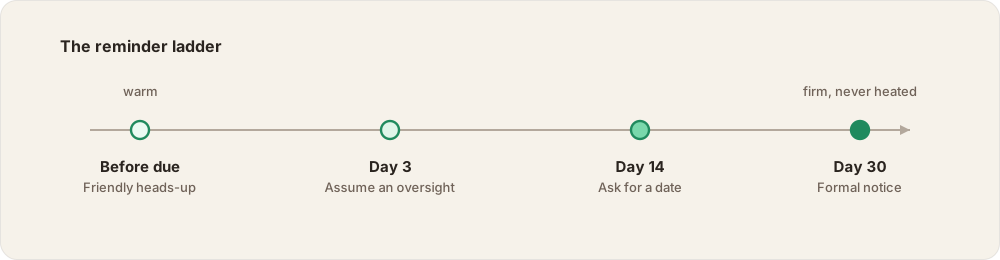
Four rules hold on every rung:
- The invoice number, the amount and the due date appear in every single message. The person reading may not be the person who hired you. Make it effortless to find the bill.
- Attach the invoice again every time. "I cannot find it" is the most common honest reason for a late payment. Remove it.
- One ask per email, with a date on it. Not "when you get a chance." A date you can follow up on.
- Never apologise for asking. "Sorry to bother you about this" tells the client the debt is negotiable. It is not. You can be warm without being sorry.
Late payment reminder templates
Subject: Invoice [number] due on [date]
Hi [name],
A quick note ahead of time rather than a chase after. Invoice [number] for [amount] is due on [date]. I have attached it again so it is at the top of your inbox rather than buried three weeks deep.
If it is already scheduled, ignore me entirely. If anything on it needs a tweak for your records, tell me now and I will sort it before the date.
Thanks as ever,
[Your name]
Subject: Invoice [number], a small nudge
Hi [name],
I think this one may have slipped through. Invoice [number] for [amount] was due on [date] and has not arrived yet.
No drama. These things drift, especially around month end. The invoice is attached again with the payment details at the bottom.
If it has already gone out, thank you and ignore this. If not, could you let me know when to expect it?
[Your name]
Subject: Invoice [number] is now two weeks overdue
Hi [name],
Following up properly now. Invoice [number] for [amount] was due on [date] and is two weeks overdue.
Could you confirm today when payment will be made? If there is a problem with the invoice itself or with cash flow at your end, tell me and we will work something out. The one thing I cannot work with is silence.
The invoice is attached with payment details. [If a payment link is faster, here is one: link.]
Thanks,
[Your name]
Subject: Overdue account: invoice [number], [amount]
Hi [name],
Invoice [number] for [amount] is now [30] days past its due date of [date]. A statement of the account is attached along with the original invoice.
I would much rather resolve this between us than escalate it. Please arrange payment by [a specific date one week out] or reply today with a date I can rely on.
For clarity: our terms provide for late payment interest on overdue business accounts and it applies from this point. I would honestly prefer never to add it.
[Your name]
Subject: Invoice [number]: the payment we agreed
Hi [name],
When we spoke on [date] you told me payment for invoice [number] would be made by [promised date]. That date has passed and nothing has arrived.
I held off on reminders because you gave me a date. That is what makes this one harder to write than the first chase was.
Tell me today what happened and when the payment will actually land. If the honest answer is that [amount] is difficult right now, say so and we will agree a plan. A kept plan beats a broken promise from where I am sitting.
[Your name]
Subject: Can we fix how invoices flow between us?
Hi [name],
A slightly different email from me. Not a chase, more of a reset.
You are one of my favourite clients to work with and every invoice does get paid. Getting there just seems to take three reminders a month. I suspect that is no more fun at your end than it is at mine.
Can we fix the plumbing instead? Any of these work for me: [a standing payment / an invoice date that matches your pay run / a card held on file / part payment up front]. Pick whichever removes the friction for you.
Nothing about the work changes. I would just rather spend our emails on the work than on the chasing.
[Your name]
Subject: Final notice: invoice [number]
Hi [name],
This is the last reminder I will send about invoice [number] for [amount], now [60] days overdue.
Unless payment is received by [date], I will pass the account to [a collections agency / the small claims process] and pause any further work in the meantime. I take no pleasure in either step. It is simply what happens next.
There is still an easy version: pay today using the details attached or call me and agree a plan I can put in writing.
Whatever has gone wrong at your end, this stops being fixable between us on [date]. I hope we fix it before then.
[Your name]
Staying warm on the person, firm on the money
The clients you chase are usually the clients you keep. That is what makes this email different from a complaint to a stranger: you have to collect the debt and preserve the relationship in the same breath. The trick that makes both possible is to separate them out loud. The warmth goes to the person. The firmness goes to the invoice. "I know things are hectic over there" and "the invoice is still due Friday" belong in the same email and do not contradict each other.
It also helps to blame the system rather than the human. "My accountant is on at me about the aged debtors list" is a small kindness that lets the client save face while paying up. Whether you have an accountant is between you and your conscience.
When the excuse is real
Sometimes the client is not dodging. They are drowning. A one-line "we are having a rough quarter" deserves a different reply than silence does, because a client who tells you the truth is offering you something you can work with. A payment plan with dates in writing nearly always beats a standoff: you get cash moving again and they get to stop dreading your name in their inbox. Put the plan in an email the same day it is agreed, with amounts and dates. Treat the first missed instalment as the moment the goodwill expires.
Before you quote interest or threaten court: late payment interest, collection rules and small claims thresholds are set by the country you trade in, not by your invoice footer. Business customers and consumers are treated differently almost everywhere. Check the rules where you operate and make sure your own terms actually provide for anything you rely on in writing.
The part nobody admits
The reason invoices go unchased is not that people do not know what to write. It is that writing it costs something. Reminder three to a client you like is a genuinely awkward email. Awkward emails get postponed. Postponed reminders cost you money. If you have ever spent twenty minutes softening a payment chase and then deleted half of it, you know exactly where the afternoon went.
That is the gap ReciteMail closes. It keeps your whole reminder ladder as templates that adapt to each client rather than pasting the same paragraph, learns your tone from emails you have already sent and drafts rung three so it reads firm without the edge that creeps in when you are annoyed. You read it, adjust anything and send it from your own inbox. Nothing connects to your mailbox and nothing sends without you. Accountants use the same ladder for client records requests. If you are building out your own reply library the guide on building templates that do not sound like templates pairs with this one.
And if the money you are waiting on is stuck because a supplier let you down first, the other side of this playbook is here: chasing a supplier by email. The even better fix is upstream: an invoice that goes out the same day the work finishes, with a friendly nudge before the due date, prevents most chases from ever being needed. That whole play is in how to send an invoice by email. Further upstream still, taking a deposit filters out the worst payers before the work even starts. And if you are chasing in English as a second language, the English payment reminder guide covers the phrases that are polite and firm at the same time.
And when the reply to a reminder is an honest I cannot pay this in full right now, the ladder pauses and a different playbook opens: the structured instalment plan, covered start to finish in the payment plan guide.
Common questions
How long should I wait before chasing a late invoice?
Two or three days past the due date, no longer. Waiting feels polite. In practice it teaches the client that your due date is a suggestion. It also drops you down the pile behind every supplier who chased sooner. An early nudge is easier to write and easier to receive, because at day three everyone can still pretend it was an oversight.
Should I charge late payment interest?
On business-to-business invoices you are often entitled to, though the rules and rates depend on the country and on what your own terms say. In practice the mention matters more than the money. A line noting that interest starts accruing moves your invoice up the pile. Check the rules where you trade and make sure your terms actually provide for it before you rely on it.
Is it better to phone or email about a late invoice?
Both, in that order. Email first, because it creates a record with the invoice number, the amount and the date in writing. If two written reminders change nothing, phone. A call is much harder to ignore than an email. Then put whatever was agreed on the call into a short follow-up email the same day. The promise then exists somewhere you can point to.
What happens if the client never pays?
Most countries have a small claims route for modest amounts that does not need a solicitor. Collections agencies will take on larger debts for a cut. Before either, send a final notice with a hard date so the escalation never arrives as a surprise. Then weigh the debt against the time. Sometimes the right business decision is to write it off and never work for that client again. The rules and thresholds vary by country. Check the process where you trade.
Send reminder three without dreading it
ReciteMail drafts every rung of the ladder in your own voice, from the friendly nudge to the final notice. You read it and you send it. Free for 7 days, no credit card and no connection to your inbox.
Start your free trial