Welcome Email to a New Client: 6 Templates for a Confident Start
Published 19 August 2026 · 8 minute read · The ReciteMail Blog
The yes arrives, you do a small quiet fist pump and then most businesses make the same mistake: they go silent while they set things up. Meanwhile the client sits at the peak of their enthusiasm with nothing to hold onto and doubt starts doing its quiet work. Did I pick the right firm? Was that price fair? Why has nobody written to me? The welcome email exists to kill that doubt in its first hour. Here is the shape of one that works, the timing that matters more than the wording, plus six copy-paste templates for agencies, trades, retainers and the client who came back.
The most dangerous hours in a client relationship
Buyer's doubt is not a retail-only phenomenon. It hits hardest on exactly the purchases your clients make with you: large, infrequent and hard to judge from the outside. The evening after signing, your new client replays the decision. If the last thing they heard from you was the invoice, the replay runs unopposed. If instead there is a warm, organised email in their inbox naming what happens next and when, the replay ends differently: I picked well, they are already on it.
That is the entire job of the welcome email. Not information delivery, doubt removal. Which is why the two failure modes are the ones you would not expect. The first is silence, days of it, while you set up folders and schedule people, all invisible to the client. The second is the opposite: the 900-word onboarding dump with five attachments, which replaces doubt with homework. The email that wins is short, warm, specific and fast. Roughly 100 words, sent the same day, ideally within the hour of the yes you worked so hard to earn with the quote.

The shape of a welcome email
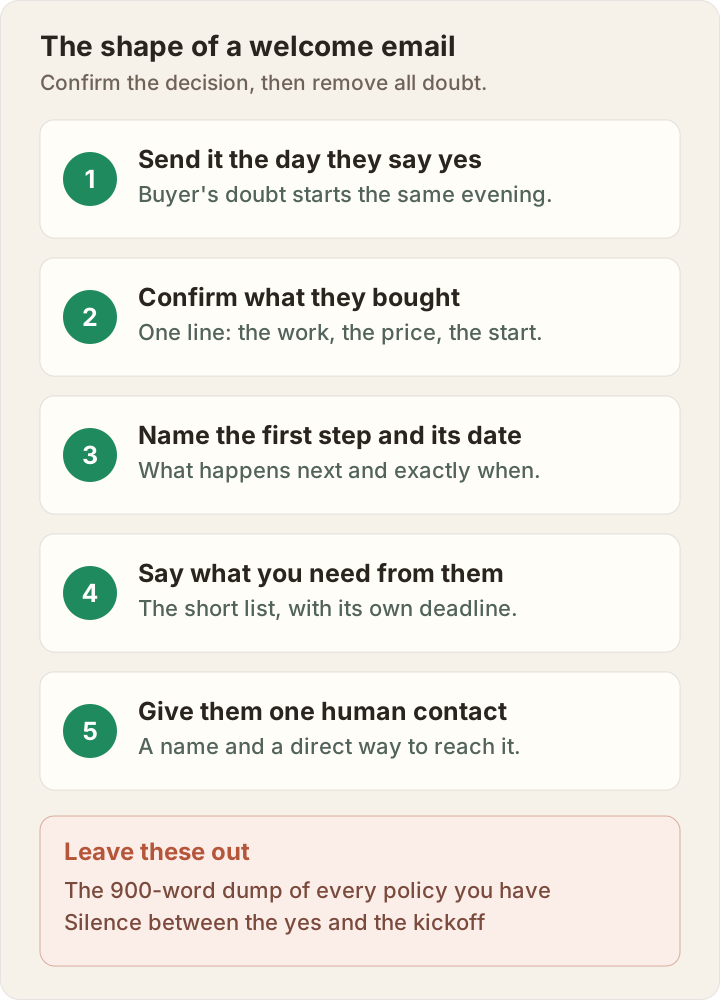
- Send it the day they say yes. The welcome is time-sensitive in a way almost no other email is. Its value halves with every silent day.
- Confirm what they bought, in one line. The work, the price, the start. It closes the "did we agree what I think we agreed" worry before it opens.
- Name the first step and its date. A kickoff call on Thursday, a site visit on the 9th, the first draft by the 20th. Concrete beats soon, every time.
- Say what you need from them. The short list, with its own deadline. Clients are happiest when they have a job and your timeline depends on them doing it.
- Give them one human contact. A name, a direct email or number. "Reply to me personally" turns a supplier into a person on their side.
Welcome email templates
Six templates for the ways a yes actually arrives. Swap the brackets, keep it warm and keep it under 150 words. If a sentence does not confirm, point forward or ask for something specific, cut it.
Subject: Welcome aboard, [name]. Here is what happens next
Hi [name], delighted to have you with us and thank you for choosing [business] for [the work]. To confirm: [one line of scope] for [price], starting [date]. First step: [the kickoff call / site visit / first draft] on [specific date], invite to follow shortly. From you, we just need [the one or two things] by [date] so nothing holds us up. Any question at any point, reply to me personally, this is my direct inbox. Looking forward to it.
[Your name], [business]
Subject: You are booked in: [the job], [date]
Hi [name], thanks for going ahead, you are in the diary. We start [date] at [time] and expect to finish [timeframe]. Before we arrive: [the practical thing, e.g. please clear access to the back gate and keep the driveway free for the skip]. The price stands as quoted, [amount], with [deposit arrangement if any]. If anything changes on your side before then, call or text me on [number]. Otherwise we will see you on the day, on time.
[Your name], [business]
Subject: Welcome, [name]. Three things to get us moving
Hi [name], welcome aboard, we are genuinely pleased to have [their business] with us. Everything on our side is set up. To start on [date] as planned, we need three things from you: [item one], [item two] and [item three]. If those reach us by [date], the timeline holds exactly as discussed. That is the only homework, promise. Everything else comes from us, starting with [the first deliverable] on [date]. Reply here with the bits or with any questions.
[Your name], [business]
Subject: Welcome to [business], [name]. How our months run
Hi [name], welcome and thank you for trusting us with [the ongoing work]. Here is the rhythm so you always know where things stand: [the cadence, e.g. work lands by the 20th of each month, a summary note follows and invoices arrive on the 1st]. Your first [deliverable] arrives [date]. Anything urgent between times, email me directly and you will hear back within [timeframe]. We measure ourselves on you never having to chase. If you ever do, tell me.
[Your name], [business]
Subject: You made a good call, [name]. Here is the plan
Hi [name], thank you for the trust, especially knowing how carefully you weighed this up. That diligence tells me you care about [the outcome] as much as we do, which makes for the best kind of client. So let me repay it with certainty: [the work] starts [date], [the first milestone] lands [date] and you will get an update every [cadence] without asking. The number and scope stand exactly as agreed: [one line]. Nothing left for you to do today except feel good about the decision. Speak on [date].
[Your name], [business]
Subject: Good to have you back, [name]
Hi [name], it is genuinely good to see your name again. Welcome back. Since you know how we work, the short version: [the new work] starts [date], same team where possible, [price] as quoted. One thing that has improved since last time: [a true improvement, e.g. updates now come weekly without you asking]. We still have your [files / preferences / history] from the last job, which means no starting from scratch. Anything you want done differently this time, say the word.
[Your name], [business]

The hidden deadline inside the welcome
Template three carries the part most businesses learn the hard way: almost every late project is late because of the materials, approvals and access the client was supposed to provide. The welcome email is your one moment to set that expectation while enthusiasm is at its peak. Give the client's homework a real deadline and tie it visibly to the timeline: "if those reach us by the 12th, the schedule holds". When the date slips past anyway, the chase is a normal, friendly follow-up, the same rhythm as any other unanswered email, made easier because the welcome put the dependency in writing on day one. For businesses that run on booked slots rather than projects, the same confirm-early logic continues into the appointment reminder rhythm.
The email you send 40 times a year, differently every time
Here is the trap with welcomes: because each one is nearly identical in structure, they end up as a stale template with the wrong name in it and clients can tell. The details that make a welcome land, their actual project, their actual dates, the thing they mentioned worrying about on the call, are exactly the parts a static template cannot hold. So the choice becomes twenty fresh minutes per client or a paste job that undoes the warmth it was meant to create. The wider fix for that trap is covered in how to stop rewriting the same emails.
The faster fix is ReciteMail. It learns your voice from emails you have already sent, holds your welcome as a living template and turns one line, "welcome the Hendersons, deck starts the 9th, need the gate cleared, quote stands at 2400", into a complete, personal welcome that sounds like you wrote it fresh, because in every way that matters, you did. It runs on your PC, never connects to your inbox and your client details never leave your machine.
The welcome sets the price of every later email. A client who starts with a warm, organised, specific welcome extends you goodwill for months: the odd late reply forgiven, the difficult conversation heard fairly. A client who starts with silence keeps score from day one. Five minutes on the day of the yes buys the cheapest goodwill you will ever purchase. See who ReciteMail is for.
Common questions
How soon should you send a welcome email to a new client?
The same day they say yes and ideally within the hour. The moment of saying yes is the peak of a client's confidence in you. Every silent hour after it lets doubt creep back in: did I pick the right firm, was the price fair, should I have asked more questions. A fast, warm, organised welcome lands while the enthusiasm is still high and confirms the decision before second thoughts get a vote.
What should a welcome email to a new client include?
Five things. A genuine thank-you that names the actual work. A one-line confirmation of what they bought: the scope, the price, the start. The first concrete step with its date, whether that is a kickoff call, a site visit or a document arriving. A short list of what you need from them with its own deadline. And one human contact: a name and a direct way to reach it. That way day one never starts with a generic inbox.
How long should a client welcome email be?
Around 100 to 150 words for the email itself. The welcome confirms and points, it does not document. Every policy, portal login and process guide you attach on day one competes with the one thing the email must achieve: certainty about what happens next. Send the essentials now and drip the rest when each piece becomes relevant. A short, confident welcome reads as competence, a long one reads as homework.
Should contracts and paperwork go in the welcome email?
Only what is genuinely needed to start and even then as the clearly labelled action, not an attachment pile. If a signature or deposit is required before work begins, make it the single call to action with its own sentence and deadline. Everything else, the brand questionnaire, the portal guide, the terms already agreed, arrives in its own email when it is actually needed. One action per email gets done. Five attachments get opened never.
Every welcome, personal, in five minutes
ReciteMail drafts welcomes, kickoff notes and every repeating client email in your own voice, learned from mail you have already sent. It runs on your PC, never connects to your inbox and your client list never leaves your machine. Free for 7 days, no card needed.
Start your free trial