Follow-Up Email After No Response: 8 Templates That Get a Reply
Published 13 August 2026 · 8 minute read · The ReciteMail Blog
You wrote a good email. A quote, a proposal, a question that needs an answer. Then nothing. Silence is rarely a no. People are busy, inboxes bury things and the person who follows up politely is usually the one who gets the reply. This is how to write a follow-up email after no response: how long to wait, what to say, when to stop, plus eight copy-paste templates for the chases that actually come up.
Why the follow-up email works
The numbers are blunt about this. Backlinko's study of 12 million outreach emails found that sending a single follow-up lifted replies by around 65 percent. Woodpecker's data from more than 20 million cold emails shows campaigns with follow-ups roughly doubling the reply rate of one-and-done sends. Most of that gain comes from the first one or two polite nudges, not from a long campaign.
Yet the follow-up is the email most people never send. Chasing feels rude from the inside. From the outside it almost never reads that way. The recipient meant to reply, got pulled into something else and is quietly glad you resurfaced so they did not have to dig. A gentle reminder is not pestering. It is a favour to a busy person.

How long to wait before following up
Two or three working days for the first follow-up. Sooner reads as impatient. Much later and the original email needs re-explaining, which doubles the reader's work. After the first nudge, widen the gap: about a week before the second, around two weeks before the one after that. Each message should feel calmer than the last, not more urgent.
The exception is anything with a real deadline. If the quote expires Friday or the slot goes to someone else on Monday, say so in the first follow-up and follow up sooner. A true deadline is the most polite reason to chase that exists.
The follow-up rhythm that gets replies
The pattern below covers almost every business chase: a quote, a proposal, an unanswered question, a decision you are waiting on. Three to four sentences per message. Every message adds something rather than repeating the last one.
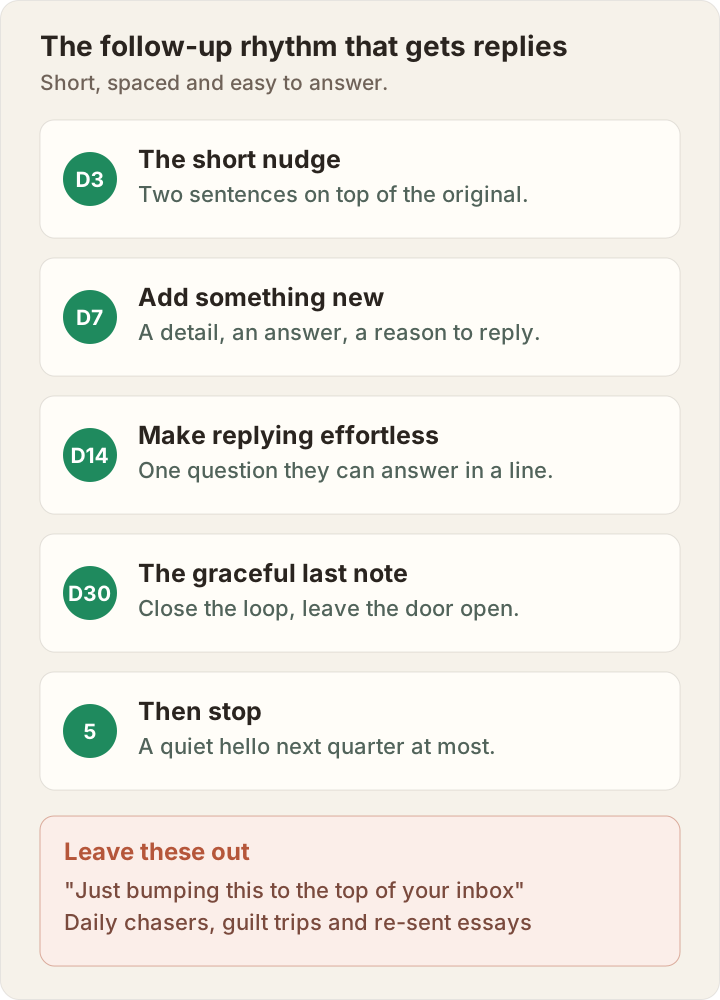
- Day 3: the short nudge. Two sentences on top of the original thread. You are surfacing the email, not rewriting it.
- Day 7: add something new. A detail you left out, an answer to a question they might have, a small piece of proof. Give them a fresh reason to reply rather than the old reason again.
- Day 14: make replying effortless. One question that can be answered in a single line. "Is this still on your list for this month?" beats "any thoughts?" every time.
- Around day 30: the graceful last note. Close the loop, take the pressure off and leave the door open. This one gets a surprising number of replies precisely because it asks for nothing.
- Then stop. A quiet hello next quarter at most. Persistence past this point stops being diligence.
Follow-up subject lines
Reply in the same thread. A plain "Re:" on your original subject keeps the whole context one scroll away and saves the reader the work of remembering who you are. A clever new subject line breaks that chain. Start a fresh subject only when the question has genuinely changed, for example when a lapsed quote becomes a new offer. When you do write a fresh one, run it through the free subject line tester before it goes.
The mistakes that kill a follow-up
- "Just bumping this to the top of your inbox." The most copied line in follow-up emails and the emptiest. It adds nothing and admits it.
- Opening with an apology. "Sorry to chase" and "sorry to bother you again" teach the reader that your emails are a bother. You are asking a fair question about your own work. Stand behind it.
- Guilt-tripping. "As per my last email" and "I have now written three times" win the argument and lose the customer.
- Re-sending the essay. Do not paste the whole original into a new message. Reply on top of the thread and keep the new part short.
- Chasing daily. Frequency does not read as enthusiasm. Spacing is what separates a professional rhythm from pestering.

Follow-up email templates
Eight templates for the follow-ups that actually come up. Swap the bracketed parts, cut anything that does not sound like you and keep each one under five sentences. If you are building a standing set of these, the guide on building a reply library pairs well with this one.
Subject: Re: Quote for [job]
Hi [name],
Just making sure the quote for [job] reached you on [day]. Happy to talk any of it through or adjust things if the scope has moved since we spoke.
Is it still something you would like to get done this month?
[Your name]
If the quote itself is the part that needs sharpening rather than the chase, the full playbook from first enquiry to price pushback is in how to send a quote by email. And when you are the one who went quiet and now owe someone an overdue answer, the late reply guide covers the other side of the silence.
Subject: Re: Proposal for [project]
Hi [name],
Following up on the proposal I sent over last week. One thing I did not include: [a relevant detail, an option or a result from similar work].
If the timing or budget needs adjusting, tell me what would make it work and I will look at it from your side.
[Your name]
Subject: Re: Our call on [day]
Hi [name],
Good to speak on [day]. As promised, here is [the thing you agreed to send].
You mentioned wanting to move on this by [their timing]. Shall I pencil in [next step] so we hold that date?
[Your name]
Subject: Re: [project], one thing needed to keep moving
Hi [name],
Quick one so [project] stays on schedule. I am waiting on [the specific item or approval] before I can [next step].
If it is easier, reply with a yes to [simplest option] and I will run with that.
[Your name]
Subject: Re: Your enquiry about [product or service]
Hi [name],
You asked about [product or service] a little while back and I did not want to leave it hanging. [One new line: it is back in stock, a date has opened up, a small update.]
Would you like me to hold [the item or slot] for you?
[Your name]
Subject: Re: [original subject]
Hi [name],
One more thought since my last note. [Something genuinely new: a similar job finished, a change in availability, an answer to the objection you suspect they have.]
If now is wrong, a one-line "not this quarter" is completely fine and saves us both the guessing.
[Your name]
Subject: Re: [original subject]
Hi [name],
I will close this off my side so you are not getting chasers from me. If [the quote / the proposal / the idea] becomes useful later, it will be here and I would be glad to pick it back up.
Thanks for considering it either way.
[Your name]
Subject: [Their company] and [the topic], revisited
Hi [name],
We spoke about [topic] back in [month]. Since then [what has changed: new capacity, new work you can show, a better price on the materials].
If it is worth a fresh look, I can send over an updated [quote / proposal] this week.
[Your name]
How many follow-ups is too many?
Three or four across a month, then stop. The studies above agree that most replies arrive by the third message and the curve flattens fast after it. The final note earns its place because it asks for nothing: closing the loop reads as confidence and it is the message people feel safe replying to. Whatever happens, resist scoring points. The person who stayed polite is the one who gets the work next time. And when the silent person is a customer who drifted away rather than a prospect who never bit, the chase becomes a different email entirely: the win back note.
A follow-up is not a debt collection. When the silence is about an unpaid invoice, the chase changes shape and has its own ladder: the late payment reminder templates. When it is a supplier sitting on your order, use chasing a supplier by email.
The follow-up you keep postponing
Nobody skips follow-ups because they are hard to write. They get skipped because they are awkward to start, easy to defer and instantly forgotten under the day's real work. By the time you remember, the moment feels gone.
That is the job ReciteMail does. Screenshot the thread, add a one-line note like "gentle nudge on the quote, friendly, offer to adjust" and a polite follow-up in your own voice comes back in seconds. You read it, tweak a word and send it from your own account. The chase that has been sitting on your conscience for a week becomes a thirty-second job.
One follow up deserves its own clock: the trade show lead, where the whole game is played inside the first 48 hours. That version, sorting the card pile and referencing the booth conversation, is covered in the trade show follow up guide.
Common questions
How long should you wait before sending a follow-up email?
Two or three working days for the first follow-up. That is long enough to respect a busy week and short enough that the original email is still findable. After that, widen the gap: about a week for the second and roughly two weeks for the one after. If a month has passed, start a fresh conversation instead of extending the old chase.
How many follow-up emails should you send?
Three or four across a month is enough for almost any business situation. Studies of millions of sales emails show that most replies arrive by the third message and that the curve flattens quickly after it. Send the graceful last note, then stop. Protecting the relationship is worth more than one more nudge.
What should the subject line of a follow-up email be?
Reply in the same thread so your original email sits underneath for context. A plain Re: beats a clever new subject line because it saves the reader the work of remembering who you are. Start a new subject only when the offer or the question has genuinely changed.
How do you politely follow up without being pushy?
Keep it to three or four sentences, add something new each time and end with one question that can be answered in a single line. Pushy is not about frequency. It is asking again without adding anything or making the reader feel guilty for being busy. Never open with an apology for chasing.
Send the follow-up you keep putting off
ReciteMail turns the original thread plus a one-line note into a polite, specific follow-up in your own voice. You read it, adjust it and send it from your own account. Free for 7 days, no credit card and no connection to your inbox.
Start your free trial