How Much Do You Charge? How to Reply to a Price Enquiry (6 Templates)
Published 21 August 2026 · 7 minute read · The ReciteMail Blog
"Hi, how much do you charge?" Five words, no context. Yet this is the most valuable email a small business receives: a stranger with money asking to be convinced. It is also the easiest to fumble, with a slow reply, a dodge or a wall of questions where a number should be. Here is how to answer it: why speed frames everything that follows, when to give a figure and when an honest range, the one question that sharpens a vague ask into a quotable job, plus six copy-paste templates for the ways the question actually arrives.
The lead is cooling while you think
Someone asking your price is in a shopping moment. They have a browser full of tabs, they have probably messaged two or three of your competitors in the same sitting and their attention on this problem will not survive the week. The first business to come back with a clear, friendly answer does two things at once: it becomes the benchmark every later reply gets measured against and it quietly demonstrates what being a customer here feels like. The same dynamic that decides formal quote requests applies double to the casual ask, because the casual asker has invested nothing and will drift at the smallest friction.
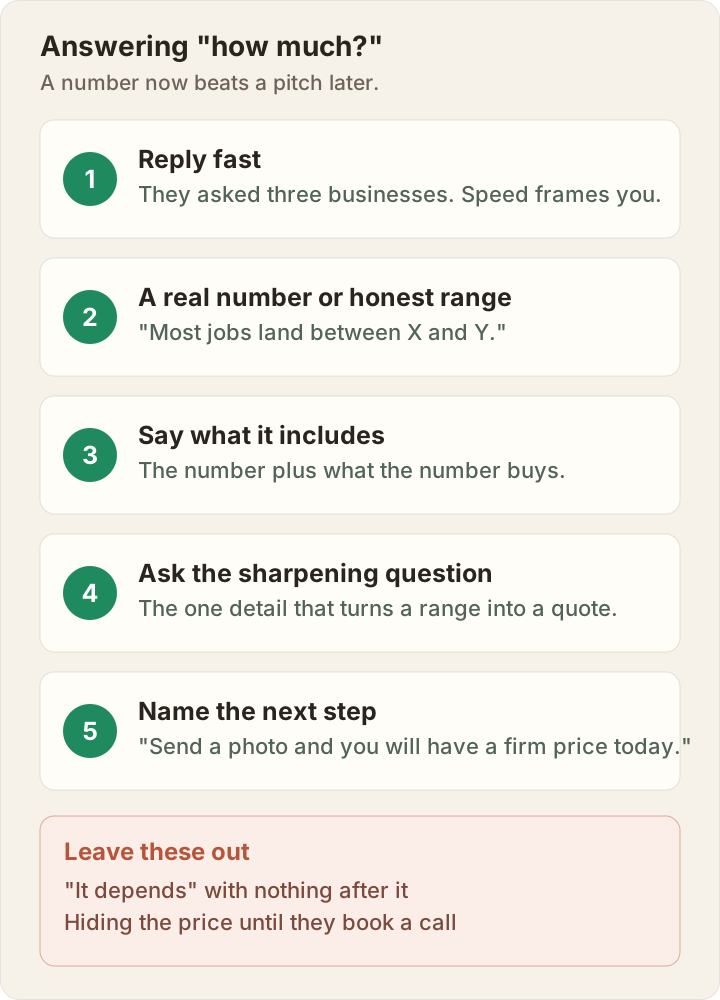
So the first rule is boring and decisive: answer the same day, inside the hour if you can. If the real answer needs thought, send two lines now, "good question, I want to give you an accurate number rather than a guess, you will have it by five". Then beat five.

Give a number. Yes, really.
The great temptation with price enquiries is to withhold the figure: get them on a call, build the value first, then reveal. For big enterprise deals that logic has its place. For a small business fielding "how much for a deck" it mostly filters out your best prospects, the busy people comparing in good faith who read price-hiding as either games or expensiveness. A real number or an honest range with one line about what it includes reads as confidence: this business knows what it charges and is not ashamed of it.
The range is the underused tool here. "Most jobs like yours land between 1,800 and 2,600 depending on [the real variable]" does three jobs in one sentence: it anchors expectations, it politely filters the mismatched budgets before anyone wastes an afternoon and it earns the follow-up question that turns a range into a firm quote. Which brings in the second rule: every reply ends with the sharpening question, the one detail that would let you price it properly. Not five questions, one. Five questions is homework. One question is momentum.
The shape of the reply
Price enquiry reply templates
Six templates for the ways the question actually lands. Swap the brackets, keep the number early and end every one with a step the customer can take in ten seconds.
Subject: Re: [their subject]
Hi [name], thanks for asking, happy to be straight about it: [service] is [price]. That includes [the two or three things that matter, e.g. materials, the follow-up visit, the guarantee], with no extras hidden anywhere. If you would like to go ahead, [the ten-second step, e.g. reply with a couple of dates that suit] and I will confirm the same day. Any questions, ask away.
[Your name], [business]
Subject: Re: [their subject]
Hi [name], good question and here is an honest answer rather than a runaround. Most [jobs like theirs] land between [low] and [high]. Where yours falls depends mainly on [the one real variable, e.g. the size of the area / the condition of the existing wiring]. Tell me [the sharpening question, e.g. roughly how many square metres] and I will turn that range into a firm number today. Either way the price includes [what is included], with no surprises later.
[Your name], [business]
Subject: Re: [their subject]
Hi [name], thanks for getting in touch. Honest answer: this is one I cannot price blind without guessing high to protect myself, which serves neither of us. Most [job type] come in between [low] and [high]. A couple of photos of [the thing] or a [duration] look in person turns that into a firm quote with nothing padded. If photos are easiest, just reply with them attached and you will have your number by [time]. Which suits?
[Your name], [business]
Subject: Re: [their subject]
Hi [name], thanks for asking, here is the short menu: [option one, price]. [Option two, price]. [Option three, price]. Most people go for [the popular one] because [one plain reason]. All prices include [what is included] and there is nothing to add at checkout. If you tell me [one tailoring detail], I can say which one actually fits you rather than which one is most popular. Happy to book you in whenever you are ready.
[Your name], [business]
Subject: Re: [their subject]
Hi [name], thank you for being upfront about the budget, that saves us both time. Straight answer: [the full job] runs [price] and I cannot do that version properly for [their budget] and I will not pretend otherwise. What I can offer inside [their budget] is [the honest smaller version, e.g. the repair rather than the replacement / the two-room option], which covers [what it genuinely achieves]. If that works, I am glad to do it well. And if you would rather save toward the full version, I will happily hold the quote for [period].
[Your name], [business]
Subject: Re: [their subject]
Hi [name], just closing the loop on the price I sent over on [day], in case it arrived while life was busy. The number stands: [price or range], including [the headline inclusion]. If you have questions, I am happy to answer them. If the timing or the budget is not right just now, no hard feelings at all. I am around whenever it is. One line either way lets me plan properly.
[Your name], [business]

What happens after the number
Three sequels, each with its own playbook. The yes turns into a proper quote with scope, validity and a next step. The haggle, "can you do anything on that?", gets the calm hold-or-trade treatment from the discount request guide, never a flinch. And the silence gets exactly one warm follow-up, template six, on the rhythm covered in the follow-up guide. What the silence never gets is a spontaneous discount fired into the void. A price that drops when ignored teaches the whole market to ignore you first.
The fifth "how much" of the week
Answering one price enquiry well is easy. The trap is volume: the fifth one this week, arriving at 4pm between jobs, each needing the same confident warmth with different numbers and different sharpening questions. That is when replies slow down, shrink to a bare figure or fall back on it depends, while the lead cools past saving. That is the job ReciteMail does: it learns your voice from emails you have already sent, then turns "answer this one, decks run 1800 to 2600 depending on size, ask for square metres, warm" into a complete reply while the enquiry is still minutes old. It runs on your PC, never connects to your inbox and your pricing stays on your machine. See who ReciteMail is for.
Your price reply is your cheapest advertising. Every asker who does not buy still walks away with an impression: fast, clear and confident or slow and cagey. Markets are small and people repeat how it felt to ask you the price. Answer every enquiry as if the asker's friend is also reading, because eventually one is.
Common questions
Should you put prices in your first reply to an enquiry?
Yes, a number or an honest range, in the first reply. Withholding the price to force a call filters out the exact customers you want: busy people comparing options in good faith. A real figure with one line about what it includes reads as confidence. If the job genuinely cannot be priced unseen, say so and give the range most jobs land in, then name the one thing that would firm it up. It depends is only acceptable as the start of a sentence, never the whole answer.
How fast should you respond to a price enquiry?
Inside the hour where you can and the same working day always. Someone asking your price is usually asking two or three businesses in the same sitting. The first clear answer becomes the benchmark the others get measured against. Speed also signals how you will be to work with. If a full answer needs time, send a two-line acknowledgement naming when the real answer will arrive, then beat that time.
What if you cannot price the job without seeing it?
Give the honest range first, then make the inspection feel like progress rather than a barrier: most jobs like yours land between X and Y. A photo or a fifteen-minute visit turns that into a firm number, when suits you? The range anchors the conversation and filters budget mismatches politely, while the concrete next step keeps momentum. What loses the lead is the bare we would need to see it first, which reads as evasion.
What do you do when someone goes quiet after hearing the price?
Follow up once, a few days later, warmly and without discounting: checking my price note reached you, happy to answer any questions. If the timing or budget is off just say so, no hard feelings. Silence after a price is often just life, not rejection. The one follow-up recovers a surprising share. What you do not do is chase the silence with a lower number, which teaches everyone that your prices soften if they wait.
Every enquiry answered while it is still warm
ReciteMail drafts price replies, quotes and every repeating customer email in your own voice, learned from mail you have already sent. It runs on your PC, never connects to your inbox and your prices never leave your machine. Free for 7 days, no card needed.
Start your free trial