How to Tell a Client It Is Out of Scope: 6 Email Templates
Published 30 August 2026 · 8 minute read · The ReciteMail Blog
"While you're at it, could you also..." is the most expensive sentence in client work. Not because the request is big. Because it is small. Small requests get a quiet yes. Quiet yeses stack up until the project you quoted has grown a second project inside it that nobody is paying for. The Project Management Institute has found that around half of all projects suffer scope creep and the ones that do usually blow their budget too. For a freelancer or a small firm, that budget is your evenings. Here is the reply that stops the drift without souring the client, plus six copy-paste templates.
Why the quiet yes is the real problem
Most scope creep is not a pushy client. It is a polite one making a reasonable-sounding request of a supplier who does not want to seem difficult. You absorb the small ask. Then the next one. The client is not being cynical: from their side of the fence, all they can see is that requests go in and work comes out. Nobody told them where the paid part ended so as far as they know, it has not.
That is the thing to hold on to before writing this email. An out-of-scope note is not a confrontation. It is information the client is missing. The version of you that says nothing and simmers is being far less fair to them than the version that says "love the idea, here is what it costs". And the maths is brutal: every silent yes prices your next quote wrong, because the client now believes the last project cost what they paid rather than what it took. The same logic sits behind telling a customer a job will cost more than quoted: bad news delivered early and plainly is a professional courtesy, not an apology.
The shape of an out-of-scope reply
Every good version of this email is the same five moves, whatever the trade.
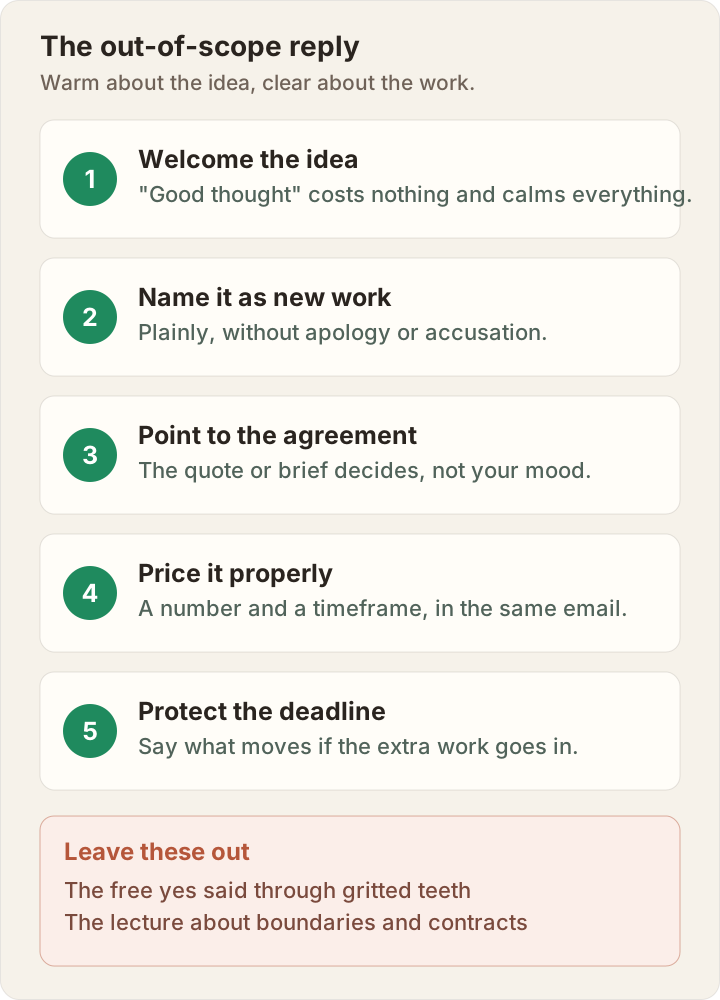
- Welcome the idea. "That's a good thought" costs you nothing and changes the entire temperature of what follows. The client hears a partner, not a gatekeeper.
- Name it as new work. Plainly and without drama: "that sits outside the scope we agreed". No apology, because you have done nothing wrong. No accusation, because neither have they.
- Point to the agreement. The quote, the proposal, the brief. Let the document hold the boundary so you do not have to. This is why a quote that lists what the price covers pays for itself ten times over.
- Price it properly. In the same email, give a number and a timeframe for the addition. An out-of-scope note without a price is just a no with paperwork. With a price, it is an option.
- Protect the deadline. Say what moves if the extra work goes in. Clients agree to added cost far more easily than they forgive a missed date they were never warned about.
The mistakes that sour it
- The gritted-teeth yes. Doing it free and resenting it teaches the client nothing and burns you twice: once in hours, once in mood. If you ever gift work, gift it out loud so it lands as generosity rather than vanishing as expectation.
- The contract lecture. Quoting clause numbers at a client who asked an innocent question turns a pricing conversation into a legal one. Point to the agreement in one sentence, then get straight back to being helpful.
- Waiting until invoice time. A surprise line item for work the client thought was included is how good relationships end. The scope conversation happens when the request lands, never when the bill does.
- Vague pricing. "That would be extra" invites a negotiation. "That's about six hours at £420 and it would move delivery to Friday" invites a decision.
- Making it personal. The boundary is the project's, not yours. "The current scope covers X" survives forwarding to their boss. "I can't keep doing freebies" does not.
Out-of-scope email templates
Six templates for the versions of this that actually land in an inbox. Swap the brackets and keep the warmth real: the client asked because they trust you, which is the best problem a business can have.
Subject: Re: [their request]
Hi [name], good idea, I can see why you'd want that in there. It sits outside the scope we agreed in the quote, which covered [short recap] so it would be a small addition: about [X hours], [price] and I can fold it in without moving your delivery date. Want me to go ahead? If you'd rather park it for a later phase, that works too.
[Your name]
Subject: [Their request]: here's what it would involve
Hi [name], thanks for sending this over, it's a genuinely good addition and worth doing properly rather than squeezing in. It's a bigger piece than the current project covers so I've put together a short quote: [scope of the addition], [price], [timeframe]. If you'd like it as part of this project, delivery of the whole thing would move to [new date]. If it can wait, I'd suggest we finish the current scope first and start this as phase two. Happy either way, just tell me which.
[Your name]
Subject: Re: [their request]
Hi [name], strictly speaking this one's outside our scope but it's ten minutes and you've been great to work with so I've just done it. You'll see it in [where]. For anything bigger along these lines I'd need to quote it as an addition but this one's on the house.
[Your name]
Subject: Quick check-in on scope before we go further
Hi [name], before I dive into the latest requests I want to flag something while it's still easy to solve. The last few additions ([list two or three briefly]) sit outside the original brief and together they're now a meaningful chunk of work. I'd rather raise it now than surprise you at invoice time. Two options: I can quote the additions as a batch ([rough price]) or we finish the agreed scope first and gather everything extra into a phase two. Which would you prefer?
[Your name]
Subject: Re: [their request]
Hi [name], I can see why it reads that way so let me point at the paper rather than my memory: the quote from [date] covered [quoted line or short recap] and [the request] wasn't part of that. I should have listed the exclusions more clearly and I'll do that in future so here's what I suggest: [a fair middle, e.g. I'll do the first part within the current price and quote the rest at [price]]. Does that feel reasonable to you?
[Your name]
Subject: Re: [their request]
Hi [name], this one I'm going to point you elsewhere on and honestly that's better for you: [the request] is outside what we do and you'd get a stronger result from a specialist. [Recommendation if you have one] does exactly this and I'm happy to make the introduction. Everything within our project is on track for [date] and I'll have [next deliverable] with you [when].
[Your name]
Preventing the next one
The cheapest out-of-scope email is the one you never send. Three habits get you there. Put a short "what this price includes" list in every quote, plus one line of exclusions where a project has a known temptation. Take a deposit, because a client with money down reads the scope. And confirm every scope conversation in writing the same day, even if it happened on a call: two sentences by email turn a memory into a record. When drift keeps happening with the same client anyway, that pattern is worth reading next to the signs it is time to let a client go.
The fifth scope conversation this month
Writing one graceful out-of-scope email is easy. Writing the fifth one this month, to a client you like, at 6pm, without letting the tiredness leak into the tone, is the hard part. That is when the gritted-teeth yes happens: not because you lack a boundary but because you lack the energy to phrase it kindly one more time. The fix is the same as for every recurring hard email: a shape you trust and a draft that starts in your voice instead of a blank box.
That is the job ReciteMail does. It learns how you write from emails you have already sent, then turns a one-line note like "tell Dana the extra landing page is out of scope, quote 420, offer phase two" into a warm, specific reply that sounds like you on a good day. And because it runs on your own machine and never connects to any mailbox, client work stays exactly where it should: on your desk.
Agencies and trades live this weekly. Scope replies, quotes, price-change conversations and polite nos are the same dozen hard emails at volume. ReciteMail drafts all of them in your voice, private by architecture because it never connects to a mailbox. See ReciteMail for agencies and ReciteMail for trades.
Common questions
How do you tell a client something is out of scope without upsetting them?
Welcome the idea before you price it. Say the request is a good one, name it plainly as work beyond the agreed brief, point to the quote or proposal that defines the boundary and offer a price and timeframe for the addition in the same email. Clients rarely resent being charged. They resent feeling accused of sneaking something past you. Keep the tone of a partner presenting an option rather than a lawyer catching a breach.
Should you ever do out-of-scope work for free?
Occasionally and always out loud. A ten-minute favour for a good client is fine when you name it as one, because a favour named builds goodwill while a favour absorbed in silence resets the boundary. The dangerous yes is the quiet one: the client cannot tell paid work from free work unless you tell them. Every silent yes teaches them the scope is soft.
What if there is no written scope to point to?
Anchor to whatever record exists: the quote email, the proposal, even the message thread where you listed what the price covered. Say what the price was based on, name the request as an addition to that and quote for it. Then fix the real problem for next time by putting a short scope list in every quote, because this conversation is ten times easier with one sentence of paper trail behind it.
What if the client insists it was included?
Do not argue by trading memories. Go back to the written scope, quote the relevant line and let the document disagree with them instead of you. If the wording genuinely is ambiguous, own that: split the difference on this one, then tighten the wording in the next quote. One ambiguous line settled generously costs less than a client who feels beaten on a technicality.
The fifth scope email, as warm as the first
ReciteMail drafts scope replies, quotes and every hard client email in your own voice, learned from mail you have already sent. It runs on your PC, never connects to your inbox and client details never leave your machine. Free for 7 days, no card needed.
Start your free trial