How to Say No in an Email: 7 Templates That Keep the Relationship
Published 31 July 2026 · 9 minute read · The ReciteMail Blog
The no is the email you rewrite the most. You type it, delete it, soften it, add a paragraph explaining yourself, delete that paragraph, start again. Twenty minutes for four sentences. And the version you finally send is usually worse than the one you wrote first, because every round of softening pushed the answer further down the page. Here is the shape that fixes it and seven templates for the nos that actually turn up.

Nobody minds a no
This is the part most advice gets backwards. People assume the difficulty is the answer and spend their effort disguising it. In practice the answer is rarely the problem. Almost everyone has been turned down before and survived it.
What people do mind is hunting for the answer. They mind reading four paragraphs of warmth and then discovering, somewhere near the bottom, that the warmth was cushioning. They mind a maybe that was always going to be a no, because a maybe costs them a week of planning around something that was never happening. And they mind the follow-up round of guessing, where they cannot tell whether you have said no, said not yet or said convince me.
Clarity is the kindness here. Softening is what feels kind to the person writing.
The shape of a good no
Four parts, in this order. Then you stop.
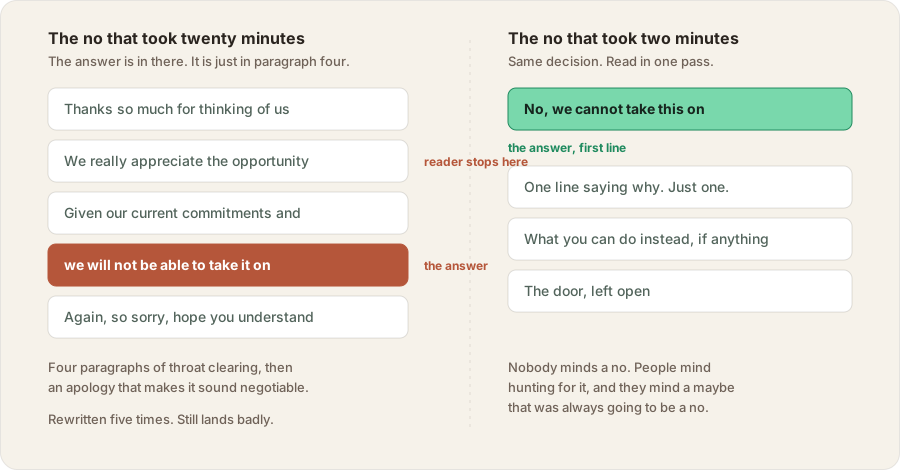
- The answer, in the first line. Not the third paragraph. If someone has to scroll to find out whether you are doing the thing, the email has failed regardless of how nicely it is written.
- One reason. Exactly one. This is the rule people break most. Three reasons do not sound three times more justified, they sound like excuses. Each one hands the other person something separate to argue with. Give the real reason and stop.
- What you can do, if anything. An alternative turns a closed door into a redirection. Only offer one you actually mean. A fake alternative is worse than none, because now you have to decline twice.
- The door, left open. One warm line. Then stop writing. Every extra apology after the decision makes the decision sound negotiable.
That last point deserves its own sentence, because it is the difference between a no that holds and a no that gets tested. Over-apologising reads as an invitation. If you say sorry four times, you have signalled that you feel bad enough to be talked round. A reasonable person will try. Apologise once if you have genuinely caused inconvenience. Otherwise do not apologise at all. Declining work you cannot take is not a wrong you have committed.
Seven templates for saying no
Subject: [Project] and the new [request]
Hi [name],
Happy to take this on, though I should flag that it sits outside what we agreed for [project] so it would be a separate piece of work.
It is roughly [time or cost]. If you want it, say the word and I will send a short quote today. If you would rather leave it, that is completely fine and nothing changes about the original delivery.
Either way I will keep [project] on track for [date].
[Your name]
Subject: Your quote for [item or project]
Hi [name],
I am not able to move on the price for this one. [Amount] is what it costs to do properly and I would rather quote you honestly than quote you low and cut corners later.
What I can do is look at the scope. If the budget is fixed at [their number], tell me and I will come back with a version that fits it. That is a real option rather than a polite deflection.
Let me know which way you would like to go.
[Your name]
Subject: [Project]
Hi [name],
Thanks for thinking of me. I am going to pass on this one.
It is not really the kind of work I do best. You would get a better result from someone who specialises in it. [If you like, I can put you in touch with [name], who is genuinely good at this.]
I hope it goes well and I would be glad to hear from you again on something closer to my patch.
[Your name]
Subject: [Project] timing
Hi [name],
I cannot make [their date]. I would rather tell you that now than tell you on the day.
What I can commit to is [your realistic date]. If [their date] is genuinely immovable, there is one route: [reduced scope option], which would fit the time properly.
Tell me which suits and I will plan around it today.
[Your name]
Subject: The [percentage] increase from [date]
Hi [name],
We are not able to absorb an increase of that size. At [new price] the numbers stop working on our side.
We have been buying [volume] from you since [date] and I would much rather keep it that way. Is there a version that works for both of us? [A smaller rise, a longer commitment at the current rate, better terms on volume] would all be worth talking about.
Happy to jump on a call this week if that is easier.
[Your name]
Template five has a mirror image. When you are the one raising prices, the price increase email templates cover the announcement and the pushback that follows it. And if the no you keep writing is to job applicants rather than clients, the candidate rejection templates handle that harder version of the same email.
Subject: Re: [meeting topic]
Hi [name],
I am going to skip the call on this one, though I do want to help.
Here is where I stand on [topic]: [two or three lines of the actual answer they needed].
If that covers it, we have both saved half an hour. If it does not, send me the specific bit that is unclear and I will come back properly. We can also find a slot next week.
[Your name]
Subject: Re: [original subject]
Hi [name],
I understand why you are pushing on this. The answer is still no.
It is the same reason as before: [the one reason, in the same words you used the first time]. Nothing has changed at my end since we spoke. I would only be giving you a different explanation for the same decision.
[If [specific thing] changes, come back to me and we can look again.] Otherwise I would rather be straight with you than leave it hanging.
[Your name]
Why the same words matter on the second no
Template seven is the one people get wrong. The mistake is subtle. When someone pushes back, the instinct is to find a better reason, a more convincing one, something that will finally land. It is a trap. Producing a new justification tells the other person that your first reason was not the real one, which means this one probably is not either, which means it is worth pushing a third time.
Repeating yourself feels blunt. It is actually the most respectful option available, because it treats the first answer as having been true.
Three things that quietly wreck a no
- "Unfortunately." It is a signal word. Readers see it and brace, then stop reading properly. Say the thing instead.
- "At this time" and "right now." These turn a no into a not-yet whether you meant that or not. If you do mean not-yet, say when. If you mean no, delete the qualifier.
- Blaming a policy you control. "Our policy does not allow it" is fine when a policy genuinely exists. When it is really your decision, hiding behind a rule is transparent and slightly insulting. Own it.
One useful test before sending. Read only your first sentence and ask whether someone could tell what the answer is. If they could not, your answer is in the wrong place. That single check catches most bad nos. It takes about three seconds.
The part that actually costs you the afternoon
None of this is hard to understand. It is hard to execute at four in the afternoon on the fourth awkward email of the day, when the person you are declining is someone you like and want to keep. That is when the softening creeps back in, the apologies multiply and the answer drifts down the page again.
That gap is what ReciteMail is for. You give it the decision in one line, something like tell them no on the extra round and offer a quote instead. It drafts the whole thing in your own voice, learned from emails you have already sent. Firm comes out firm rather than apologetic, because you are not writing it while feeling guilty. You read it, change anything you want and send it yourself. Nothing connects to your mailbox and nothing sends without you.
Agencies use this most for scope conversations. The same shape does the work when you are chasing a late invoice or declining a refund request. The biggest no of all, ending a client relationship entirely, has its own playbook in how to fire a client politely. If you are building a proper library of these, the guide on templates that do not sound like templates pairs with this one.
One no deserves its own playbook: the rush job you cannot fit. The fee ladder for the yes and the fast graceful decline are both covered in the rush job guide.
Common questions
How do you politely say no in an email?
Put the answer in the first line, give one plain reason, offer an alternative if you genuinely have one, then leave the door open and stop writing. Politeness comes from clarity and warmth rather than from softening. A no buried in paragraph four reads as evasive, not kind.
Should I apologise when declining a request?
Once at most and only if you have actually caused inconvenience. Repeated apologising signals that the decision is negotiable and invites a second attempt. You can be warm without being sorry. Saying no to work you cannot take is not something that requires an apology.
Do I have to give a reason for saying no?
One line helps, because a bare no feels abrupt and leaves people guessing at something worse. Do not give three. Every additional reason is another thing the other person can argue with. A stack of justifications reads as an excuse rather than a decision.
What do I do if they ask again after I said no?
Repeat the same answer in the same words rather than inventing new reasons. Changing your explanation suggests the first one was not the real one. Acknowledge that you have heard them, restate the decision plainly and say what would need to change for the answer to be different, if anything would.
The hard emails, written once
ReciteMail turns a one line decision into a reply that sounds like you on a good day, even the ones you have been putting off since lunch. Free for 7 days, no credit card and no connection to your inbox.
Start your free trial