Accountant Email Templates: 10 Emails for Chasing Records, Deadlines and Fees
Published 26 September 2026 · 12 minute read · The ReciteMail Blog
A small practice sends the same ten emails on a loop. The records chase goes out in the first week of the month. The deadline warning goes out in the last. In between there is the missing invoice, the client who wants a payroll question answered by five o'clock, the one who has not paid the last bill and the one who has just asked for a management report that was never in the engagement letter. None of these emails are hard. The cost is that each one is written from scratch, at the end of a day spent on actual work, by someone who has already written it forty times. Here are the ten, written to be short, with the rules behind them and a note on how each gets drafted in under a minute.
Three rules for practice email
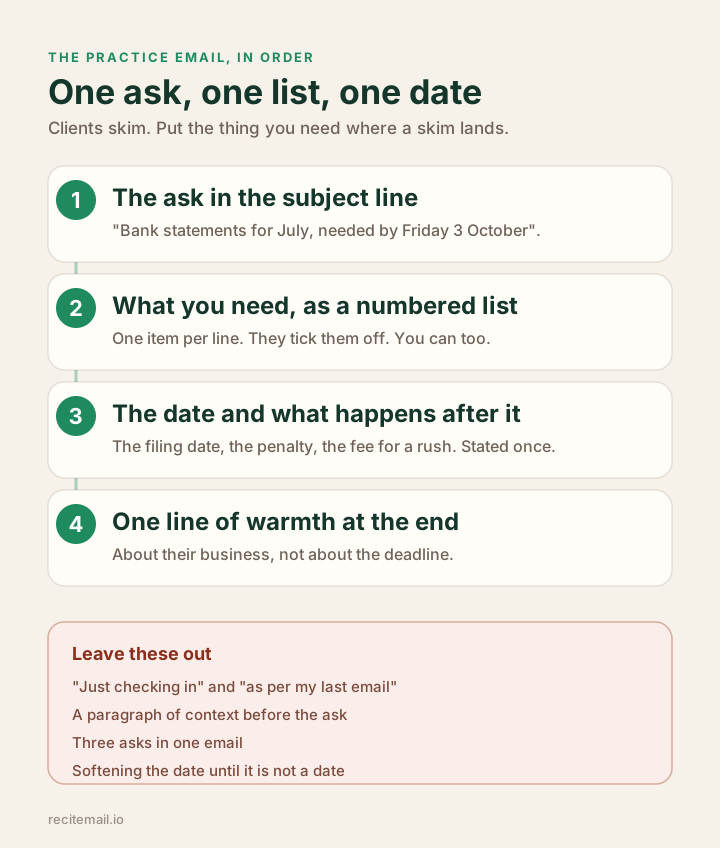
Accountants write long emails because the work is precise and the email feels like it should be too. Clients do not read them that way. They open the email on a phone between two other things, look for what is being asked of them and either do it or put it off. The rules follow from that.
- One ask per email. If you need the bank statements and the VAT question answered and the engagement letter signed, that is three emails or one email with a numbered list of three. Never three paragraphs. A client who cannot see the list does the first thing they notice and stops.
- The date in the subject line. "Records for the June quarter" gets opened next week. "Records for the June quarter, needed by Friday 3 October" gets opened today. If there is a penalty behind the date, say so once in the body in plain figures. It is not a threat. It is the information they would want.
- The list before the paragraph. Anything you need from a client goes as a numbered list, one item per line, before any explanation. They can tick it off. You can paste it back to them with the done ones removed. See our guide to chasing a client for approval for the same idea applied to sign-off.
The ten below follow those rules. Change the names, the dates and the figures. Keep the length.

1. The first records chase
Sent in the first week of the month or the quarter, before anything is late. Its job is to make the list easy to complete. The tone is routine because it is routine.
Subject: Records for July, needed by Friday 15 August
Hi Priya, time for the July records. Here is what I need:
1. Bank statements for all three accounts, 1 to 31 July
2. Sales invoices raised in July or access to the invoicing app
3. Receipts for anything paid personally that the business should reimburse
4. The Stripe payout report for July
Upload to the client portal or reply to this email with attachments. If any of the four is not ready, send the rest and tell me which one is coming. Friday 15 August gives me time to have the VAT figures to you a week before the filing date.
Best regards,
Dan
The line "send the rest and tell me which one is coming" is the one that gets replies. Without it, a client with three of the four waits for the fourth and you get nothing for a fortnight.
2. The third records chase
The first chase was ignored. The second, a one line nudge, was ignored. The third has to change something or it will be ignored too. What changes is that it names what happens next and puts a date on it that is yours, not theirs.
Subject: July records, still needed, filing date is 7 September
Hi Priya, third time of asking on the July records and I am conscious the filing date is Thursday 7 September. Still outstanding:
1. Bank statements for the Monzo account
2. The Stripe payout report
If I have both by Tuesday 2 September I can file on time as normal. After that I can still file but it becomes a rush job at the rate in our engagement letter and I cannot promise to hit the 7th. If something is making these hard to get hold of, tell me and I will help. A read only bank feed would solve the first one for good.
Best regards,
Dan
Notice the list has shrunk. Pasting back only what is still missing tells the client you are keeping count and it makes the remaining job look small, which it is.
3. The deadline warning
Different from the chase. This one goes to every client with a filing date coming up, whether or not they owe you anything. That way the responsibility for the date is shared in writing. Keep it to the date, the penalty and what you need from them, if anything.
Subject: Your corporation tax is due Tuesday 1 October
Hi Marcus, a reminder that the corporation tax for the year to 31 December is due for payment on Tuesday 1 October. The amount is 4,860.00 and the payment details are in the return I sent on 12 September. Interest runs from 2 October if it is paid late. Nothing needed from me at this point. If cash is tight this month, tell me before the 1st and I will set out what a time to pay arrangement would look like.
Best regards,
Dan
Ending with "nothing needed from me at this point" is deliberate. The client can close the email knowing there is no list. The ones who do need help will answer the last line.
4. The missing information query
You are halfway through the accounts and there are eleven transactions you cannot categorise. The temptation is to send them as a spreadsheet. Send them as a numbered list in the email body instead. Clients answer lists in the body. They open spreadsheets later, which means never.
Subject: 6 transactions I need you to explain, year end accounts
Hi Priya, six payments in the year I cannot place. A word or two against each is enough:
1. 14 March, 420.00 to "JL Designs"
2. 2 May, 1,150.00 to "Hetzner"
3. 19 June, 89.99 to "Amznmktplace"
4. 3 August, 2,000.00 transfer to your personal account
5. 11 October, 340.00 cash withdrawal
6. 28 November, 615.00 to "WeWork"
Reply in this email with the number and the answer, for example "3. Office chair". Once I have these I can finish the accounts. The sooner the better.
Best regards,
Dan
5. The fee quote
A new enquiry has asked what you charge. The quote email is not a proposal document. It is the scope, the price, what is not included and how to say yes. Our guide to sending a quote by email covers the structure in more depth.
Subject: Your quote for bookkeeping and year end accounts
Hi Tom, good to speak yesterday. Based on what you described, roughly 80 transactions a month and one director on payroll, here is the quote:
Monthly bookkeeping, VAT returns and payroll for one: 240.00 a month
Year end accounts and corporation tax return: 950.00 once a year
Self assessment for you personally: 220.00 once a year
Included: a quarterly call to go through the numbers and unlimited short questions by email. Not included: management accounts, R&D claims or anything for a second company, which I can quote separately. If that works, reply "yes" and I will send the engagement letter and a form to set up the bank feed. The quote is good for 30 days.
Best regards,
Dan
The "not included" line saves you the out of scope email later. Write it into every quote.
6. The out of scope request
A bookkeeping client has asked for monthly management accounts, a cash flow forecast for the bank and a call with their business partner, all in one email, as if it were part of the service. It is not. The reply is warm, clear about the boundary and comes with a price. See how to tell a client something is out of scope for the reasoning.
Subject: Re: Management accounts and forecast for the bank
Hi Marcus, happy to help with this and it is a good sign that the bank is asking. It sits outside the monthly bookkeeping we agreed. Here is what it would cost:
Monthly management accounts: 150.00 a month, added to the standing order
12 month cash flow forecast in the bank's format: 450.00 as a one off
A call with you and Sam to go through both: included
If you would like to go ahead, reply "yes" and I will have the forecast to you by Friday 10 October. If the bank only needs the forecast this once, we can leave the management accounts for now.
Best regards,
Dan
7. The same day request you cannot do
It is four in the afternoon on a Thursday and a client needs a letter confirming their income for a mortgage broker by five. Sometimes you can. When you cannot, the reply gives the real time and the reason, without an apology paragraph. Our guide to answering a rush job request has the same shape.
Subject: Re: Income letter for the broker today
Hi Priya, I can do the income letter but not by five today. It needs the last two years' figures checked against what was filed and I am not able to sign off on that in an hour. You will have it by 11am tomorrow, signed, on letterhead, sent to you and to the broker if you give me their email. Most brokers are fine with next morning. If yours is not, tell me and I will call them.
Best regards,
Dan
8. The fee increase
Fees go up once a year or they never go up at all. The email says the new figure, the date, the reason in one sentence and what the client gets. It does not ask permission. Our full guide to price increase emails covers the timing.
Subject: Your monthly fee from 1 January
Hi Tom, from 1 January the monthly fee moves from 240.00 to 265.00. It is the first change in two years and it reflects the payroll going from one person to three and the extra VAT work since you registered. Everything in the current engagement letter stays the same and the year end fee is unchanged. Nothing needed from you. The standing order will need updating for the January payment and I will send a reminder in December.
Best regards,
Dan
9. The late payer
An accountant's own invoices get paid last, because the client knows you will still do the work. The fix is a short, dated chase that names what stops if it is not paid. Our late payment reminder templates cover all four stages. This is the second one.
Subject: Invoice 2041, 950.00, now 21 days overdue
Hi Marcus, invoice 2041 for the year end accounts was due on 4 September and I have not received it. The amount is 950.00 and the bank details are on the invoice. If it has gone this week, ignore this. If not, could you pay it by Friday 4 October. I will pause work on the October VAT return until it is settled, which I would rather not do with a filing date on 7 November.
Best regards,
Dan
10. Letting a client go
Some clients cost more than they pay: the records arrive in a shoebox in the last week, the emails come at eleven at night and every fee is disputed. The disengagement email is calm, gives a date, sets out the handover and does not list grievances. See how to fire a client for when to do it and what to do first.
Subject: Ending our engagement from 31 December
Hi Marcus, I have decided that from 31 December I will no longer be able to act for Redwood Ltd. I will complete the accounts for the year to 30 September and the VAT return due 7 November, both of which are already in hand. After that I will send your new accountant everything they need: trial balance, fixed asset register, the last two years' accounts and returns and the payroll records, once you tell me who they are. There is no additional fee for the handover. Thank you for the last four years and I hope the business goes well.
Best regards,
Dan

Writing them in under a minute
The templates above cover the routine cases. Real client emails are rarely routine. The records chase has to mention that they told you the Monzo statements were coming last Tuesday. The out of scope reply has to reflect that the bank wrote to them yesterday and they are worried. That is where the template stops being useful and the email goes back to being written by hand. Here is how ReciteMail handles it.
- Snip the client's email. Press the snip button and drag over their message on screen. ReciteMail reads it the way you would. It never connects to your inbox and it does not touch your practice software.
- Say the decision. "Third chase. Monzo statements and the Stripe report still missing. Need them by Tuesday the 2nd or it becomes a rush job at the engagement letter rate. Offer the bank feed again." About ten seconds.
- Read the draft. It comes back as email 2 above, with their name, their dates and your plan, in the way you write. It learned your voice from emails you have already sent. It sounds like Dan and not like a practice management system.
- Adjust if you need to. Say "firmer" or "shorter" and it redrafts. Pick a tone before you start for the client who needs a softer hand.
- Copy, paste, send. From your own email, as always. Nothing sends without you. This 40 second video shows the whole flow.
A practice with 60 clients sends something like 40 of these emails a week. At five minutes each by hand that is over three hours. At under a minute it is about 40 minutes and the emails are better, because the facts came from the client's message rather than from memory.
Client email is the part of the practice nobody bills for. ReciteMail drafts the chase, the quote and the difficult reply in your own voice from a snip of the client's email. It runs on your PC, never connects to your inbox and everything is encrypted on your machine. See ReciteMail for accountants or the other industries it is built for.
Common questions
How do you chase a client for records without sounding rude?
Make the list short, put the date in the subject line and say what happens after the date in plain terms. Rudeness comes from tone words like "as per my last email" and from vagueness that forces a second chase. A numbered list with a date and a reason reads as organised, not rude.
How many times should an accountant chase a client for missing records?
Three, with the third one naming the filing date and the consequence of missing it, which is usually a rush fee or a late filing penalty on the client. After the third, a phone call does more than a fourth email. Put a read only bank feed in place and the chase disappears for the next quarter.
Should an accountant put fees in an email or a formal proposal?
For a small business client, an email with the scope, the price, what is not included and a clear way to say yes converts better than a proposal document. Put the engagement letter behind the yes, not in front of it.
What should a fee increase email from an accountant include?
The new figure, the date it starts, the reason in one sentence and confirmation that the scope has not changed. Do not ask for agreement and do not apologise. Send it at least six weeks before the new fee takes effect.
How can a small practice spend less time on client email?
Use the same ten templates for the routine cases, keep every email to one ask and one list and let a drafting tool handle the ones that need a proper reply. ReciteMail reads the client's email from a snip of the screen, takes the decision from you by voice and writes the reply in your voice, on your PC, without connecting to your inbox.
The records chase, written before the kettle boils
Snip the client's email, say what you have decided and ReciteMail writes the reply in your own voice with their dates and figures in it. It learns from mail you have already sent, runs on your PC and never connects to your inbox. Free for 7 days, no card needed.
Start your free trial