How to Write a Price Increase Email: 6 Templates
Published 13 August 2026 · 7 minute read · The ReciteMail Blog
Every business puts this email off. Costs crept up months ago, the margin is quietly gone and the announcement sits half-written in drafts because it feels like asking for trouble. Here is the truth from the customer's side: a fair price increase with proper notice rarely loses anyone worth keeping. A surprise on an invoice does. This is how to write a price increase email that customers accept, plus six copy-paste templates for the ways it actually happens.
Why price increase emails go wrong
Almost every bad price increase email fails the same three ways. The number is buried in the fourth paragraph, where it looks hidden. The tone apologises so hard that the reader concludes the increase must be optional. The reason is a fog of corporate weather like "current market conditions", which reads as cover even when the underlying costs are painfully real.
Customers do not need convincing that prices rise. They buy groceries. What they need is to feel they were told straight, told early and told by a person rather than a notice generator.
The shape of a price increase customers accept
Five beats, in this order. The whole email fits in six or seven sentences.
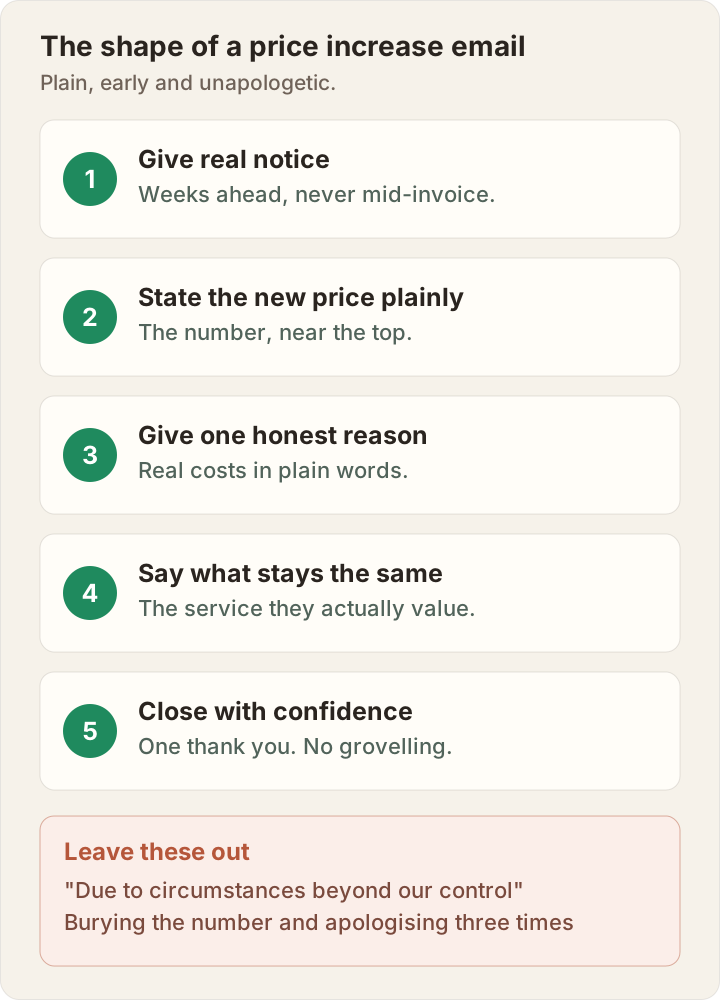
- Give real notice. Weeks ahead, never mid-invoice. The notice is the respect.
- State the new price plainly. The number and the date it starts, in the first two or three sentences. Hiding it is what breaks trust, not the number itself.
- Give one honest reason. Materials, supplier costs, wages or the level the work should have been priced at all along. One reason, in plain words.
- Say what stays the same. The turnaround, the quality, the person answering the phone. Remind them what the money actually buys.
- Close with confidence. One thank you for their custom. No grovelling, no second apology, no paragraph inviting a negotiation you do not want.
How much notice to give
Thirty days is the working minimum for anything ongoing: services, retainers, subscriptions, regular orders. Annual arrangements deserve more. A contract may also set its own notice period. Check before you write. For one-off shop purchases the new price simply applies to new orders, though a short note to regulars ahead of time costs nothing and buys real goodwill. For your two or three biggest customers, consider a phone call first with the email as confirmation. Nobody important should learn a number like this from a bulk send.
The lines that make it worse
- "Due to circumstances beyond our control." The classic. It names nothing, owns nothing and reads as a shrug.
- Apologising three times. One warm tone throughout beats three sorries. An email that apologises for existing invites the reader to negotiate.
- Burying the number. If the new price arrives after 200 words of preamble, the reader feels managed. Put it high.
- Overexplaining. A costs breakdown with percentages reads as a defence brief. You are informing, not testifying.
- The silent increase. Worst of all. Customers forgive a clear rise with notice. Discovering it on an invoice is how you end up in a review you then have to answer.
Price increase email templates
Six templates for the ways a price rise actually happens. Swap the bracketed parts, keep your own turns of phrase and resist adding a second apology while you paste.
Subject: A price update from [business name], effective [date]
Hi [name],
From [date], our prices are changing: [item or service] moves from [old price] to [new price]. Anything ordered before then is at the current price.
The honest reason is [one line: supplier costs, materials, postage]. We have held prices for [period] and absorbing it further would mean cutting corners we are not willing to cut.
What does not change: [turnaround, quality, the way we look after you]. Thank you for buying from us. It genuinely matters.
[Your name]
[Business name]
Subject: My rates from [date]
Hi [name],
A quick heads-up before it appears on a quote: from [date] my rate moves from [old rate] to [new rate] an hour. Work already booked stays at the rate we agreed.
Costs on [materials, insurance, fuel] have moved and the new rate reflects where the work now sits. The standard you get from me does not change.
Happy to answer anything. Thank you for the continued work.
[Your name]
Subject: Your [plan or retainer] from [date]
Hi [name],
From [date], your [plan or retainer] moves from [old price] to [new price] a month. Nothing changes before then and there is nothing you need to do.
Since you joined we have added [one or two genuine improvements]. The new price reflects that and the rising cost of [the honest driver].
If you would like to review what is included before the change lands, reply and we will set up a time. Thank you for staying with us.
[Your name]
Subject: A change to your pricing from [date]
Hi [name],
Before the general announcement goes out, I wanted to tell you directly. From [date], [service] moves from [old price] to [new price].
You have been with us [period] and that is exactly why you are hearing it from me first rather than from a mailout. The reason is simple: [one honest line]. Because of the history, your change will not apply until [later date].
Thank you for the years of trust. If you want to talk it through, call me any time.
[Your name]
Subject: [Product] pricing from [date]
Hi [name],
Our costs on [material or product] have risen [roughly how much] since [period] and we have been absorbing it until now. From [date], [product] moves from [old price] to [new price].
If our costs come back down, the price follows them down. That is a commitment, not a line.
Orders placed before [date] are at the current price. If you were planning to stock up, now is the moment. Thank you as always.
[Your name]
Subject: Re: Price increase
Hi [name],
Completely fair question and I am glad you asked rather than quietly going elsewhere. The increase stands because [one honest line]. I would rather charge properly than trim the [quality, time, care] that you actually come to us for.
What I can do: [one genuine option: honour the old price for orders placed this month, a loyalty rate on the annual plan, nothing at all if nothing is right].
Whatever you decide, thank you for the direct question and for your custom so far.
[Your name]
When a customer pushes back
Expect a handful of replies and treat them as engagement rather than revolt. The people who write back are the ones who care enough to stay. Hold the line kindly: restate the price, give the reason once more in one line and offer a decision rather than a debate. A short grandfather period for a few long-standing customers is a gesture that costs little. A general climbdown teaches everyone that your prices are opening offers. Some churn at the bottom is not a failure. It is what correct pricing looks like in its first month.
The silent increase is the risky one. Customers forgive a clear price rise announced early. What they do not forgive is finding it on an invoice. If the announcement triggers a discount request you do not want to grant, the discount request guide covers holding the new number and the wider craft is in how to say no in an email. And when even the right price cannot fix the account, how to fire a client politely covers the exit.
The email you only send once a year
A price increase email gets rewritten more than almost any other message. It is high stakes, it goes to your best customers and every draft swings between too blunt and too soft. Then come the replies, each needing the same calm answer in slightly different words.
That is the job ReciteMail does. It drafts the announcement in the voice your customers already know from you, then handles every reply that follows: the pushback, the "does this affect my order", the long-standing client who deserves a personal note. Screenshot the email, add a one-line instruction, read the draft and send it yourself. If you are building a standing set of these, the guide on building a reply library pairs well with this one.
Common questions
How much notice should you give for a price increase?
Thirty days is the working minimum for ongoing services, retainers and subscriptions. Give more for annual arrangements or where a contract sets a notice period. For one-off purchases in a shop the new price simply applies to new orders, though telling regulars ahead of time still buys goodwill.
Should you apologise in a price increase email?
No. Give notice, give a reason and be warm about it, yet never apologise for charging what the work costs. An apology invites the reader to treat the increase as negotiable and quietly tells them you think it is unfair too. Save sorry for when something actually went wrong.
What reason should you give for a price increase?
One honest reason in plain words: supplier costs, materials, wages or the investment you have made in the service. Never write "due to circumstances beyond our control". Vague reasons read as cover. If the honest reason is simply that you were underpriced, say the new price reflects the work involved and leave it there.
What if a customer refuses to accept the new price?
Expect a little pushback and hold the line kindly. Restate the price, thank them for their custom and let them decide. For a handful of long-standing customers you may choose to delay the change a month or two as a gesture. Losing a small number of underpriced customers is usually the cost of charging correctly.
Announce the new price in your own voice
ReciteMail drafts the announcement and every reply that follows it, warm, plain and unapologetic, in the voice your customers already know. You read every word before it goes anywhere. Free for 7 days, no credit card and no connection to your inbox.
Start your free trial