Chasing a Client for Approval or Information: 6 Email Templates
Published 2 September 2026 · 8 minute read · The ReciteMail Blog
The job is ready to move and it cannot, because the client has not sent the one thing you need. The sign-off on the proof. The logo files. The documents for the tax return. The decision between the two options you sent last Tuesday. You are not behind. You are waiting, which is worse, because the deadline is still yours and the delay is theirs. Here is the chaser that gets a reply without turning you into a nag, when to stop asking and start moving the date, plus six copy-paste templates for the ways a client quietly holds up their own job.
Most projects are late waiting, not working
Ask anyone who runs client work where the time goes and they will tell you it is rarely the doing. Research on project delivery keeps landing on the same finding: most projects are late not because of one big event but because of an accumulation of small unresolved questions and approvals are the biggest single category of those questions. Agencies report brands taking around ten days on average to approve a piece of work. Ten days in which nothing happens, billed to nobody, while your delivery date drifts toward you.
The reason ordinary chasers fail is that they ask the client to do work. "Just checking in on the feedback" hands them a task: open the thing, form an opinion, write it up. That gets deferred to a quieter day that never comes. The chaser that works does the opposite. It shrinks the decision to something they can answer from their phone in a lift. This is a different problem from a prospect who has gone quiet on a proposal: that person owes you nothing yet. A client blocking their own project has a deadline, a budget and a reason to answer. Your email just has to make answering easy.

The shape of a chaser that gets answered
Every version that works runs the same five moves.
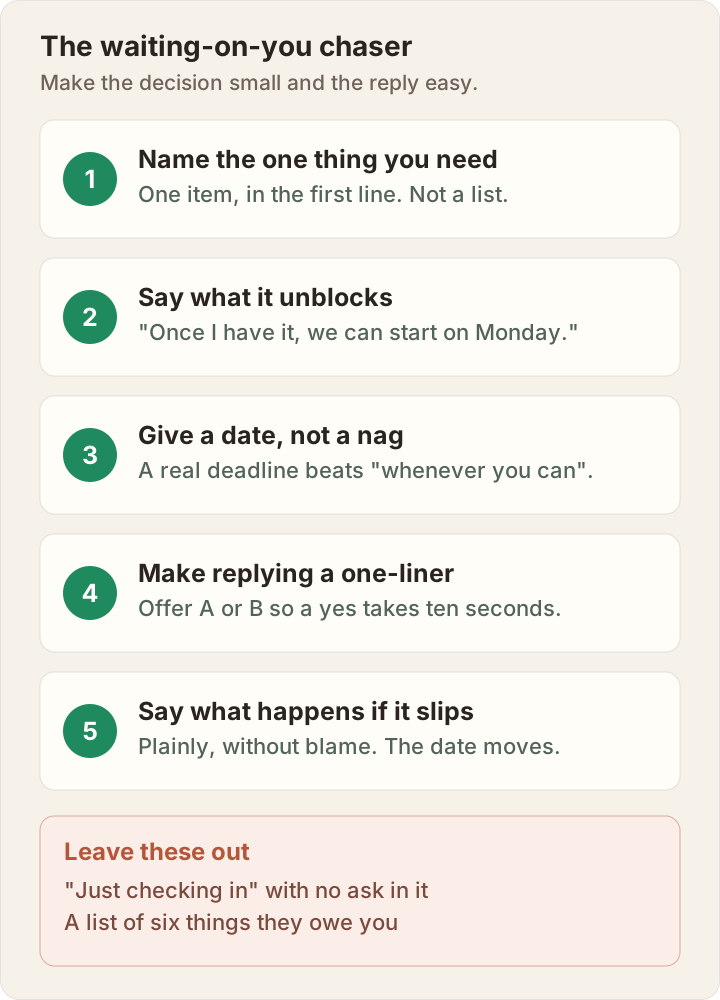
- Name the one thing you need. In the first line. If you need four things, chase the one that blocks the most and mention the rest at the bottom. A list gets skimmed and parked. A single ask gets done.
- Say what it unblocks. "Once I have the logo files, print goes Monday." Now the request has a reason and the delay has a visible cost, without you having to say a word about the delay.
- Give a date, not a nag. "Whenever you get a chance" means never. "By Thursday so we hold Monday" is a real thing to plan around.
- Make replying a one-liner. Offer A or B. Attach the exact file to approve. Ask a yes-or-no question. The easier the reply, the sooner it comes.
- Say what happens if it slips. Plainly and without blame. "If it lands after Thursday, delivery moves to the following week." Information, not threat. It is often the first time the client realises they are on the critical path.
The mistakes that get a chaser ignored
- "Just checking in." No ask, no date, no reason. It reads as a nudge and gets treated like one.
- The six-item list. Everything you are waiting on, in one email. It feels thorough. It reads as homework and gets deferred wholesale.
- The passive-aggressive timestamp. "As mentioned on the 3rd, the 8th and the 12th" makes the client defensive and defensive people go quiet. Keep the history out of it until you are formally moving the date.
- Chasing the wrong person. The account contact is not always the one who can decide. Ask who owns the sign-off and copy them in, politely.
- Quietly absorbing the delay. Working weekends to hit the original date after the client cost you a fortnight teaches everyone that their silence is free. It is not. The chaser should say so calmly.

Chaser email templates
Six templates covering the ladder from a friendly first nudge to a formal pause. Swap the brackets, keep the ask to one thing and keep the warmth, because this is a client you still want next year.
Subject: One thing to unblock [project]
Hi [name], quick one. I need [the one thing] to keep [project] moving: once I have it, [what it unblocks, e.g. we start the build Monday]. Could you send it over by [day]? That keeps us on track for [delivery date]. If it's easier, just reply to this with it attached and I'll take it from there.
[Your name], [business]
Subject: [Project]: A or B?
Hi [name], I've narrowed it to two options so this is a quick call rather than a study. A is [one line]. B is [one line]. My recommendation is [A or B] because [one reason] but either works and I'll run with whichever you pick. A one-word reply is perfect. If I have it by [day] we hold [date].
[Your name], [business]
Subject: Two documents to finish your [return / file]
Hi [name], I'm most of the way through [the work] and I'm now blocked on just two things: [document one] and [document two]. Photos from your phone are fine, they don't need to be tidy. If they reach me by [day] I can file by [date] and you can stop thinking about it. If either is going to take longer, tell me which and I'll plan around it.
[Your name], [business]
Subject: Sign-off needed on [item] to keep [date]
Hi [name], the [proof / design / draft] is attached and it's the last thing standing between us and [next stage]. If it's right, a simple "approved" is all I need. If something needs changing, tell me the one or two things and I'll turn them round the same day. I need the go-ahead by [day] to hold [delivery date]. After that the print slot moves to [later date], which I'd rather avoid for you.
[Your name], [business]
Subject: [Project] delivery date, an honest update
Hi [name], I want to be straight with you rather than let this drift. I've been waiting on [the thing] since [date] and without it [the stage] can't start. That means the [original date] delivery is no longer realistic. The moment it arrives I can commit to [new date] and I've carried on with [the parts that don't depend on it] so we lose as little time as possible. No blame intended at all, projects get busy on both sides. Send it when you can and I'll confirm the new date the same day.
[Your name], [business]
Subject: Pausing [project] until we hear from you
Hi [name], I've chased [the thing] a few times now without a reply so rather than keep nudging I'm going to pause [project] and free up the slot. Nothing is lost: everything we've done is saved and the moment you send [the thing] we'll pick it straight back up and I'll give you a fresh date within a day. If priorities have changed on your side, that's completely fine too, just let me know so I can plan properly. Thanks for the work so far, I'd like to finish it with you.
[Your name], [business]
Designing the wait out at the start
The best chaser is the one you never send. Put client turnaround times in the quote: feedback within five working days or the schedule moves. List every piece of information you will need at kick-off so nothing is a surprise halfway through. Put decision deadlines in your calendar the way you put delivery deadlines and chase the day before, not the week after. Clients rarely mean to be the bottleneck. They were simply never told they were on the critical path and a quote that says so does most of your chasing for you. When the delay is on your side instead, the project delay email is the mirror of this one and when the wait turns into extra work, the out-of-scope reply picks up from here.
The fourth chaser this week
One good chaser is easy. The fourth this week, to a client you like, about the same missing file, without a trace of the irritation you actually feel, is the hard part. That is when "as mentioned on the 3rd, the 8th and the 12th" sneaks into the first line, not because you are unreasonable but because you are tired and the wait has cost you a weekend. The fix is the same as for every recurring hard email: a shape you trust and a draft that starts in your voice instead of your mood.
That is the job ReciteMail does. It learns how you write from emails you have already sent, then turns a one-line note like "chase Priya for the logo files, need them Thursday, print slot moves otherwise, keep it warm" into a friendly, exact chaser that sounds like you on your most patient day. And because it runs on your own machine and never connects to any mailbox, your client work stays exactly where it belongs.
Agencies, accountants and trades live this weekly. Approval chasers, supplier chasers, delay notices and scope replies are the same dozen project emails at volume, each one easiest to get wrong when you are waiting. ReciteMail drafts all of them in your voice, private by architecture because it never connects to a mailbox. See ReciteMail for agencies and ReciteMail for accountants.
Common questions
How do you chase a client for approval without being annoying?
Ask for one thing, not a list. Put it in the first line. Say what it unblocks so the request has a reason attached, give a real date rather than "whenever you can" and make replying a one-liner by offering a choice such as option A or option B. A chaser that needs the client to think, dig and compose gets deferred. A chaser they can answer with a single word gets answered on the phone in the lift.
How many times should you chase a client before moving the deadline?
Two friendly chasers spaced a few working days apart, then the third message changes shape: it stops asking and starts stating what the delay does to the date. Not as a threat, as information. Most clients only realise the cost of their silence when someone spells out that Friday is now the following Wednesday. After that, if nothing moves, pause the job formally and tell them how to restart it.
Should you keep working while you wait for the client?
Only on the parts that genuinely do not depend on the missing piece and say so in the chaser. Working around a gap on assumptions is how you end up redoing a week when the answer finally arrives. It is fine to write "we have carried on with X and Y in the meantime" but the honest line is that Z cannot start until the decision lands and the delivery date moves with it.
How do you stop clients holding up their own projects?
Design the wait out at the start. Put client turnaround times in the quote, for example feedback within five working days or the schedule moves, list every piece of information you will need up front so nothing is a surprise mid-project and set decision deadlines in the calendar the way you set delivery ones. Clients rarely mean to be the bottleneck. They just were never told they were on the critical path.
Every chaser, warm on the fourth send
ReciteMail drafts approval chasers, delay notices and every recurring client email in your own voice, learned from mail you have already sent. It runs on your PC, never connects to your inbox and client details never leave your machine. Free for 7 days, no card needed.
Start your free trial