Payment Reminder Email in English: 6 Templates for International Businesses
Published 21 August 2026 · 8 minute read · The ReciteMail Blog
Your client speaks English, the invoice is overdue and the reminder you would write in your own language does not translate. You know it does not, which is why the email keeps not getting sent while the money stays unpaid. This guide is for every business chasing an invoice in English as a second language: why literal translations misfire, the exact phrases that are polite and firm at the same time, the timing that respects international transfers, plus six copy-paste templates from the friendly first nudge to the final notice.
Why translated reminders misfire
Politeness does not translate word for word, it recalibrates. The formal register that reads as correct in a French or German business letter often lands in English as cold and stiff, the opening move of a legal dispute rather than a nudge between partners. Meanwhile the humble, indirect constructions many languages reach for, we would be very grateful if perhaps payment might be considered, land in English as uncertainty and uncertainty invites delay. The reader senses that nothing in particular has been asked for by any date in particular and files the email accordingly.
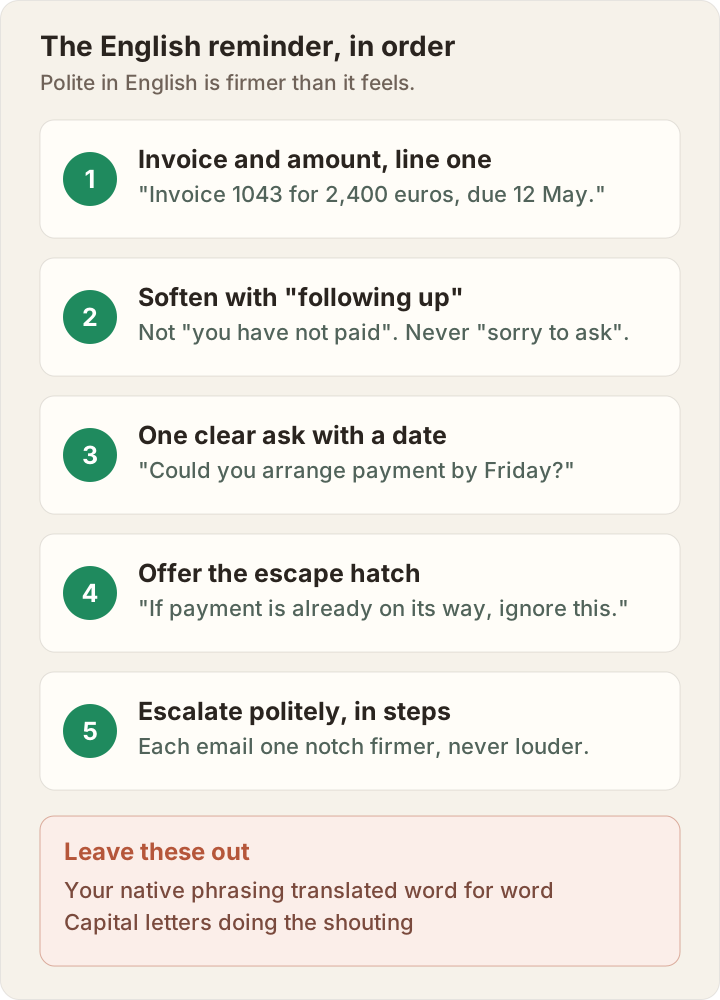
English business politeness works on a different mechanism: a warm, casual surface wrapped around a very specific core. Short sentences. First names. A friendly opener. And then, precisely stated, the invoice number, the amount and the date you expect payment. What sounds impolite in English is not directness about facts. It is directness about blame. "You have not paid" accuses. "I am following up on invoice 1043" states. The facts stay hard while the tone stays light. That combination, firmer than it feels when you write it, is the entire trick.
The phrases that do the work
Steal these. They are the standard, natural constructions native speakers use for exactly this email.
- "I am following up on invoice 1043, which was due on 12 May." The universal opener. Neutral, factual, blameless.
- "Just a gentle reminder that..." The softest opener, right for the first reminder only.
- "Could you arrange payment by Friday?" The ask. "Could you" reads as polite in English while still naming a real date. Avoid "as soon as possible", which sounds urgent but sets no deadline at all.
- "If payment is already on its way, please ignore this message." The escape hatch. It lets the reader save face and it covers the genuinely slow international transfer.
- "Please let me know if anything is missing on our side." Turns the chase into cooperation and flushes out the missing PO number or the invoice stuck in approval.
And the traps to avoid: "you must pay" and "you have to" read as threats, not requests. Writing in capital letters reads as shouting everywhere. "Please do the needful" is common in Indian English but reads oddly to British and American clients. And do not apologise for asking. "Sorry to bother you about the money" hands your leverage away in the first line: you did the work, the request is legitimate and English politeness never requires pretending otherwise.
The shape of the English reminder
Payment reminder templates in English
Six templates, ordered by how late the payment is. Swap the brackets, keep the sentences short and resist decorating them with formality. Plain is polite here.
Subject: Invoice [number], due [date]
Hi [name], a quick note ahead of time: invoice [number] for [amount] falls due on [date]. Since international transfers can take a few working days, I wanted to flag it early. If it is already scheduled on your side, perfect, please ignore me. If your accounts team needs anything from us, a PO number or a different format, just reply and I will send it today. Thanks again for the business.
[Your name], [business]
Subject: Re: Invoice [number], due [date]
Hi [name], just a gentle reminder about invoice [number] for [amount], which was due on [date]. Could you arrange payment in the next few days? The account details are on the invoice and also here: [details]. If payment is already on its way, please ignore this message, cross-border transfers sometimes take a little longer to land. And if anything is missing on our side, tell me and I will fix it today.
[Your name], [business]
Subject: Re: Invoice [number], now [X] days overdue
Hi [name], I am following up again on invoice [number] for [amount], which is now [X] days past its due date of [date]. I have not seen a payment or heard back, which is unusual for you. I wanted to check everything is okay. Could you let me know the payment date by [specific day]? If there is a problem with the invoice or with cash flow timing, tell me directly. It is always easier to agree a date than to chase one.
[Your name], [business]
Subject: Invoice [number]: overdue by [X] days, response needed
Hi [name], invoice [number] for [amount] is now [X] days overdue and my two earlier reminders, sent [date] and [date], have gone unanswered. I need a reply to this email by [date] with either the payment confirmation or a firm payment date. [If your terms allow: As a reminder, our terms provide for late payment interest of [rate], which applies from [date].] I would much rather resolve this with one email than escalate it. The work was delivered as agreed and I am confident the payment will be too.
[Your name], [business]
Subject: Final notice: invoice [number], [amount]
Dear [name], despite my reminders of [dates], invoice [number] for [amount], due [date], remains unpaid. This is my final notice before I pass the matter to [a collections agency / our legal adviser], which I would genuinely prefer to avoid, for both of us. To stop that step, payment or a written payment plan needs to reach me by [date, e.g. seven days from now]. The full history, invoice, delivery confirmation and reminders, is attached for reference. I hope we can close this simply.
[Your name], [business]
Subject: Re: [their subject]
Hi [name], thank you for the quick reply, good to hear it is moving. Could you send me the payment reference or transfer confirmation, plus the date it was sent? International transfers usually land within [X] working days. With the reference I can watch for it and confirm the moment it arrives. If it has not appeared by [date], I will come back to you and it may be worth checking with your bank at that point. Thanks for sorting it.
[Your name], [business]
Timing, with an allowance for borders
The rhythm is the same ladder that works domestically: a nudge before the due date, a light reminder a few days after, a firmer one at two weeks, a serious one at a month and a final notice with a deadline. Each step one notch firmer than the last, none of them louder. The full escalation logic, including what belongs in writing at each rung, is covered in the late payment reminder guide. The international adjustment is simply generosity at the front of the ladder: transfers genuinely take days, time zones eat response windows and the escape-hatch line earns its place in every early email. And the best chase remains the one you never send, which starts with an invoice email done properly on the day the work finishes.
Writing it in a second language, at speed
Here is the part nobody says out loud: these emails take non-native speakers three times longer to write, not because the English is missing but because the calibration is. Is this too rude? Too soft? Would a native speaker say it this way? Twenty minutes of second-guessing per reminder, multiplied by every overdue invoice, is how chasing falls behind and cash flow pays the price.
That is a job ReciteMail quietly solves. You give it one line, in plain words, about what needs saying, "remind Baxter and Co, invoice 1043, 2400, three weeks late, stay friendly but get a date". It drafts the full email in natural, calibrated English. When the reply comes back, its built-in translation shows you exactly what was said in your own language. Nothing is lost in either direction. It runs on your PC, never connects to your inbox and your client correspondence never leaves your machine.
The escape hatch is doing more than politeness. "If payment is already on its way, please ignore this message" lets an embarrassed client fix the situation without ever having to admit it slipped. Emails that allow face-saving get acted on. Emails that corner people get argued with. One line, disproportionate returns, in any language.
Common questions
How do you politely ask for payment in English?
Open with a soft frame, then make a hard ask. The frame: I am following up on invoice 1043 or just a gentle reminder about invoice 1043. The ask: could you arrange payment by Friday? English business politeness lives in that combination. The softener keeps the relationship warm while the specific amount, invoice number and date make the request impossible to misread. What reads as impolite in English is not directness about facts, it is directness about blame.
Why do translated payment reminders sound wrong in English?
Because politeness is calibrated differently between languages, not translated word for word. Formal phrasing from French or German business letters often lands as stiff or cold in English, while the humble constructions many languages use for requests land as unsure, which invites delay. English business emails run warmer in tone and firmer in content than most literal translations produce: short sentences, first names, a friendly opener and then a very specific request with a date.
When should you send the first payment reminder to an international client?
A few days after the due date passes, with one extra allowance international desks should make: cross-border transfers genuinely take longer, meaning a payment sent on time can arrive late. That is why the first reminder stays light and carries the escape-hatch line, if payment is already on its way, please ignore this message. Better still, send a friendly nudge a few days before the due date, which catches slow transfers and approval queues while everyone is still relaxed.
What do you write when a client says the payment was already sent?
Thank them, take the claim at face value and ask for the one thing that settles it: the payment reference or a transfer confirmation, plus the date it was sent. Say plainly that international transfers can take several working days and you will confirm the moment it lands. If nothing arrives within that window, return with the facts: the confirmation they sent, the days elapsed and a request to check with their bank. Paper beats accusation every time.
Business English, calibrated for you
ReciteMail drafts reminders, replies and every hard business email in natural English from one plain line, then translates what comes back. It runs on your PC, never connects to your inbox and your mail never leaves your machine. Free for 7 days, no card needed.
Start your free trial