How to Respond to a Negative Review: 7 Templates
Published 11 August 2026 · 8 minute read · The ReciteMail Blog
A bad review stings twice. Once when you read it and again every time a future customer does. You cannot delete it and arguing with it only makes it bigger. What you do control is the reply underneath. That reply is quietly one of the most read pieces of writing your business will ever publish. This is the shape of a reply that wins the next customer, the mistakes that make a one-star worse, plus seven copy-paste templates for the reviews that actually turn up.
Who a review reply is actually for
The instinct is to write to the reviewer. Wrong audience. The person your reply really addresses is the stranger reading the page next week with their card half out of their wallet. The reviewer may never look at the page again. The next customer definitely will. What they are checking is not whether you were perfect. It is how you behave when something goes wrong.
The numbers back this up. In BrightLocal's Local Consumer Review Survey, 88 percent of consumers said they would use a business that replies to all of its reviews. Only 47 percent said the same about a business that never replies. A study of hotels published in Harvard Business Review found that when hotels began responding to their TripAdvisor reviews they received 12 percent more reviews and their average ratings rose. Replying is not damage control. It is some of the cheapest reputation work there is.

The five parts of a reply that wins the next customer
Nearly every reply that lands well moves through the same five beats. Three to five sentences carry all of them. Past that length a reply starts to read as a defence, whatever the words say.
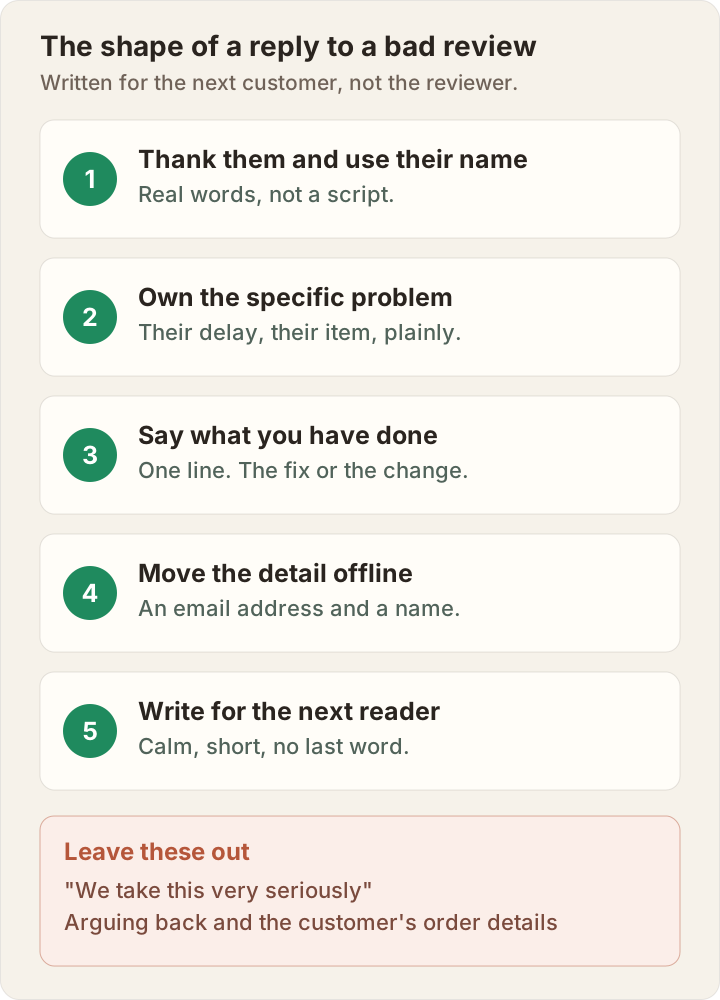
- Thank them and use their name. Even when the review is harsh. "Thanks for the feedback, Dan" reads like a person. "Dear valued customer" reads like a legal department.
- Own the specific problem. Name what actually went wrong in plain words. Vague regret tells the next reader you did not really read the review.
- Say what you have done. One line on the fix or the change. This is the sentence the next customer is scanning for.
- Move the detail offline. Give a real email address and a name to ask for. The order-number conversation does not belong on the public page.
- Write for the next reader. Calm, short and finished. You are not trying to win the exchange. You are trying to be the reasonable one on the page, because that is who the next customer buys from.
The mistakes that make a bad review worse
- Arguing the facts. Even when you are right. A point-by-point rebuttal wins the argument and loses the reader, who only remembers that the business argues with customers in public.
- "We take this very seriously." The most copied phrase in review replies and the emptiest. If you took it seriously, the reply would name the problem and the fix.
- Pasting the same reply under every review. Review pages are read as a page. Five identical replies stacked on top of each other tell the next customer that nobody is actually listening.
- Sharing the customer's details. Never confirm order history, addresses or anything personal in public, even to correct the record. It can put you on the wrong side of privacy law and it always reads as retaliation.
- Replying angry. The review will still be there in two hours. Draft it, leave it, then cut the first sentence you wrote while hot. It was for you, not for them.

Reply templates for negative reviews
Seven templates for the reviews that actually turn up. These are public replies rather than emails. There is no subject line. Swap the bracketed parts for real details and rewrite anything that does not sound like you. If two of these ever sit on the same page word for word, they stop working. If you are building a set of standard replies, the guide on building a reply library pairs well with this one.
Hi [name], thank you for taking the time to write this. You are right. Your order should not have [arrived late / arrived damaged] and I am sorry it did. We have [the change you made] so it does not happen to the next order. If anything is still unresolved, email me at [address] and ask for [your name]. I will sort it personally.
[Your name], owner
Hi [name], I am sorry the delivery let your order down. You ordered in good time and it should have been with you by [date]. The delay happened with the courier. It is still our problem rather than yours. We have [raised it with them / moved the service we use] and if the parcel has still not arrived, email [address] and I will chase it today.
[Your name], [store name]
Hi [name], thank you for the honest feedback on [product]. It clearly did not live up to what you expected and I am sorry about that. Your notes have gone straight to [the maker / our supplier] and we have [the change]. I would also like to put it right for you. Email [address] with your order number and we will take care of it.
[Your name]
Hi [name], thank you for the kind words about [the good part]. You are also right about [the problem part] and that is the bit I care about fixing. [One line on the change.] I hope the next order earns the rest of the stars.
[Your name], [role]
Hi [name], I am sorry you came away this frustrated. I do want to be accurate for anyone reading: [one plain fact, stated once and without heat]. If I have any part of that wrong, email me at [address] and I will put it right. Either way I am sorry the experience ended with you feeling like this.
[Your name], owner
Hi, we have not been able to match this review to any order or customer. If you are a genuine customer, please email [address] with your order details and I will look into it straight away. If this review was meant for a different business, we would appreciate it being amended.
[Your name], [store name]
Hi [name], I am sorry. This should have been fixed in one email instead of ending up here. I have just [refunded the order / sent the replacement / emailed you directly] and the details are in your inbox. Once it is sorted, an updated review would mean a lot, though the fix is yours either way.
[Your name]
Template six deserves one extra step. Alongside the public reply, report the review through the platform itself. Each of the big ones has a route for it: Google through your Business Profile, Trustpilot through its flagging tool, Yelp through the report option on the review. Keep the factual public reply up while you wait, because reports take days and the page keeps being read in the meantime.
How fast to reply
Within a couple of days is the sweet spot. Fast enough that the review never sits unanswered at the top of your page while it is freshest and most read. Slow enough that you never reply in the first heat. If the situation needs investigating, a short holding reply beats silence: thank them, say you are looking into it and give the email address. Then come back and edit once you know the full story.
Can you get a bad review taken down?
Not for being bad. Google, Trustpilot and Yelp only remove reviews that break their rules: fake or paid reviews, spam, competitors or ex-employees with a conflict of interest, abuse and off-topic rants. Report those through the platform and be patient. Everything else stays up, however unfair it feels. A genuine one-star from a real bad day cannot be appealed away. It can only be outweighed, by the rating around it and by the reply underneath it.
The habit that makes this easy
None of this is hard once. It is hard the fourth time in a month, when the review is unfair, it is 9pm and everything you type sounds either grovelling or defensive. That is the moment replies get skipped. An unanswered bad review quietly costs more than the review itself.
The other half of a healthy review page is volume and volume comes from asking. The guide on how to ask customers for reviews covers the right moment, the platform rules and the templates for the ask itself.
The fix is the same as for any difficult message: a structure you trust and a draft that starts in your voice instead of a blank box. That is the job ReciteMail does. Screenshot the review and add a one-line note like "own the delay, keep it warm, hand them my email". You get back a calm reply in your own voice to read, adjust and paste into the reply box. The private follow-up email that often comes next is the same three clicks.
The public reply and the private fix are different messages. The reply under the review is for the audience. It stays short and free of order details. The actual repair happens in email, where the order numbers, dates and amounts belong. For that second message, the apology email templates cover the relationship side. If money is moving, the refund request templates cover the rest.
Common questions
Should you respond to every negative review?
Yes. Reply to every negative review and to as many positive ones as you can manage. In BrightLocal's Local Consumer Review Survey, 88 percent of consumers said they would use a business that replies to all of its reviews. Only 47 percent said the same about a business that never replies. The reply is not really for the reviewer. It is for everyone who reads the page after them.
How long should a reply to a negative review be?
Three to five sentences. That is long enough to thank them, own the specific problem, state the fix and hand over an email address. Anything longer starts to read as defensive. A reply that outruns the review usually looks like an argument to the next person scrolling past.
Can you get a negative review removed?
Not for being negative. Google, Trustpilot and Yelp only remove reviews that break their rules, such as fake reviews, spam, conflicts of interest or abuse. You report those through the platform itself. A genuine review of a real bad experience stays up. The reply underneath it is the tool you control.
Should you offer a refund or discount in a public reply?
No. Keep money off the public page. A visible payout under a harsh review quietly teaches people what a harsh review earns, which invites more of them. Acknowledge the problem publicly, move the conversation to email, then sort the refund or gesture privately.
Reply to every review in your own voice
ReciteMail turns a screenshot of a review into a calm, specific reply in seconds, written the way you actually talk to customers. You read it, adjust it and paste it in. Free for 7 days, no credit card and no connection to your inbox.
Start your free trial