How to Reply to a Supplier Price Increase Email
Published 30 October 2026 · 5 minute read · The ReciteMail Blog
The email arrives on a Tuesday: "Due to rising costs, our prices will increase by 8% from 1 December." For a small online store or a business that buys stock from a handful of suppliers, that 8% might be most of the margin on some lines. The reflex is one of two replies. Accept it with "no problem, thanks for letting us know", which signals that the next increase will be accepted too. Or fire back about how unreasonable it is, which damages a relationship you depend on. Neither gets you anything. There is a better reply and it takes five minutes.
What you are actually negotiating
Usually not the increase itself. Suppliers rarely put prices up for fun and most will not reverse a rise because one customer asked. What is negotiable is almost everything around it: when it starts, whether it applies to orders you have already placed, whether it comes in all at once or in stages and whether a bigger or longer commitment earns a better rate. That is where small businesses leave money on the table. They argue about the number they cannot move and never ask about the terms they can.
The four steps
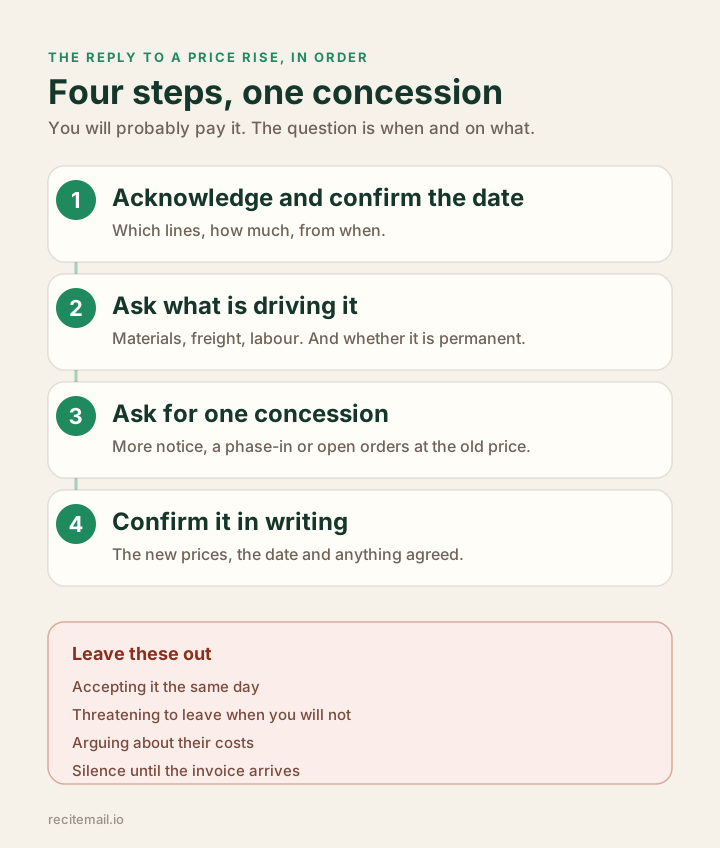
- Acknowledge it and confirm the date. Thank them for the notice. Check which products it covers, by how much and from which date. Suppliers sometimes send a blanket notice when only some lines are going up.
- Ask what is driving it. Raw materials, freight, energy, wages. It is a fair question and the answer tells you whether this is a one-off or the first of several. It also tells you whether to look for a second supplier.
- Ask for one concession. One, not five. More notice, a phase-in over two or three months, open orders at the old price or a better rate for a larger order. One clear ask is far more likely to get a yes.
- Confirm it in writing. Whatever you agree on the phone or by email, set it out in one short message: the new prices, the start date and the concession. Our guide to confirming an agreement by email has the five lines.

Three example replies
Subject: Re: Price update from 1 December
Hi Mark, thanks for letting us know. Understood on the 8% from 1 December. Could you confirm it covers the full range, including the 500ml bottles? One request: our December prices are already printed and live on the site for the Christmas period. Would you be able to hold the current prices for us until 1 January? We would then move to the new list for the January order. We have been ordering monthly for three years and plan to keep doing so.
Best regards,
Leah
Subject: Re: Price increase notice
Hi Mark, thanks for the notice. Before the new prices start, we have PO 2214 open with you for 1,200 units, placed on 14 October at the current list price. Can you confirm that order will be invoiced at the price it was placed at? From 1 December we will order at the new prices. If you can share what is behind the increase, that would also help us plan, whether it is materials, freight or something else.
Best regards,
Leah
Subject: Re: New prices from 1 December
Hi Mark, thanks for this. The 8% on most lines makes sense given what we are seeing elsewhere. The 22% on the gift boxes is a lot higher and I wanted to ask about it before we plan our spring range. Is that driven by something specific to the boxes? If it would help, we can commit to ordering the boxes quarterly instead of monthly, which might bring the rate down. Could we have a quick call this week?
Best regards,
Leah
The mistakes that cost money
- Accepting it the same day. It tells the supplier the price was never a concern. Take a day, check your margins and reply with your question and your one ask.
- Threatening to leave when you will not. If they call the bluff, you either leave a supplier you need or stay with less credibility. Only mention other suppliers if you have actually priced them.
- Arguing about their costs. You do not know their costs and they will not show you. Ask what is driving it, then move on to the terms.
- Silence until the invoice arrives. Saying nothing is accepting it. If you want anything different, you have to ask before the start date.
If you are the one putting prices up, our price increase email templates cover the other side of this email. If the supplier goes quiet after you reply, see our guide to chasing a supplier by email.
Firm, not rude
The tone is the hard part. Too soft and you get nothing. Too sharp and you sound like you are spoiling for a fight. ReciteMail has a separate supplier mode for exactly this. Snip the supplier's price notice, switch the target to supplier and say "thank them, confirm it covers the 500ml, ask to hold current prices until January because December is printed, mention three years of monthly orders". The reply comes back in your voice, firm and polite, with their product names and dates in it. You read it and send it from your own email. It runs on your PC and never connects to your inbox. This 40 second video shows the flow.
You will probably pay the new price. The question is when and on what. Acknowledge it, ask what is behind it, ask for one thing and confirm it in writing. ReciteMail drafts supplier replies in a firmer tone than customer ones, from a snip of the supplier's email. See ReciteMail for online stores.
Common questions
How do you respond to a supplier price increase?
Thank them for the notice, confirm which products and dates it covers, ask what is driving it and ask for one concession such as more notice, a phase-in or open orders at the old price. Confirm whatever you agree in writing before the new prices start.
Can you negotiate a supplier price increase?
Usually not the increase itself. Often the terms around it: the start date, whether existing orders are honoured at the old price, whether it is phased in and whether a larger or longer commitment earns a better rate. Ask for one of these, clearly, before the start date.
Should you accept a supplier price increase straight away?
No. Take a day to check what it does to your margins and whether the increase covers every product. Accepting on the same day signals that price is not a concern and makes the next increase easier for them.
How do you ask a supplier to delay a price increase?
Give a specific reason and a specific date. For example, explain that your prices are fixed until the end of the month and ask to move to the new list from the first order after that. Mention your order history if it is long and regular.
The supplier reply, firm and polite, in under a minute
Snip the supplier's email, switch to supplier mode and say what you want. ReciteMail writes the reply in your own voice with their products and dates in it. It runs on your PC and never connects to your inbox. Free for 7 days, no card needed.
Start your free trial