Candidate Rejection Email Templates: 7 Kind Examples
Published 14 August 2026 · 8 minute read · The ReciteMail Blog
Every hire you make means a stack of people you did not. Most businesses handle that stack with silence, which feels easier and costs more than any email could. Rejected candidates talk, review and buy. Many of them will apply again, refer a friend or sit across a negotiating table from you in five years. This is the shape of a rejection that keeps their respect, the timing that matters more than the wording, plus seven copy-paste templates for every stage of the process.
Silence is the most expensive rejection
Ghosting is now the default experience of job seeking. In Greenhouse's most recent candidate experience survey, 53 percent of job seekers said an employer had ghosted them in the past year and 61 percent of interviewed candidates reported being dropped without a word after the interview itself. Candidates notice, then they talk. The same research found people who were ghosted were around 37 percent less likely to buy from that company afterwards.
The flip side is just as measurable. Talent Board's candidate experience research has found for years that the companies rated best by candidates share one habit: they close the loop within three to five days of a decision, at every stage. A fast, kind no is remembered as professionalism. A slow no is remembered as disrespect and no answer at all is remembered loudest.

The shape of a kind rejection
A good rejection email is short. Five beats, five or six sentences, done. Length does not soften a no. Clarity and warmth do.
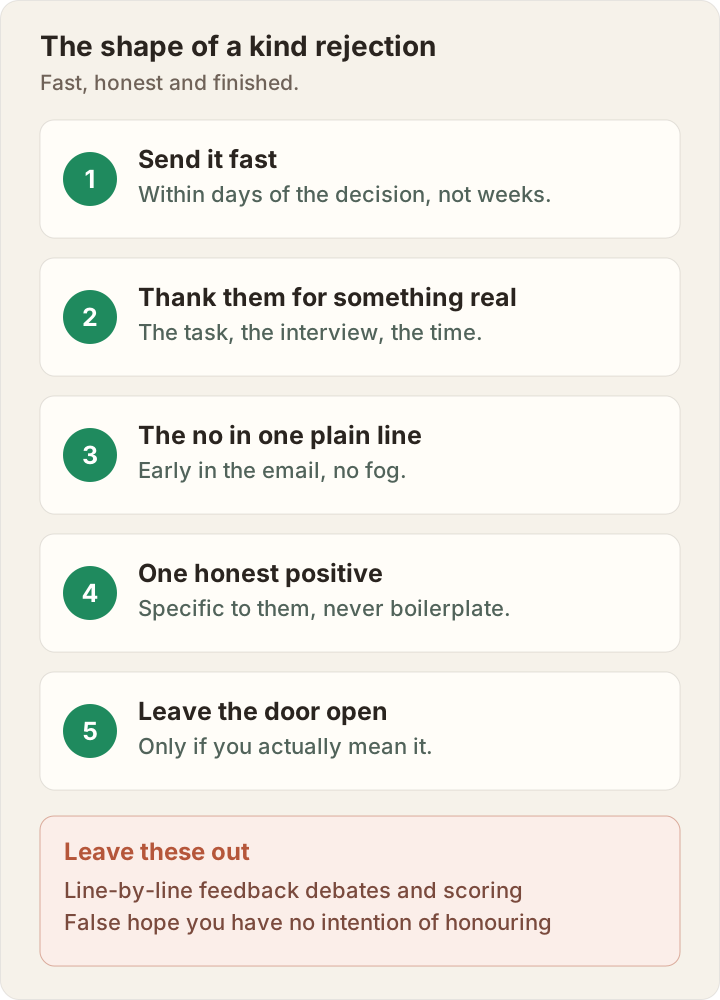
- Send it fast. Within three to five days of the decision. The kindest wording in the world cannot repair three weeks of silence before it.
- Thank them for something real. The application, the interview, the take-home task. Name the thing that cost them effort.
- The no in one plain line. Early in the email. "We will not be moving forward with your application" hurts less than three paragraphs of throat-clearing that end in the same place.
- One honest positive. Specific to them. The portfolio piece, the thoughtful question, the way they handled the case study. One line and only if true. Skip it entirely rather than fake it.
- Leave the door open only if you mean it. "We would genuinely like you to apply for the next opening on this team" is a gift. The same sentence as boilerplate is noise and candidates can tell.
The mistakes that undo a kind rejection
- The instant auto-reject. A no that lands minutes after the application or at two in the morning tells the candidate no human ever looked. Even automated screening deserves a delay and business hours.
- The unmistakable merge-blast. Wrong name, wrong role, "Dear applicant". One wrong field and the whole email reads as contempt.
- Line-by-line feedback. Detailed scoring invites a debate you cannot win and in some cases creates legal exposure. One structural reason is generous. A rubric is a trap.
- False hope. "We will keep your CV on file" when the file is a bin. If there is no realistic future, warmth plus finality is kinder than a vague maybe.
- Ghosting the final rounds. The later the stage, the more the silence stings and the more likely it ends up on Glassdoor with your company name attached.

Candidate rejection templates
Seven templates for the rejections that actually come up. Swap the brackets, keep the one specific line about them and adjust the warmth to the stage. The more of their time you took, the more personal the email owes them.
Subject: Your application to [company]
Hi [name], thank you for applying for the [role] position. We read every application and this time we will not be taking yours further. The field was strong and the decision came down to closer matches with the specific experience the role needs. We appreciate the time you took and wish you every success with the search.
[Your name], [company]
Subject: Following up on your interview
Hi [name], thank you for taking the time to talk with [interviewer] on [day]. We enjoyed the conversation, particularly [one specific thing they said or showed]. After careful thought we have decided not to move you to the next stage. Other candidates matched the [skill or experience] the role leans on more closely. We know interviews take real preparation and we are grateful for yours.
[Your name], [company]
Subject: Our decision on the [role] position
Hi [name], thank you for the time and energy you gave us across the whole process. This was a genuinely close decision and it went to another candidate whose background in [area] edged it. I want to be clear that [one honest, specific strength] impressed the whole panel. If you would find a short call useful, I am happy to share more context. I hope our paths cross again and I mean that.
[Your name], [role]
Subject: Your [role] task and our decision
Hi [name], thank you for the work you put into the task. We know it took hours of your own time and it was reviewed properly by [who]. We will not be moving forward, as other submissions sat closer to what the role needs day to day. One thing worth keeping: [one specific strength of their submission]. We are grateful for the effort and wish you well.
[Your name], [company]
Subject: An update on the [role] position
Hi [name], I owe you an update. The [role] position has [been closed / changed significantly] since you applied, which means the process is ending for reasons that have nothing to do with your application. I am sorry for the time you have spent on it. If the role reopens in its original shape, you would be one of the first people I contact.
[Your name], [company]
Subject: Not this role, hopefully not the last conversation
Hi [name], the [role] decision went another way and I did not want that to be the end of the conversation. Your [specific strength] is exactly what this team will need as it grows. We expect to open [likely role] within [timeframe] and with your permission I will contact you directly when we do. Thank you for a genuinely strong process.
[Your name], [role]
Subject: Re: [their subject]
Hi [name], of course. Thank you for asking so graciously. The honest answer is [one structural reason: the stronger match, the missing experience, the level the role needed]. It was not about [reassurance on what it was not, if true]. For what it is worth, [one genuine strength] stood out and I would lead with it in your next process. Wishing you the best with the search.
[Your name]
The feedback question
Offer brief feedback to anyone who interviewed. Keep it structural rather than personal: the closer match, the specific experience the role needed, the level the team was hiring at. One or two sentences, honestly meant. Do not share interviewer scores, do not compare them to the winning candidate by name and do not get drawn into a reply-by-reply debate about the decision. The decision is made. The feedback is a parting gift, not a negotiation.
The habit that makes this survive volume
Nobody sets out to ghost candidates. It happens at volume, when there are forty nos to send, each one deserves three personal sentences and the blank box wins. The same failure produces the same silence in every busy inbox, which is why the fix looks the same here as it does for saying no to a client: a structure you trust and a draft that starts in your voice.
That is the job ReciteMail does. It learns how you write from emails you have already sent, then turns a one-line note like "reject after final round, genuinely close, strong on systems design, keep in touch for the platform role" into a warm, specific email that sounds like you rather than an applicant tracking system. Candidate forty gets the same care as candidate four. And because it runs on your own machine with no connection to any mailbox, candidate details stay exactly where they should.
Recruiters and HR teams run this at scale. Rejections, offers, interview scheduling and reference requests are the same twenty emails at volume, each one needing to sound like a person. ReciteMail drafts all of them in your voice with reusable templates that adapt to each candidate, private by architecture because it never connects to a mailbox.
Common questions
Should you reject a candidate by email or by phone?
Email is fine for application-stage and early-interview rejections. For a final-round candidate who spent hours with your team, a phone call is worth the discomfort. Talent Board research found rejection by phone lifts a candidate's rating of the experience by around a third compared with an automated email. If you cannot face the call, a personal email that names their interview beats a merge-blast every time.
How quickly should a rejection email be sent?
Within three to five days of the decision. That is the pace the companies rated best for candidate experience actually hold themselves to. The one exception is application-stage rejections: never send them within minutes of the application arriving, because an instant no at two in the morning tells the candidate nobody ever looked.
Should you give rejected candidates feedback?
Offer it briefly to anyone who interviewed and keep it structural: the skill gap, the closer match, the experience the role needed. One or two honest sentences. Never score them line by line and never get drawn into a debate, which helps nobody and creates risk. For application-stage rejections at volume, honest feedback is not realistic and a warm, fast no is enough.
Is it unprofessional to use a rejection template?
No, provided the template is adapted. Use their name, name the role and include one line that could only be about them, such as the project they presented or the question they asked. What reads as unprofessional is the unmistakable merge-blast or, worse, no email at all. An adapted template sent in three days beats a handcrafted email sent in three weeks.
Forty kind rejections before lunch
ReciteMail drafts rejections, offers and every candidate email in your own voice, learned from mail you have already sent. It runs on your PC, never connects to your inbox and candidate details never leave your machine. Free for 7 days, no card needed.
Start your free trial