How to Ask for Referrals by Email: 6 Templates
Published 31 August 2026 · 8 minute read · The ReciteMail Blog
Here is the strangest gap in small business marketing. Survey after survey finds that the overwhelming majority of happy customers say they would gladly refer you, yet only a small fraction ever do it unprompted. Not because they changed their minds. Because it never crossed theirs. Your best salespeople are sitting in your sent folder waiting for one polite sentence and most businesses never send it. Here is when to ask, how to word it so it feels like a favour between equals, plus six copy-paste templates.
Why the ask does all the work
A referred customer is the best customer there is. They arrive pre-sold by someone they trust, they haggle less, they stay longer and they cost you nothing to acquire. Everyone knows this. What the numbers show is how little of that goodwill converts on its own: happy customers overwhelmingly say yes when researchers ask "would you refer?" and overwhelmingly fail to do it in real life. One widely cited industry figure puts it around 83 percent willing against 29 percent who actually do.
The missing ingredient is not satisfaction. It is a trigger. Your customer is not thinking about your pipeline while they get on with their life so the referral happens only when something surfaces it: their friend mentions needing a plumber or your email lands asking the question. You control exactly one of those. The ask is not pestering. It is the difference between word of mouth as a business channel and word of mouth as an occasional accident. It sits in the same family as asking for reviews: the happy customer does the marketing but only after you make the ask.

The shape of a referral ask
Every version that works runs the same five moves.
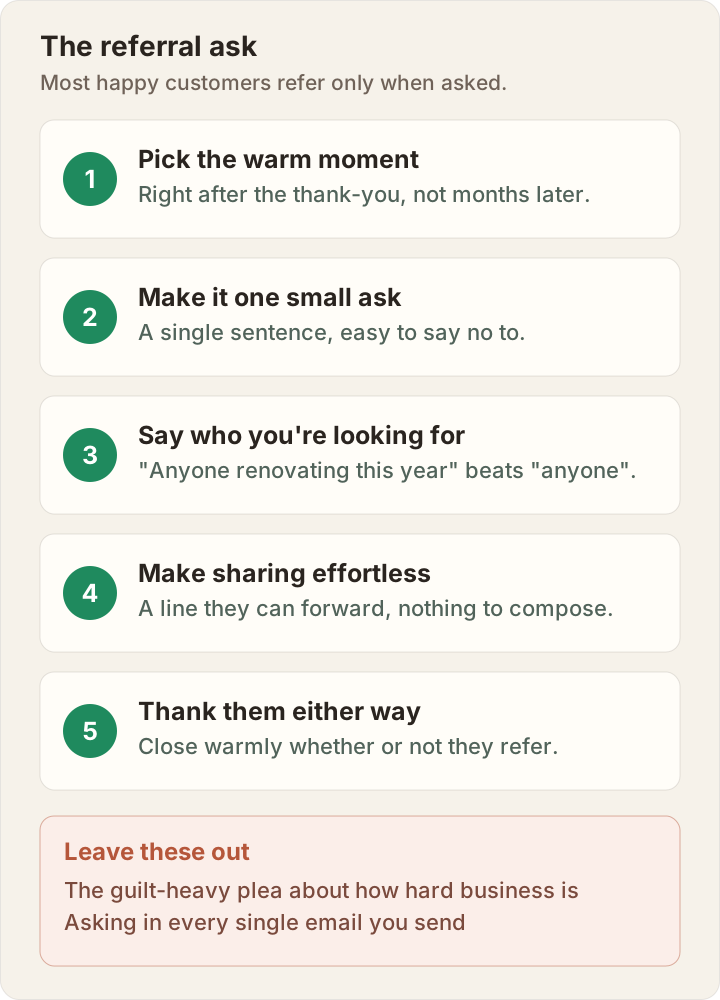
- Pick the warm moment. Right after the thank-you email, the delivered job or the five-star review. Referral intent decays by the day so the ask that follows a thank-you within a day converts several times better than the one sent a month later.
- Make it one small ask. A single sentence that is easy to say no to. Pressure kills referrals; lightness earns them.
- Say who you are looking for. "Anyone else planning a renovation this year" gives their memory something to search. "Anyone who might need us" gives it nothing.
- Make sharing effortless. Include one forwardable line about what you do so referring is a ten-second forward rather than a composition exercise.
- Thank them either way. Close warmly whether or not they refer and when one lands, thank them properly. A referrer who feels appreciated becomes a repeat referrer.
The mistakes that make it awkward
- The guilt-heavy plea. "Small businesses like ours really depend on..." turns a favour into an obligation. Confidence converts; neediness repels.
- Asking everyone in every email. A referral line in your signature that never changes becomes wallpaper. Save the ask for the customers who just had a great experience and it stays a genuine question.
- The homework ask. "Write a short introduction to anyone you think suitable" is a task. "Forward this to them" is a favour. Do the composing for them.
- The bounty headline. Leading with "GET £50 PER FRIEND" makes your customer a commission agent. If you reward referrals, reward both sides and mention it after the ask, as a thank-you rather than a deal.
- Vanishing after the referral. A customer who sends you a friend and hears nothing back has done you a favour into a void. That thank-you email is the most profitable two minutes of the whole system.

Referral request templates
Six templates for the moments a referral ask actually fits. Swap the brackets, keep it to your voice and remember the rule: one sentence of ask, zero sentences of pressure.
Subject: Re: [their thank-you]
Hi [name], that's really kind, thank you, messages like this are why we do it. Can I ask one small favour while you're pleased with us? If you know anyone else who [specific situation, e.g. is planning a bathroom this year], I'd love an introduction and a simple forward of this email does the job. Either way, thank you again, it was a pleasure working with you.
[Your name], [business]
Subject: All finished and one small ask
Hi [name], the [job] is done and I hope you're as pleased with it as we are. Everything carries our [guarantee/aftercare] so shout if anything needs a tweak. One small ask before I go: most of our work comes from customers passing our name along. If a neighbour or friend mentions needing [service], we'd love the introduction, [phone/email] is all they need. Thanks for having us, it was a good one.
[Your name], [business]
Subject: Thank you for your review
Hi [name], I've just read your review and it made the whole team's day, thank you for taking the time. Since you know first-hand what we're like to work with, may I ask one more small thing? If anyone in your circle is looking for [service], an introduction from you would mean more than any advert we could run. No pressure at all and thank you again for the kind words.
[Your name], [business]
Subject: If anyone you know needs [service]
Hi [name], it's been great working with you this year. If someone you know is looking for [service], here's a line you can send them as-is so it takes ten seconds rather than ten minutes:
"[Business] handled our [job] and they were excellent: [one concrete thing, e.g. on time, tidy and the quote was the final price]. If you need [service], talk to [first name]: [email/phone]."
That's it, no obligation whatsoever. Thanks for being a customer we can count on.
[Your name], [business]
Subject: A thank-you for introductions
Hi [name], a quick note about something we've started. When a customer sends a friend our way, the friend gets [their benefit, e.g. 10 percent off their first job] and you get [referrer thank-you, e.g. £25 off your next visit] as a thank-you from us. There's nothing to sign up for: they just mention your name when they book. You've been brilliant to work with and if anyone you know needs [service], we'd love to look after them the way we've looked after you.
[Your name], [business]
Subject: [Friend's name] found us through you, thank you
Hi [name], I wanted you to know that [friend's first name] got in touch and mentioned you'd sent them our way. Thank you, genuinely: an introduction from a customer is the biggest compliment this business can get. We'll look after them properly, you have my word. [If applicable: your [thank-you] is on your account for next time.] Hope all is well with the [their job] and see you soon.
[Your name], [business]
Make it a habit, not a campaign
The businesses that grow on referrals do not run referral drives. They attach the ask to moments that already happen: every completed job gets template 2, every thank-you gets template 1, every landed referral gets template 6 the same day. Three small habits, each riding an email you were sending anyway. Pair it with the review ask sensibly, one ask per moment rather than both at once and give new arrivals a proper welcome, because a referred customer who is looked after brilliantly becomes the next referrer. That is the whole flywheel and it runs on nothing but good work and polite emails.
The ask you keep meaning to send
Nobody objects to any of this in principle. The referral ask dies in practice, at 6pm, when writing one more email that has to sound warm rather than needy feels like one email too many. So the moment passes, the thank-you goes unanswered until Thursday and the warmest window your business had closes quietly. The gap between businesses that grow on word of mouth and businesses that stay a secret is rarely the quality of the work. It is whether the sentence got sent.
That is the job ReciteMail does. It learns how you write from emails you have already sent, then turns a one-line note like "thank Dana for the review, ask if anyone she knows is renovating" into a warm, natural ask that sounds like you on your best day. The moment stays caught. And because it runs on your own machine and never connects to any mailbox, your customer relationships stay yours alone.
Trades, agencies and clinics grow on referrals. The ask, the review request, the welcome and the follow-up are the same warm emails at volume, each one easiest to skip on a busy day. ReciteMail drafts all of them in your voice, private by architecture because it never connects to a mailbox. See ReciteMail for trades and ReciteMail for agencies.
Common questions
When is the best time to ask a customer for a referral?
In the warmth of a good moment: right after they thank you, right after the job lands well or right after a glowing review. Referral intent decays fast so an ask within a day of the thank-you converts far better than one sent a month later. The worst times are mid-problem, mid-invoice or so long after the work that they have to remember why they liked you.
How do you word a referral request without sounding desperate?
One sentence, easy to decline, specific about who you are looking for. Something like: "if you know anyone else planning a renovation this year, I would love an introduction". No essay about how hard small business is and no pressure. Confidence converts and neediness repels so the ask should sound like a favour between equals rather than a plea. Then make sharing effortless by giving them a line they can forward.
Should you offer a reward for referrals?
It can work, with two rules. Reward both sides, because a discount for the friend plus a thank-you for the referrer feels generous while a one-sided bounty makes your customer feel like a salesperson. And keep it a thank-you rather than a bribe: modest, mentioned after the ask, never the headline. Many of the best referral relationships run on no incentive at all beyond good work and a proper thank-you.
Why do happy customers not refer without being asked?
Not because they are unwilling. Industry surveys repeatedly find a large majority of satisfied customers say they would happily refer, while only a small fraction ever do it unprompted. Referring simply never crosses their mind unless something triggers it and your ask is that trigger. The gap between "would refer" and "did refer" is one polite email, which is why businesses that ask consistently grow on word of mouth while equally good ones that never ask stay a secret.
The warm ask, sent while the moment is warm
ReciteMail drafts referral asks, review requests and every relationship email in your own voice, learned from mail you have already sent. It runs on your PC, never connects to your inbox and customer details never leave your machine. Free for 7 days, no card needed.
Start your free trial