Client No-Show Email: 7 Templates (Kind, Firm, Paid)
Published 30 August 2026 · 8 minute read · The ReciteMail Blog
The 2pm did not come. The chair sat empty, the room stayed set up and the hour is gone whether anyone paid for it or not. Salons and clinics typically lose one appointment in six or seven this way. For a small practice that quietly adds up to tens of thousands a year. The email you send in the next few hours decides which kind of loss it becomes: a client who rebooks a little sheepishly or a client too embarrassed to ever come back. Here is the follow-up that recovers them, when a fee is fair, plus seven copy-paste templates.
Why the kind email wins
Almost nobody no-shows on purpose. It is a sick child, a dead phone battery, a shift that ran over, a reminder that went to the wrong address. The client already knows they let you down and most of them are dreading your reaction, which is exactly why the wrong email loses them: open with the wasted hour and coming back now means facing a telling-off. They solve the awkwardness by finding a new hairdresser, physio or accountant instead.
The counterintuitive move is to lead with concern. "We missed you today, is everything okay?" costs you one sentence of pride and it does two jobs at once: it gives the honest majority a graceful way back in and it quietly documents the miss for the rare repeat offender. The firmness comes later, in the policy and the deposit, never in the tone. It is the same trick that makes a good payment reminder work: assume the kind explanation out loud and let the paperwork be the tough one.
The shape of a no-show follow-up
Every good version runs in the same order, whatever you charge.
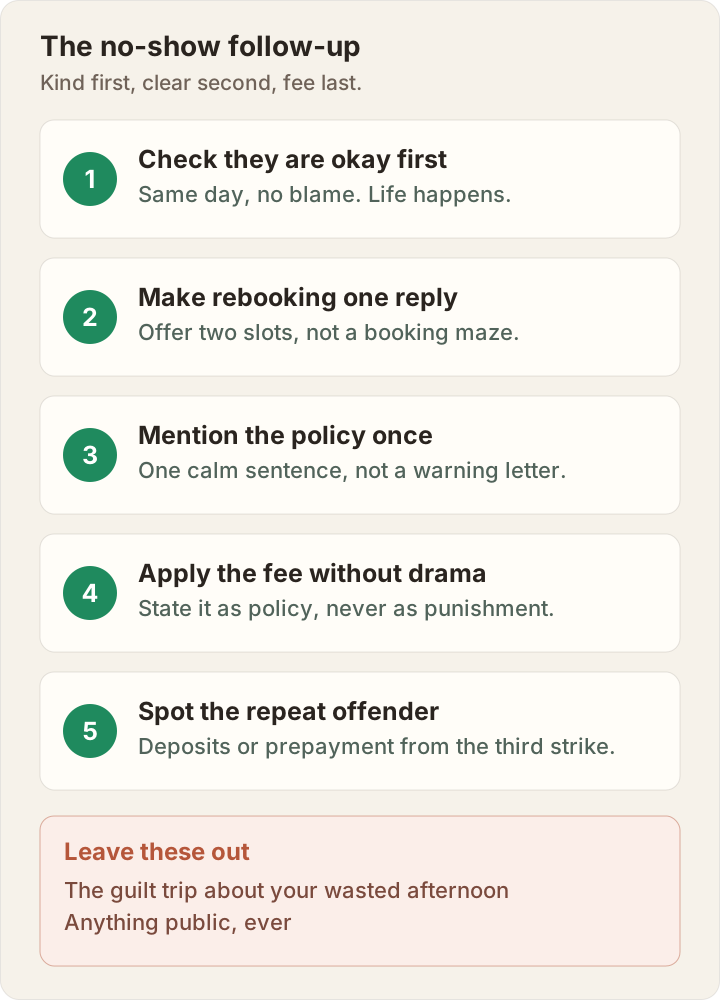
- Check they are okay first. Same day, no blame. One sentence of concern converts more rebookings than any policy ever written.
- Make rebooking one reply. Offer two concrete slots rather than a link into a booking maze. The easier the way back, the fewer clients quietly disappear.
- Mention the policy once. A single calm sentence and only if a policy actually exists. Repeating it three times turns a reminder into a warning letter.
- Apply the fee without drama. When it applies, state it as the policy working, not as a punishment you have decided to hand out. Anger has no place in an invoice.
- Spot the repeat offender. By the third miss the problem is not communication. Move them to deposits or prepayment and let the money do the enforcing.
The mistakes that lose the client twice
- The guilt trip. "We turned two people away for that slot" may be true and it converts nobody. The client cannot un-miss the appointment. All guilt does is make the exit cheaper than the return.
- The surprise fee. A charge the client first hears about after the miss reads as a fine invented in anger, whatever the number. Fees only feel fair when the policy was visible at booking.
- Anything public. Naming no-shows on social media feels great for an afternoon and reads as unhinged to every future customer who scrolls past it. All enforcement happens in private, always.
- The instant invoice with no words. A fee that arrives before any human sentence turns a lapse into a dispute. Concern first, fee second, even when the fee is certain.
- Silence. Sending nothing feels gracious and it is how you lose the honest ones: no route back in, no policy on record and the same gap in next month's diary.
No-show email templates
Seven templates covering the ladder from first miss to firm terms. Swap the brackets, keep the tone yours and remember the order: kind first, clear second, fee last.
Subject: We missed you today
Hi [name], we had you down for [time] today and I hope everything is okay, these things happen to all of us. If you'd like to rearrange, I have [slot one] or [slot two] free this week, just reply with whichever suits and I'll book you straight in. Look forward to seeing you.
[Your name], [business]
Subject: We missed you today, no charge this time
Hi [name], sorry to have missed you at [time] today, I hope all is well. Our missed-appointment policy normally carries a [amount] charge but as this is your first time I've waived it, life happens. For future visits, anything cancelled with [24/48] hours' notice is always free to move. Would [slot one] or [slot two] work to rebook? Reply and I'll hold it for you.
[Your name], [business]
Subject: Your missed appointment on [date]
Hi [name], we missed you at [time] on [date] and I hope everything is alright. As per the booking policy you agreed to when booking, missed appointments without notice carry a [amount] charge, which I've added to your account [or: which is attached as an invoice]. I'd genuinely rather see you than charge you. If you'd like to rebook, [slot one] or [slot two] are open. And if something serious got in the way, reply and tell me, I'm always happy to take that into account.
[Your name], [business]
Subject: Rebooking your appointment, one small change
Hi [name], we missed you again on [date] and I completely understand that diaries get chaotic. Because that's two missed slots now, future bookings will need a [amount] deposit to hold the time, which comes straight off your bill on the day. It's nothing personal, an empty slot is simply an hour another client asked for and didn't get. If that works for you, [slot one] or [slot two] are free and the deposit link is here: [link].
[Your name], [business]
Subject: Missed you today, hope all is well
Hi [name], not like you to miss one so mostly I just wanted to check everything is okay. No charge and nothing to apologise for, your record with us has earned that many times over. Whenever you're ready, reply with a day that suits and I'll fit you in, including [a slot you know they like] if that helps.
[Your name], [business]
Subject: We came to [address] today at [time]
Hi [name], I was at [address] for our [survey/consultation] at [time] today but couldn't get an answer at the door or by phone. No problem if something came up, it happens. I'm keen to keep your job moving so I can come back [option one] or [option two]. Because a wasted visit costs us a morning, a second missed visit would carry a [amount] call-out charge but let's assume it won't come to that. Which day works?
[Your name], [business]
Subject: How we book your appointments from here
Hi [name], I'll be straight with you because I'd rather keep you as a client than lose you to an awkward silence. That's [number] missed appointments now and each one is a slot another client wanted. From here I can only book you in with full prepayment, refundable any time you cancel with [notice period] notice. If that works, you're as welcome as ever and we'll say no more about it. If it doesn't, no hard feelings at all and thank you for the visits we've had.
[Your name], [business]
Preventing the next empty chair
Follow-ups recover no-shows. Reminders prevent them and prevention is where the real money is: practices that added easy confirm-or-cancel reminders consistently cut their miss rate, partly because making it easy to cancel converts silent no-shows into polite reschedules you can refill. A good sequence is boringly simple: confirmation at booking with the policy in it, a reminder a few days out and another the day before, each one making "reply to move it" a single step. The clients this filters out were never coming and now you know in time to fill the slot.
The fourth no-show this week
One kind follow-up is easy. The fourth one this week, written at closing time about an hour you will never bill, with the warmth still intact, is the hard part. That is when the guilt trip sneaks into the wording, not because you are unkind but because you are tired and the blank reply box does not care. The fix is the same as for every recurring hard email: a shape you trust and a draft that starts in your voice.
That is the job ReciteMail does. It learns how you write from emails you have already sent, then turns a one-line note like "no-show 2pm Mrs Patel, first time, waive fee, offer Thursday or Friday" into a warm, specific follow-up that sounds like you on your most patient day. And because it runs on your own machine and never connects to any mailbox, client and patient details never leave your desk.
Clinics, salons and trades live this weekly. No-show follow-ups, appointment reminders, payment chases and polite nos are the same dozen emails at volume, each needing to sound like a person who cares. ReciteMail drafts all of them in your voice, private by architecture because it never connects to a mailbox. See ReciteMail for clinics and ReciteMail for trades.
Common questions
What should you say when a client does not show up?
Lead with concern, not the missed slot. Say you missed them, ask if everything is okay and offer two specific times to rebook. Most no-shows are chaos rather than disrespect: a sick child, a dead phone, a diary that never synced. The email that assumes the kind explanation gets the rebooking. The email that opens with the wasted hour gets silence, because now coming back means facing a telling-off.
Should you charge a no-show fee?
Only if the policy existed before the miss and the client saw it when they booked. A fee announced after the fact reads as a fine invented in anger. Charged fairly, fees are increasingly normal: an MGMA poll in January 2025 found 42 percent of medical practices now use one. Salons and clinics typically set theirs between a token amount and the full cost of the slot. Waive it generously for a first miss with a good reason and apply it without drama from the second.
How do you word a no-show policy?
Two sentences, stated at booking: cancellations need a set notice period, usually 24 or 48 hours. Missed appointments without notice carry a set fee or the loss of a deposit. Keep the wording factual and visible everywhere someone books, then let the confirmation and reminder emails repeat it once each. A policy that only appears when it is being enforced always feels unfair, however reasonable the number is.
What do you do about repeat no-shows?
Change the booking terms rather than the tone. From a second or third miss, ask for a deposit or full prepayment to hold the slot and say why in one plain sentence: missed appointments cost the slot for someone else. Keep the warmth, keep the client if they accept the terms and let the deposit do the enforcing. A repeat offender who will not put money down was never going to show anyway. If a good client drifts away after a miss despite your best follow-up, the win-back email is the next move.
Every no-show follow-up, warm on the first try
ReciteMail drafts no-show follow-ups, reminders and every hard client email in your own voice, learned from mail you have already sent. It runs on your PC, never connects to your inbox and client details never leave your machine. Free for 7 days, no card needed.
Start your free trial