Project Delay Email to Client: 6 Templates That Keep the Trust
Published 19 August 2026 · 8 minute read · The ReciteMail Blog
Every project slips eventually. The supplier who never misses a date is usually the one padding quotes so heavily they lose the work. What separates the businesses clients keep from the ones they quietly replace is not whether delays happen, it is who says so first and how. A missed date the client discovers is a crisis. The same date, flagged early with a plan attached, is just a schedule change. Here is when to send the delay email, the five-part shape that keeps the trust, plus six copy-paste templates from the early warning to the dreaded second slip.
At risk beats missed, every time
There are two moments you can send a delay email. The first is when the date starts to wobble: the supplier goes quiet, the fault appears, the approvals drag. The second is deadline day, when the wobble has become a fact and the client is already wondering where their delivery is. The email costs the same effort at either moment. Its price to the relationship differs enormously.
Sent early, the email makes the client a partner. They adjust their plans, brief their own people, feel informed rather than handled. It also does something subtle for you: a supplier who flags risk two weeks out is demonstrably in control of the work, even while the news is bad. Sent late, the same facts read as either incompetence or concealment, the exact dynamic that governs shipping delays, except a project carries months of relationship and the next contract with it. And if the risk melts away and the original date holds? Then the follow-up, "good news, we caught it and you are back on schedule", is the cheapest reputation builder in business.
The shape of a delay email
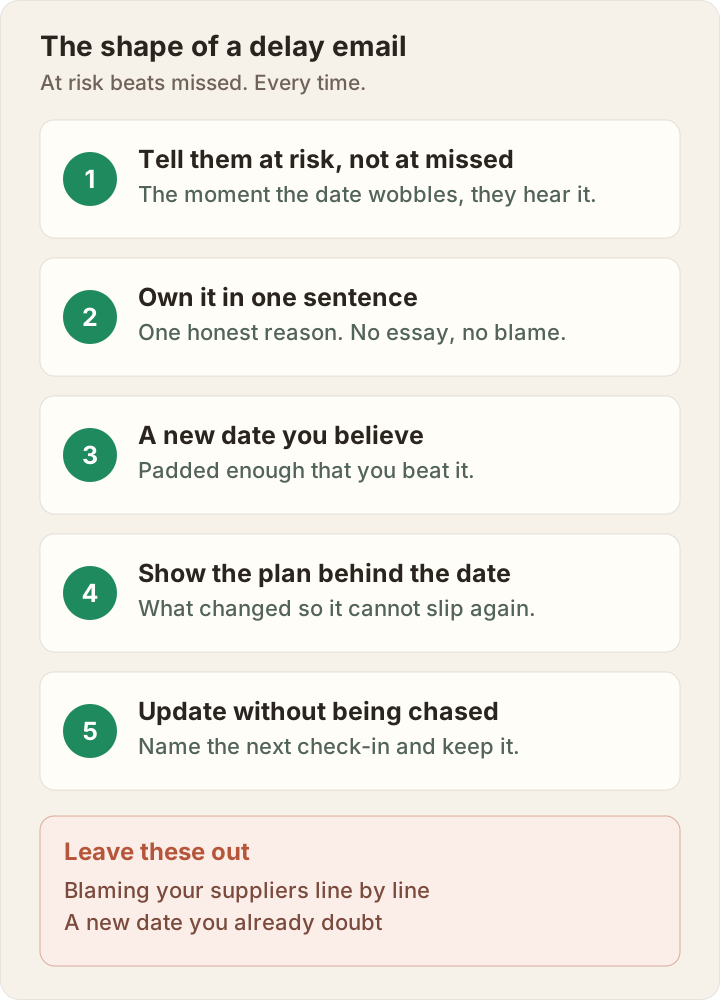
- Tell them at risk, not at missed. The moment the date wobbles, they hear it from you. Bad news does not improve with age.
- Own it in one sentence. The real reason, plainly, once. You can name a supplier failure without hiding behind it: the delay is still yours to manage.
- A new date you believe. Pad it enough that you will beat it. A second broken promise costs triple the first. Never redate under pressure to a number you doubt.
- Show the plan behind the date. What has actually changed: the second supplier, the reordered sequence, the extra hands. A date without a plan is a hope.
- Update without being chased. Name the next check-in and keep it. Every update the client does not have to ask for rebuilds a little of what the delay spent.
Project delay email templates
Six templates for the ways a slip actually unfolds. Swap the brackets, keep the reason to one sentence and only ever promise dates you expect to beat.
Subject: [Project]: a heads-up on the timeline
Hi [name], flagging something early rather than surprising you later. [The risk, plainly: our joinery supplier has pushed their delivery back a week], which puts the [original date] at risk. It is not lost yet: we are [what you are doing, e.g. chasing a second supplier and resequencing the fit-out to keep other work moving]. I will know by [date] whether [original date] holds or moves to around [realistic fallback]. You will hear from me that day either way. Wanted you to have this now so nothing lands on you cold.
[Your name], [business]
Subject: [Project]: revised completion date, [new date]
Hi [name], the update I flagged has firmed up and I will give it to you straight: [the milestone] moves from [old date] to [new date]. The cause is [one honest sentence]. Here is what protects the new date: [the concrete plan, e.g. the replacement units are already ordered and the team is booked through the weekend slot]. Everything else in the schedule holds, including [unaffected element]. I am sorry for the knock-on to your plans. Your next update comes [day], without you needing to ask.
[Your name], [business]
Subject: [Project]: a delay and an apology
Hi [name], I owe you both news and an apology. [The milestone] will now land on [new date] instead of [old date] and the reason sits with us: [the honest cause, e.g. we underestimated the prep work and I should have caught it at planning]. No dressing that up. What we are doing about it: [the fix]. And because the slip is ours, [the gesture, e.g. the additional prep work is at our cost / we have upgraded X at no charge]. The new date has room in it. I would rather beat it than repeat this email.
[Your name], [business]
Subject: [Project]: timeline update, one thing needed
Hi [name], a quick timeline note. The schedule was built on receiving [the dependency, e.g. the signed-off artwork] by [date] and it has not reached us yet. That means [the milestone] moves back day-for-day until it does. If it arrives by [date], we can still hit [revised date] and I have kept the team ready for exactly that. Nothing else is needed from you and there is no drama here, timelines just obey their inputs. Can you let me know when to expect it so I can plan the slot?
[Your name], [business]
Subject: [Project]: an honest reset on the timeline
Hi [name], this is the second time I am moving a date on you and I will not pretend that is fine. You have every right to be frustrated. So this email works differently. The new completion date is [date], set with genuine room in it, because I would rather you be surprised in the right direction. What has changed in how we are running the work: [the concrete changes, e.g. a second fitter on site and materials now held in our own store rather than ordered per phase]. From today you get a progress note every [cadence] without asking. And for the mess-around: [the gesture]. Judge us on what happens from here.
[Your name], [business]
Subject: [Project]: two ways forward, your pick
Hi [name], a delay has landed on [the affected part] and rather than choose for you, here are the honest options. Option one: we deliver [the unaffected portion] on the original date and [the affected part] follows on [later date]. Option two: everything arrives together on [single later date], which keeps [the practical benefit, e.g. one installation visit instead of two]. Cost is identical either way. If it were mine I would pick [your honest recommendation] because [one plain reason]. Reply with ONE or TWO and it is locked in today.
[Your name], [business]

After you press send: the cadence is the repair
The delay email is not the end of the job, it is the start of a short campaign. Whatever check-in you promised, keep it religiously, even when the update is only "still on track for the 14th". Silence after a delay reads as a second delay forming. If the client comes back angry, take it on the chin once, restate the plan and do not renegotiate the padded date down to soothe them: a date you cave on is a date you will miss. If the frustration tips into a formal complaint, the complaint playbook takes over. When the damage deserves a proper mea culpa, the apology guide covers that shape. The quiet win is that a delay handled this way often leaves the relationship stronger than no delay at all, because now the client has seen how you behave when things go wrong.
Why delay emails go out three days late
Nobody delays the delay email because they think silence helps. They delay it because it is the single most unpleasant email of the month: it admits a failure, it invites anger and every sentence feels like it needs a lawyer. So it gets drafted in the head on the drive home, softened at the keyboard, closed unsent. Three days pass. Now the email is later, the wobble is a miss and the version that finally goes out is written in a hurry from guilt, which is exactly the tone that invites the angry reply. The same avoidance spiral as every hard email, with a project attached.
That is the job ReciteMail does. It learns your voice from emails you have already sent, then turns one line, "tell Jordan the fit-out slips a week, joinery supplier failed, new date the 21st with room in it, offer the weekend slot as makeup", into a complete, calm, ownership-taking email in seconds, while the news is still early enough to be a plan rather than a confession. It runs on your PC, never connects to your inbox and your project mess stays on your machine.
Trades, agencies, freight desks and studios all live and die on dates. The early warning, the redate, the client-side nudge and the second-slip reset are the same four emails at every desk that delivers work over weeks. ReciteMail drafts all of them in your voice, private by architecture because it never connects to a mailbox. See who ReciteMail is for.
Common questions
When should you tell a client about a project delay?
The moment the date is at risk, not the day it is missed. An early warning gives the client time to adjust their own plans, brief their own stakeholders and feel like a partner rather than a victim. It also buys you credibility: the supplier who flags a wobble two weeks out is trusted, the one who confesses on deadline day is managed. If the risk resolves and the date holds after all, the follow-up is the best email you will ever send.
Should you explain the reason for the delay?
Yes, in one honest sentence. A delay email with no reason reads as evasive, one with three paragraphs of reasons reads as excuse-making. Name the real cause plainly, a supplier slipped, a fault was found, the scope grew, take ownership of the impact regardless of the cause and move fast to the part the client actually cares about: the new date and the plan protecting it.
What if the delay is the client's fault?
State the dependency without the blame. The framing that works: the schedule is built on receiving X by Y, X has not arrived yet. Here is how the timeline moves and here is what keeps it from moving further. The facts do the pointing so your tone does not have to. Attach the new maths visibly, one week of waiting equals one week of delay. Make providing the missing piece the single easy action of the email.
How do you tell a client about a second delay on the same project?
Differently from the first, because your promises are now discounted. Lead by acknowledging that plainly: this is the second time and you have every right to be frustrated. Then change what you offer. Give a date with real padding you are confident of beating, show concretely what has changed in how the work is being run and add a check-in cadence so they hear progress without chasing. A gesture that costs you something also lands here. What you cannot afford is a third slip.
Hard news, sent while it is still early
ReciteMail drafts delay notices, apologies and every email you dread in your own voice, learned from mail you have already sent. It runs on your PC, never connects to your inbox and your projects never leave your machine. Free for 7 days, no card needed.
Start your free trial