How to Write an Apology Email to a Customer: 6 Templates
Published 10 August 2026 · 7 minute read · The ReciteMail Blog
An apology email is one of the few messages where the words do the repair. The mistake has already happened. What decides whether the customer stays is the reply. Most apology emails quietly make things worse: too slow, too vague, too busy protecting the business to sound like a person. This is how to write one that actually lands, the phrases that sink it, plus six templates for the situations that keep coming up, including the hard one where you have got it wrong twice.
What an apology email is actually for
It is not for clearing your conscience and it is not for restating your policy. It has one job: to make the person on the other end feel that a real human saw what went wrong, took it seriously and is fixing it. Everything that does not serve that job is padding. Padding is exactly what makes an apology read as insincere. The shortest sincere apology beats the longest careful one every time.
The five parts of an apology that works
Almost every good apology email, whatever the situation, moves through the same five beats in the same order. Get the order wrong and even the right words feel off.
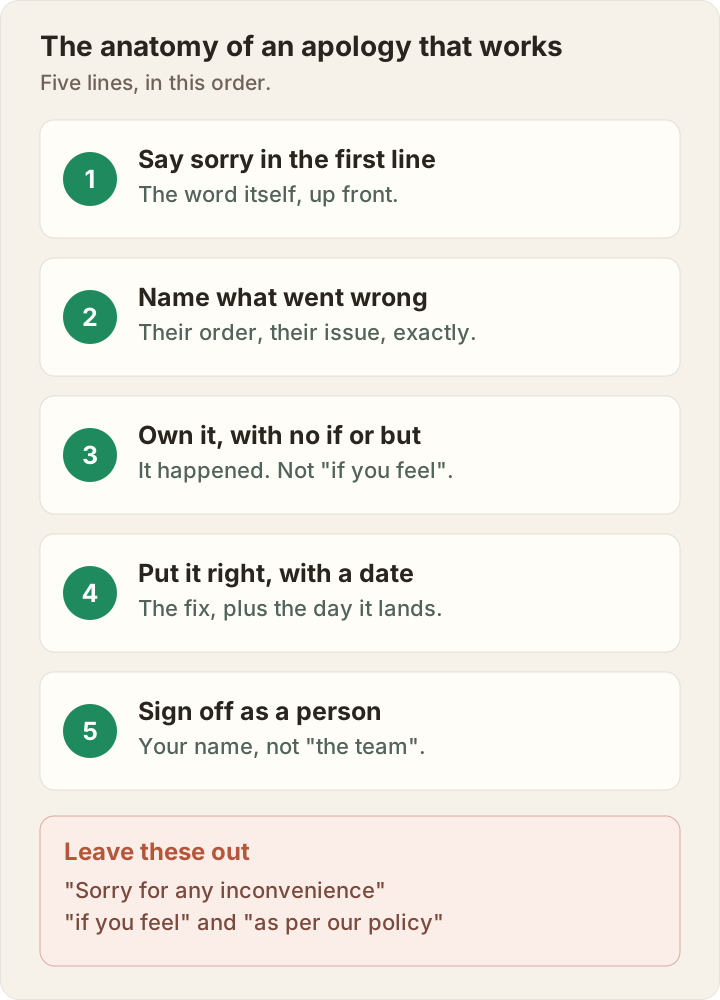
- Say sorry in the first line. The actual word, up front. No thanks, no context, no run-up.
- Name exactly what went wrong. Their order, their issue, in plain words. Specific regret reads as real. Generic regret reads as a script.
- Own it, with no if or but. "I am sorry your order is late" lands. "I am sorry if you feel let down" does the opposite.
- Put it right, with a date. What you are going to do, plus the day it happens by. An apology with no fix is just a feeling.
- Sign off as a person. Your name, not "the team". Someone owning it by name is half the reassurance.
The phrases that make an apology worse
A few stock lines have been used so often to dodge responsibility that customers now read them as exactly that. Cut them:
- "Sorry for any inconvenience." It apologises for nothing in particular, which is the tell. Name the real thing instead.
- "If you were affected" or "if you feel". The "if" quietly disputes that anything happened. Drop it and state what happened.
- "As per our policy." True or not, it moves the blame onto a document at the exact moment the person wants a human.
- "We apologise for the frustration this may have caused." May have. Passive. Distant. Say "I am sorry this happened" and mean the specific this.
Apology email templates
Six templates for the apologies that actually turn up. Swap the bracketed parts for real details and keep whatever wording sounds like you rather than like a form. A template pasted raw is easy to spot. Being handed one is its own small insult when someone is already annoyed.
Subject: An update on order [number]
Hi [name],
I am sorry your order is late. That is on us and I know it is frustrating when you were expecting it by [date].
Here is where it actually is: [plain status]. It is now due to reach you by [new date]. I will email you the moment it ships or anything changes.
For the wait I have put [10 percent off your next order / free shipping] on your account already, nothing to enter.
Sorry again for holding you up.
[Your name]
[Store name]
Subject: Putting your [item] right
Hi [name],
I am sorry. [Item] should never have reached you [broken / not working / like that].
You have already done your part by telling me. Here is mine. I am [sending a replacement today / refunding [amount] now]. You should have it by [date].
You do not need to send the faulty one back. If a quick photo is easy it helps me stop this reaching the next person, though the [replacement / refund] is not waiting on it either way.
Sorry again that it turned up like this.
[Your name]
[Store name]
Subject: What happened this morning and where we are now
Hi [name],
I am sorry for the disruption. [The service / the site] was down from [time] to [time]. I know that landed in the middle of your working day.
Plainly, what went wrong: [one line, no jargon]. It is fixed now and everything is back to normal.
To stop a repeat we are [one concrete change]. If the outage cost you something specific, reply and tell me what you need. I will make it right.
Sorry again for the interruption.
[Your name]
Subject: A billing mistake on your account, now fixed
Hi [name],
You are right and I am sorry. We charged you [amount] on [date] when it should have been [correct amount].
The difference of [amount] is going back to your [card] now. It clears within [3 to 5] working days.
I have also checked the rest of your account to be sure nothing else is off. It is clean. That was our error, not yours. You should not have had to be the one to spot it.
[Your name]
Subject: Correcting what I told you about [topic]
Hi [name],
I need to correct something and apologise for it. Earlier I told you [wrong information]. That was wrong. I am sorry, especially if you made a decision based on it.
The correct position is: [right information]. Here is what that means for you: [the implication, plus any fix].
The mistake was mine, not anything you did. If it has caused a knock-on I have not thought of, tell me and I will sort it.
[Your name]
Subject: This should not have taken [three] emails
Hi [name],
I owe you a proper apology. You raised this on [date]. I told you it was sorted. It clearly was not. Now you have had to chase it again.
That is not the experience you should have had. I understand if your patience is spent. Here is what is different this time:
The fix: [the concrete action, done now, with a date].
The owner: I am now personally handling this, which stops it bouncing between people again.
I am also [a fair gesture], not to paper over it but because the time you have lost on this is real.
If it is still not right after this, reply straight to me and it stops with me.
[Your name]
How fast an apology needs to go out
Speed is part of the apology. A same-hour reply that says "I have seen this and here is what I am doing" outperforms a beautifully worded message that arrives two days later, because by then the customer has already decided how they feel about you. If you cannot fix it inside the hour, send the holding version anyway: acknowledge it, give a time you will come back with the full answer, then keep that promise. Silence is the thing that turns a fixable mistake into a lost customer or a public review. When the thing being apologised for is your own slow inbox, the late reply guide covers how big that apology should actually be. When the mistake arrives as a complaint rather than something you spotted first, the wider playbook is here: how to respond to a customer complaint.
How to keep an apology from sounding like a form letter
The templates above stop working the second they get pasted raw. Someone who has just been let down is unusually alert to a stock paragraph. A canned apology reads as a second, smaller insult. The difference between one that repairs the relationship and one that inflames it is almost always two sentences of specifics: their actual order, their actual problem, in the tone you would actually use out loud.
Writing those two sentences fresh, over and over through a bad morning, is where the time goes. That is the job ReciteMail does. It holds your templates, learns your tone from replies you have already sent and turns a screenshot of the customer's email into a finished draft in your voice. You read it, adjust anything you want, then send it yourself. If you are assembling a set of these, the guide on building a reply library pairs with this one. For the times the answer has to be no, there is how to say no in an email.
Apology and refund are not the same email. An apology repairs how the person feels. A refund moves money. They often travel together. Do not let the money paragraph swallow the apology. If the situation is really about a refund, the refund request templates cover that side. The two work well sent as one clear message.
One apology deserves its own playbook: the wrong item in the box. It has decisions the general apology does not, reshipping before the return, when to let the customer keep the mistake. It is covered start to finish in the wrong item guide.
When the apology is really about a supplier or courier
A large share of the apologies a store sends are for something that was never theirs to begin with: stock that shipped late, an item that left the warehouse faulty, a courier that lost the parcel. Apologising to the customer settles your side of it. It does nothing about the cause. If the same supplier keeps generating the same apologies, the message that actually saves you the repeat is the one you send them, not the customer. That has its own approach: chasing a supplier by email.
Common questions
How do you start an apology email to a customer?
Start with the word sorry in the first line, then name the specific thing that went wrong. Do not open with thanks, background or a paragraph of context. The customer already knows something is wrong. Making them read to find the apology reads as reluctance.
Should you apologise if it was not your fault?
You can acknowledge the impact without taking blame you do not own. Apologise for the experience, be honest about the cause, then focus on the fix. What you should not do is argue about fault while the customer is still out of pocket or out of patience. Sort the problem first.
What phrases should you avoid in an apology email?
Avoid "sorry for any inconvenience", "if you were affected" and "as per our policy". They read as distance rather than regret. Name the actual problem, in plain words, then say sorry for that specific thing instead of for a vague inconvenience.
How fast should you send an apology email?
As fast as you can, even if it is only a short holding reply while you check the details. Speed is itself part of the apology. A same-hour acknowledgement beats a perfect message that lands two days later, by which point the goodwill is gone.
Write every apology in your own voice
ReciteMail turns a screenshot or a one-line note into a warm, specific reply in seconds, even the difficult second apology. You read it and you send it. Free for 7 days, no credit card and no connection to your inbox.
Start your free trial