How to Respond to a Customer Complaint: 7 Email Examples
Published 15 August 2026 · 8 minute read · The ReciteMail Blog
A complaint is the rare unhappy customer who bothered to tell you. Customer experience researcher Esteban Kolsky found that only about 1 in 26 unhappy customers ever complains. The other 25 just leave quietly and tell their friends why. So the person in your inbox right now, however sharp their tone, is doing you a favour. This is the shape of a reply that turns that complaint around, the mistakes that make it worse, plus seven copy-paste templates for the complaints every business actually gets.
Why the reply matters more than the complaint
Service research has a name for what happens when a complaint is handled well: the service recovery paradox. A customer whose problem is fixed quickly and generously often ends up more loyal than one who never had a problem at all, because they have now seen how you behave when things go wrong. The complaint is the audition. Widely cited follow-up research puts it in numbers: resolve a complaint in the customer's favour and roughly seven in ten will do business with you again.
The reverse is also true. A slow, defensive or boilerplate reply converts a fixable product problem into a permanent character judgement about your business. The product failing was an accident. The reply is a choice.

The shape of a complaint reply
Every good complaint response follows the same five beats, whatever the product and whatever the tone of the complaint.
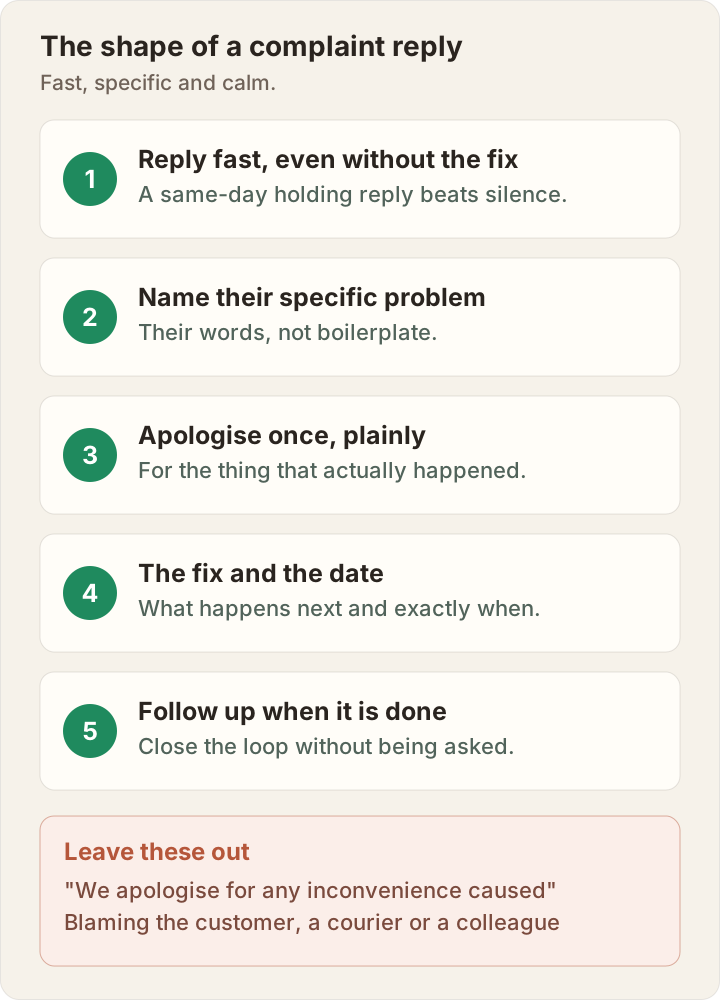
- Reply fast, even without the fix. Same working day. If the answer needs investigation, send a holding reply that says so and gives a deadline. Speed is the loudest signal that the complaint was heard.
- Name their specific problem. Repeat it back in their words: the order number, the date, what actually went wrong. The customer needs to know a person read the email rather than a system routing it.
- Apologise once, plainly. "I am sorry the jacket arrived damaged" beats a paragraph of regret. One genuine sentence about the actual thing. Then move on to the fix, which is what they really came for.
- The fix and the date. What you are doing about it and exactly when it will be done. A concrete date you hit is worth more than a generous gesture you deliver late.
- Follow up when it is done. The step almost nobody takes. A two-line email confirming the replacement shipped or the refund landed closes the loop and it is the moment the service recovery paradox actually happens.
The mistakes that make a complaint worse
- "We apologise for any inconvenience caused." The single most resented phrase in customer service. It is what companies say when nobody read the email. Apologise for the actual thing or not at all.
- Blaming anyone. Not the courier, not the supplier, not a colleague, not the warehouse. The customer bought from you. Own the outcome, chase the third party privately.
- Matching their tone. An angry complaint answered with cold formality escalates. An angry complaint answered with calm warmth deflates. You set the temperature of the thread with your first reply.
- Promising a date you cannot hit. A missed promise inside a complaint thread is a second complaint. Pad your estimate, then beat it.
- Arguing the details before fixing the problem. Even when the customer has some facts wrong, fix first and correct gently second. Winning the argument and losing the customer is not winning.

Customer complaint response templates
Seven templates for the complaints that actually arrive. Swap the brackets, keep the specific details of their case and adjust the warmth to the damage done. The worse the failure, the more personal the email owes them.
Subject: Re: [their subject]
Hi [name], thank you for flagging this and I am sorry it happened. I want to give you a proper answer rather than a fast one. I am checking [what you are checking] now. You will have a full reply from me by [specific day]. If anything changes before then, I will let you know straight away.
[Your name], [company]
Subject: Your order [number], an update and an apology
Hi [name], I am sorry your order has not arrived when we said it would. I have checked with the carrier: it is currently [location or status] and the new delivery estimate is [date]. I will watch the tracking myself and confirm the moment it is delivered. If it has not arrived by [date], I will send a replacement at no cost or refund you in full, whichever you prefer.
[Your name], [company]
Subject: Re: [their subject]
Hi [name], I am sorry the [product] arrived damaged. That is not the condition anything should leave us in. A replacement is going out [today / on date] with tracking to follow. No need to return the damaged one unless you would rather we collect it. Thank you for the photo, it helps us take this up with [packaging / the carrier] so it does not happen again.
[Your name], [company]
Subject: Re: [their subject]
Hi [name], thank you for telling me about this. What you have described is not how we want anyone treated and I am sorry it was your experience. I have spoken with the team involved and [the concrete change or action taken]. I would completely understand if this has put you off. Still, I would value the chance to show you the standard we normally hold. [Optional: a specific gesture.]
[Your name], [role]
Subject: Your invoice [number], corrected
Hi [name], you are right and thank you for catching it. You were charged [wrong amount] instead of [right amount]. The difference of [amount] has been refunded to your original payment method and should appear within [timeframe]. A corrected invoice is attached. I have also checked your previous invoices to make sure this was a one-off, which it was.
[Your name], [company]
Subject: Re: [their subject]
Hi [name], thank you for raising this, I would want to know too. I have been through the records and I think there may be a mix-up: [what the records actually show, stated plainly, with the evidence attached]. These things are easy to misread. No harm done at all. If you are seeing something different on your side, send it over and I will look again straight away.
[Your name], [company]
Subject: Re: [their subject]
Hi [name], I am sorry. I am also aware this is the second time you have had to write to us about [the problem]. Once is bad luck. Twice is our process failing you. Here is what is different this time: [the concrete change]. [The fix for the immediate problem and the date.] I am also adding [gesture] to your account, not as a substitute for getting it right, just as a recognition that we did not. You will hear from me by [date] confirming it is done.
[Your name], [role]
When to offer compensation
Not every complaint needs a gesture and reaching for a discount code too fast can even cheapen the apology. Fix the actual problem first, because most complainers want the thing they paid for rather than a voucher. Offer something extra when the failure cost the customer real time or money beyond the product, when it is a repeat failure or when the customer is one you particularly want to keep. The gesture lands hardest when it arrives before anyone asked for it.
If the complaint arrives as a public one-star writeup instead of an email, the same shape applies with an audience watching. That version has its own playbook: how to respond to a negative review.
The part nobody has time for
Everything above is easy on complaint number one. It falls apart on complaint number nine on a Friday afternoon, when the temptation is to paste the same three cold sentences and move on. The customer who gets that paste job can tell. The same crunch produces the same damage in every busy inbox, which is why the fix looks the same as it does for apology emails: a structure you trust and a draft that starts in your voice.
That is the job ReciteMail does. It learns how you write from emails you have already sent, then turns a one-line note like "order 4417 arrived cracked, replacement going out Monday, add a tenner credit" into a warm, specific reply that sounds like you on your best day. Complaint nine gets the same care as complaint one. And because it runs on your own machine with no connection to any mailbox, customer details stay exactly where they should.
Online stores run this at volume. Complaints, WISMO messages, refunds and review replies are the same dozen emails repeated all day, each one needing to sound like a person who cares. ReciteMail drafts all of them in your voice with reusable templates that adapt to each customer, private by architecture because it never connects to a mailbox. See ReciteMail for online stores.
Common questions
How quickly should you respond to a customer complaint email?
Acknowledge it the same working day, even if the fix takes longer. Speed is the part of the reply customers weigh most heavily, because a fast response signals the complaint was heard. If the investigation needs time, send a short holding reply that names the problem, gives a deadline for your full answer and then actually meets that deadline.
What should you not say in a complaint response?
Avoid the phrase "we apologise for any inconvenience caused", which reads as boilerplate and makes the customer feel processed rather than heard. Avoid blaming anyone, including couriers, suppliers or colleagues, because the customer bought from you rather than from your courier. Avoid arguing with the customer's tone and never promise a date you are not sure you can hit.
Should you offer compensation when a customer complains?
Not automatically. Fix the actual problem first, because most complainers want the thing they paid for rather than a voucher. Offer a gesture when the customer lost real time or money beyond the product itself, when it is a repeat failure or when the relationship is worth protecting. A small gesture offered before it is demanded lands far better than a large one extracted through argument.
How do you respond to a complaint when the customer is wrong?
Correct the facts without scoring the point. Thank them for flagging it, state plainly what the records show, attach the evidence and offer a path forward anyway. Most wrong complaints are honest mistakes. A reply that lets the customer retreat gracefully keeps the relationship. If you write it while annoyed, save the draft and send it after a second read.
Complaint nine, answered like complaint one
ReciteMail drafts complaint replies, apologies and every hard customer email in your own voice, learned from mail you have already sent. It runs on your PC, never connects to your inbox and customer details never leave your machine. Free for 7 days, no card needed.
Start your free trial