Insurance Broker Email Templates: 8 Replies for Quotes, Claims and Renewals
Published 5 September 2026 · 8 minute read · The ReciteMail Blog
A brokerage inbox is where trust is kept or lost, one email at a time. The quote request with half the details missing. The renewal that went up and needs explaining before the client rings a comparison site. The claim that is three weeks in and the client has heard nothing. Every one of those replies has to be warm and exact at the same time. It also has to stay inside what you are allowed to say. Here is the shape that does all three, the renewal mistake that quietly loses clients. Then eight templates you can send today.
Why the claim update is the email that decides everything
Clients do not judge a broker on the quote. Quotes are compared on price and half the time the client barely reads the cover. They judge the broker on the claim. More exactly, on the silence between reporting it and hearing back. Three weeks with no update, even when nothing has moved, is how a client who would have renewed for a decade ends up on a comparison site in March.
The fix is not faster insurers. It is telling the client where the claim stands, in plain words, on a schedule they can rely on, even when the honest answer is that the insurer has not come back yet. A broker who says "still with the insurer, I chased them today, next update Friday" is doing the job. A broker who says nothing until there is news is not, however good the news turns out to be.

The shape of a broker reply
Every good version runs the same four moves, whether it is a quote request or a difficult renewal.
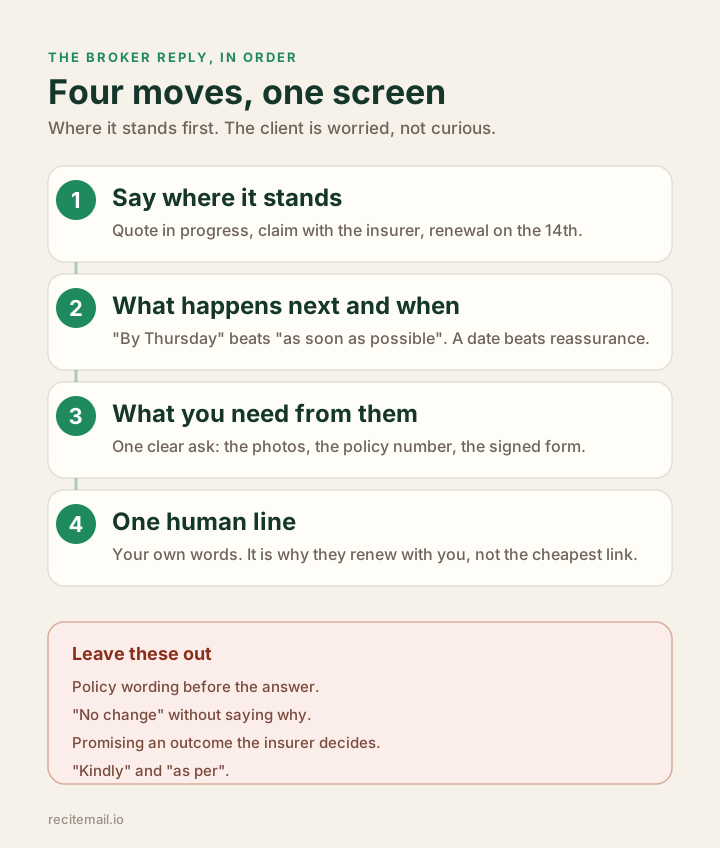
- Say where it stands. The quote is in progress, the claim is with the insurer, the renewal is due on the 14th. First sentence. The client opened the email worried rather than curious. The first line should end the worry or name it.
- Say what happens next and when. A date beats reassurance every time. "I will have three options to you by Thursday" does more than "I am working on it as a priority". If the date depends on the insurer, say so and give the date you will chase them.
- Say what you need from them. One clear ask, not three buried in a paragraph. The photos, the policy number, the signed form, the no claims proof. Put it in its own sentence so it survives being read on a phone.
- One human line. Your own words. "I know this is the last thing you needed this month" is why a client renews with you rather than with the cheapest link. Keep it to one line and keep it true.
The renewal mistake that loses clients quietly
- Sending the renewal with the new premium and no explanation. The number went up. The client sees it, assumes nobody is looking after them and opens a comparison site. Two sentences on why it rose, what you checked and what you can do about it turns the same number into evidence that somebody is on their side.
- Promising what the insurer decides. "I am sure it will be covered" is the most expensive sentence in insurance. Say what the policy says, say what you have asked the insurer for and say when you expect their answer. Warmth comes from the follow-through, not from a promise you are not allowed to make.

Insurance broker email templates
Eight templates for the emails that fill a brokerage inbox. Swap the brackets, keep the dates and policy numbers exact and check every line against what your compliance rules let you say in writing.
Subject: Your [type] insurance quote, two things I need
Hi [name], thanks for asking us to quote for [type, e.g. your commercial combined / your home and contents]. I have started on it and I can get you proper options rather than a guess if you can send two things: [item, e.g. your claims history for the last five years] and [item, e.g. the rebuild value or the sum insured you have now]. With those I will have [two / three] options to you by [day]. If it is easier to talk it through, I am on [number] this afternoon.
[Your name], [brokerage]
Subject: Your [type] insurance options
Hi [name], your options are attached. In short: [insurer A] at [premium] with [the key difference, e.g. a lower excess], [insurer B] at [premium] with [the key difference]. I have also included [insurer C] at [premium] because [reason]. My honest view is [option] because [one line of reasoning about their situation, not the price]. The quotes are valid until [date]. Reply with the one you want and I will put it on cover from [date]. Ring me if you want to go through the differences.
[Your name], [brokerage]
Subject: Your [type] policy renews on [date]
Hi [name], your [type] policy with [insurer] renews on [date] and I wanted to reach you before the paperwork does. Before I send the renewal terms, has anything changed this year that I should know about? [Examples relevant to the cover, e.g. new vehicles, a change of address, turnover up or down, new equipment]. If nothing has changed, reply "no change" and I will get the terms to you by [date] with time to review them. If something has, tell me now and I will make sure the cover still fits.
[Your name], [brokerage]
Subject: Your renewal and why the premium has changed
Hi [name], your renewal terms are attached and I want to be straight with you: the premium has gone up from [old] to [new]. The main reason is [the reason, e.g. the insurer has increased rates across this class this year / the claim in [month] / the change in sum insured]. Before sending this I checked [what you did, e.g. two alternative insurers / whether a higher excess would help]. [The result]. My recommendation is [what you recommend and why in one line]. If you would like me to look at any other options before [renewal date], tell me by [date] and I will.
[Your name], [brokerage]
Subject: Your claim on [policy number], what happens now
Hi [name], I am sorry to hear about [what happened]. I have your claim and it has been reported to [insurer] today under reference [reference]. What happens next: [insurer] will [next step, e.g. appoint a loss adjuster / ask for an estimate], usually within [timeframe]. What I need from you: [one clear item, e.g. photos of the damage and any receipts you have]. I will update you every [Friday / week] whether or not there is news. Sooner if there is. My direct line is [number].
[Your name], [brokerage]
Subject: Your claim on [policy number], update for [date]
Hi [name], as promised, here is where your claim stands. It is still with [insurer] awaiting [the specific step, e.g. the loss adjuster's report]. I chased them this morning and they have told me to expect it by [date]. I know waiting is the worst part. I will chase again on [day] and update you the same afternoon either way. Nothing is needed from you for now. If anything changes on your side, reply here or ring me.
[Your name], [brokerage]
Subject: [Policy or claim], one document outstanding
Hi [name], quick one. To [what it unlocks, e.g. put the policy on cover / move your claim to the next stage] I still need [the specific document]. Everything else is in. If you can send it by [date] I can [the result, e.g. confirm cover before the current policy ends on [date]]. A photo from your phone is fine if that is quicker than scanning. If there is a problem getting it, tell me and we will find another way.
[Your name], [brokerage]
Subject: Cancelling your [type] policy
Hi [name], I have your request to cancel the [type] policy and I will action it, no problem. Before I do, two things so there are no surprises: the cover ends on [date] and [any refund or fee, e.g. a pro-rata refund of about [amount] will follow within [timeframe] / the insurer charges a cancellation fee of [amount]]. If the reason is price, I would rather try to find you something better than lose you. Tell me if you want me to look. If you have already sorted cover elsewhere, that is completely fine. Reply to confirm and I will process it today.
[Your name], [brokerage]
A bonus for the other side: requesting an insurance quote by email
Brokers get better quote requests when clients know what to send. This one is written for the client. Put it on your website or send it to anyone who asks "what do you need from me?".
Subject: Quote request, [type] insurance for [business or property name]
Hi [broker name], I would like a quote for [type, e.g. commercial combined / landlord / professional indemnity] cover for [name]. Here is what I think you need: the business is [what it does], based at [address], trading since [year], with [number] staff and turnover of about [amount]. Current cover is with [insurer] at [premium], renewing on [date]. There have been [number or no] claims in the last five years. I have attached [the schedule / the claims history / the property details]. Tell me what else you need and the best time to call if a conversation is quicker.
[Your name], [phone]
Where the good ones come from
Every one of these replies is easier when the facts are written down once: the excesses and cancellation terms by product, the phrases compliance never wants in writing and the way your most experienced account handler explains a premium increase. Most brokerages have all of that in one person's head and sent folder. Our guide on handing an inbox to a new hire shows how to get it out. payment reminder templates cover the premium that has not been paid.
The twelfth renewal explanation this month
One careful renewal email is easy. The twelfth one this month, explaining a rise you did not set, to a client you like, with the same patience as the first, is the hard part. That is when the explanation gets shorter and the policy wording gets longer, not because the handler stopped caring but because writing the same difficult paragraph well twelve times is not something people do at four on a Friday.
That is the job ReciteMail does. It learns how your brokerage writes from emails you have already sent, then turns a line like "renewal up 12 percent, rate rise across the class, checked two alternatives, recommend staying" into a full reply that sounds like your best handler on a good day. Banned words keep the phrases compliance hates out of every draft. Every email is read and sent by a person. It runs on your own PC and never connects to any mailbox. Client details stay exactly where they are.
Brokerages run on the same eight emails. Quotes, renewals, claims and chases, each one easiest to get wrong when the queue is long. ReciteMail drafts all of them in your voice, with company facts holding the excesses and terms and banned words holding the line on wording. See who ReciteMail is built for.
Common questions
How often should a broker update a client on a claim?
On a fixed schedule the client knows about, whether or not there is news. Weekly is the usual rhythm for anything that is not urgent. The update says where the claim stands, what you chased and when, plus the date of the next update. Silence while you wait for the insurer is the single biggest reason clients leave a broker after a claim, even when the claim is eventually paid in full.
How do you explain a premium increase to a client by email?
State the old and new figures plainly in the first line, give the main reason in one sentence, say what you checked before sending the renewal and give a recommendation. Clients do not leave because the price went up. They leave because the price went up and nobody seemed to be looking after them. Two sentences of explanation and evidence of checking alternatives turn the same number into a reason to stay.
What should a broker never say in a claims email?
Anything that promises the outcome. The insurer decides what is covered. "I am sure this will be paid" is a promise you cannot keep and a compliance problem if it is wrong. Say what the policy says, what you have submitted, what the insurer has asked for and when you expect an answer. Warmth belongs in how you say it and how reliably you follow up, not in guessing the result.
How do you respond when a client wants to cancel?
Accept it without a fight, state the end date and any refund or fee so there are no surprises. Offer once to look for something better if price was the reason. A cancellation handled gracefully often comes back at the next renewal. One handled with pressure never does.
Every client email, warm and exact on the first draft
ReciteMail drafts quotes, renewals, claim updates and chases in your own voice, learned from mail you have already sent, with company facts holding the terms and banned words holding the wording. It runs on your PC, never connects to your inbox and client details never leave your machine. Free for 7 days, no card needed.
Start your free trial