Clinic Front Desk Email Templates: 8 Replies for Appointments, Results and Fees
Published 11 September 2026 · 8 minute read · The ReciteMail Blog
A clinic front desk answers the phone, greets the room and, in the gaps, writes the same eight emails to people who are usually a little worried. The patient who wants a Tuesday slot. The one who has to move Thursday. The new patient who does not know what to bring. The results that are ready but cannot be explained by email. The fee question, the referral, the no-show charge and the complaint about the wait. Each one is answered between a phone call and a person at the desk. Each one is the moment a patient decides whether the practice cares. Here is the shape that keeps them warm, exact and inside what a front desk is allowed to say, the two habits that turn a calm patient into a complaint. Then eight templates you can send this afternoon.
Why the front desk email is where patients decide
Patients rarely judge a practice on the consultation. They judge it on everything around the consultation: how long the phone rang, whether the email got a real answer and whether anyone sounded like they cared. An appointment request answered the same morning with a slot and what to bring makes a practice feel organised and kind. The same request answered two days later with "please call to book" makes it feel like the patient is a nuisance. That is the review they write.
The front desk also carries a rule the rest of the business does not: some things cannot go in an email. Results, diagnoses, anything clinical belongs on a call or in the room. A reply that says so plainly and shows the patient how to get that conversation is a good reply. One that dodges the question with "we are unable to discuss this" without a next step is what turns a worried patient into an angry one.

The shape of a front desk reply
Every good version runs the same four moves, whether it is a booking, a fee question or a complaint about the wait.
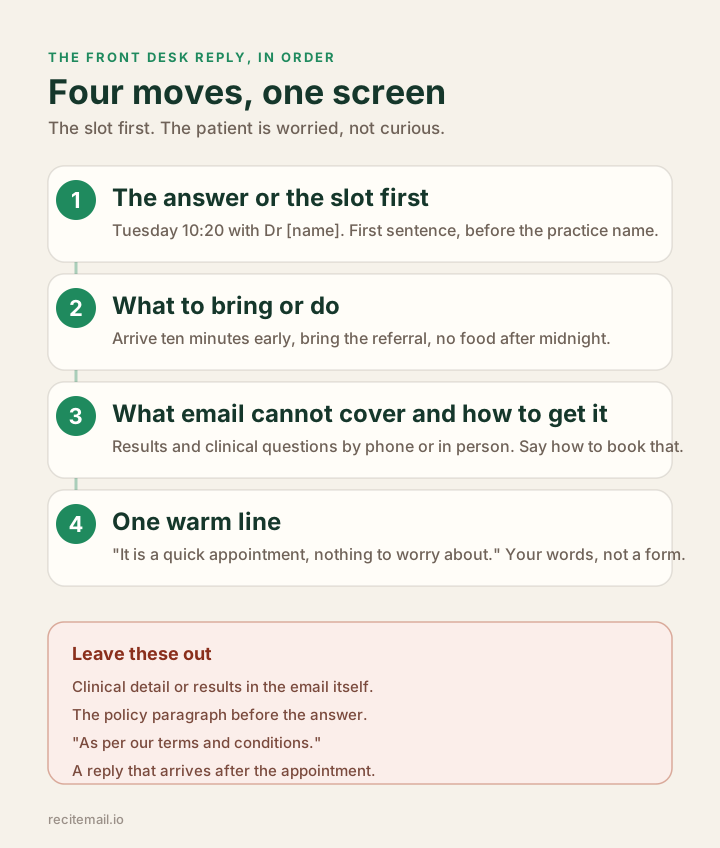
- The answer or the slot first. Tuesday at 10:20 with Dr [name]. The fee is [amount]. The referral has arrived. First sentence, before the practice name and before any policy. A patient reading on a phone in a break at work needs the answer in the first line.
- What the patient needs to bring or do. Arrive ten minutes early for the form, bring the referral letter and a list of medications, no food after midnight, park at the rear. Two lines at most. Every one of these saves a phone call later and a delay on the day.
- What the email cannot cover and how to get it. Results, clinical questions and anything about a diagnosis are for a call or an appointment. Say that plainly and say exactly how: "ring us on [number] between 2 and 4 and ask for the nurse or I can book a ten minute phone slot for you". The rule without the route is what patients complain about.
- One warm line. "It is a routine appointment, nothing to worry about." "We will get you sorted." Your own words, not a phrase from a template pack. It is the line the patient remembers when they decide whether to come back.
The two habits that turn calm patients into complaints
- Leading with the policy. The email that opens with the cancellation terms, the fee schedule and "please note" before it answers the question reads as a warning, even when the news is good. Answer first. Then, if the policy matters today, one line of it. A patient who has been given a slot will read a cancellation line kindly. A patient who has been given a lecture will not read the slot.
- Saying no to the email without opening a door. "We cannot give results by email" is true and it is not a reply. "Your results are in and Dr [name] would like to go through them with you, I can book a phone call on Thursday at 11 or Friday at 2" is the same rule with a route through it. Every refusal a front desk sends should end with the way to get what the patient actually needs.

Clinic front desk email templates
Eight templates for the emails that actually fill a practice inbox. Swap the brackets, keep the times exact and keep the tone of someone who would be pleased to see this patient walk in, not someone processing a queue.
Subject: Your appointment with [practice]
Hi [name], thank you for getting in touch. I can offer you [day] at [time] with [clinician] or [day] at [time] with [clinician]. Tell me which suits and I will confirm it straight back. Please arrive ten minutes early for the registration form and bring [anything, e.g. your referral letter and a list of current medications]. It is a [length] appointment. If neither time works, tell me the days you can do and I will find something close.
[Your name], [practice]
Subject: Moving your appointment on [day]
Hi [name], no problem at all, I have taken you out of [day] at [time]. The next available slots with [clinician] are [day] at [time] and [day] at [time]. Say which one and it is yours. One thing to know: [if relevant, e.g. we ask for 24 hours notice for changes. This one is fine and there is nothing to pay]. See you then.
[Your name], [practice]
Subject: Welcome to [practice], before your first visit
Hi [name], welcome to [practice]. Your first appointment is on [day] at [time] with [clinician]. To make it easy on the day: please arrive ten minutes early for the registration form, bring [photo ID / your insurance details / a list of medications] and [any preparation]. We are at [address], parking is [where] and the entrance is [detail]. If you have a question before then, reply here or call [number]. We are looking forward to meeting you.
[Your name], [practice]
Subject: Your results are in
Hi [name], your [test] results have come back and [clinician] would like to go through them with you rather than by email, which is our normal practice for all results. I can book a [ten minute phone call / short appointment] on [day] at [time] or [day] at [time]. Tell me which and I will confirm it. If you would rather ring, the best time to reach the nurse is [hours] on [number]. Nothing in this email should be read as good or bad news, it is simply that results are always discussed in person.
[Your name], [practice]
Subject: Re: Cost of [appointment or treatment]
Hi [name], thanks for asking before you book, it saves surprises for both of us. A [appointment type] is [amount]. That covers [what is included]. If [clinician] recommends [likely extra, e.g. a follow up or a test], that is [amount] and you would be told before anything is done. We take [payment methods] and payment is on the day. If you have insurance, send me the provider name and I will tell you what they usually cover. Would you like me to book you in?
[Your name], [practice]
Subject: Your referral to [practice] has arrived
Hi [name], we have received your referral from [referrer] for [type of appointment]. [Clinician] will review it by [day] and I will email you with appointment times as soon as it is triaged, which is usually within [number] working days. If your symptoms get worse in the meantime, please contact [your GP / the number below] rather than waiting for us. You do not need to do anything now.
[Your name], [practice]
Subject: Your appointment on [day]
Hi [name], we had you booked for [day] at [time] with [clinician] and unfortunately we did not see you. Because the slot was held and could not be offered to another patient, our missed appointment fee of [amount] applies, as set out when you booked. I know these things happen. If there was an emergency or a mix up on our side, reply and tell me and I will look at it properly rather than just apply the charge. Either way I would like to get you rebooked: I have [day] at [time] or [day] at [time].
[Your name], [practice]
Subject: Re: Your visit on [day]
Hi [name], thank you for telling us. I am sorry you waited [length] on [day]. That is not the experience we want anyone to have. [One honest line on why, e.g. an emergency earlier in the clinic ran long and we did not tell the waiting room, which we should have.] I have passed your email to [practice manager], who will reply to you personally by [day]. For your next appointment I can book the first slot of the morning, which does not run late. Thank you for giving us the chance to put it right.
[Your name], [practice]
Where the good ones come from
Every one of these replies gets easier when three things are written down: the facts patients ask about most (fees, parking, what to bring), the rule about what stays off email and the way the best receptionist in the practice says no. Most practices keep all three in one person's head and in that person's sent folder. Our guide on appointment reminder emails covers the message that stops the no-show before it happens. client no-show email templates covers the charge in more detail.
The fortieth reply between two phone calls
One warm, exact front desk reply is easy. The fortieth, between two phone calls, with a full waiting room and a patient at the counter, with the right slot and the right words about results, is the hard part. That is when "please call to book" creeps back in, not because the receptionist stopped caring but because writing the same thing well forty times is not a thing anyone does with a queue watching.
That is the job ReciteMail does. It learns how your practice writes from emails you have already sent, then turns a line like "Tuesday 10:20 with Dr Reid, bring the referral, results by phone only" into a full reply that sounds like you on your best day. Every draft is read and sent by a person. It runs on your own PC, never connects to your inbox and nothing sends without you. Patient details stay exactly where they are.
A front desk runs on the same twelve emails. Appointments, reschedules, results, fees, referrals and the occasional complaint. ReciteMail drafts all of them in your voice, private by architecture because it never connects to your inbox and patient details never leave the machine. See ReciteMail for clinics.
Common questions
Can a clinic send test results by email?
Most practices do not. The safe reply is to say so plainly and offer the route instead: a short phone slot or an appointment with the clinician, with two times to choose from. Add a line that the email itself is not good or bad news, because patients read silence as bad. A refusal with no next step is what turns a worried patient into a complaint.
How should a front desk reply to an appointment request?
With the slot in the first sentence: the day, the time and the clinician, then two options if you have them. Follow with what to bring and when to arrive. Keep the policy to one line and put it after the answer. A reply the same morning with real times is the whole difference between a practice that feels organised and one that feels like the patient is a nuisance.
How do you charge for a missed appointment without losing the patient?
State the charge, say why it exists (the slot was held and could not go to someone else) and say where it was agreed. Then open the door: if there was an emergency or a mix up on your side, ask them to say so and mean it. Finish by offering to rebook with two times. Patients accept a fair charge delivered kindly. They leave over a fair charge delivered like a fine.
How do you respond to a complaint about waiting times?
Thank them, apologise for the wait without arguing about it, give one honest line on why it happened and say who will reply personally and by when. Offer something practical for next time, such as the first appointment of the morning. Do not explain the whole clinic's scheduling. The patient wants to know they were heard and that it will not happen again.
Every front desk reply, warm and exact on the first draft
ReciteMail drafts appointment replies, reschedules, fee answers and the harder emails in your practice's own voice, learned from mail you have already sent. It runs on your PC, never connects to your inbox and patient details never leave your machine. Free for 7 days, no card needed.
Start your free trial