Out of Office Messages for Small Business Owners (7 Honest Templates)
Published 24 August 2026 · 7 minute read · The ReciteMail Blog
Every out of office guide on the internet was written for someone with colleagues. "For urgent matters, please contact my colleague Sarah." Lovely. What if there is no Sarah? When you run the business yourself, the auto-reply is not office admin, it is the closed sign on your shop door: the only thing standing between your one week off and a phone that never stops. Here is how to write one that lets you actually switch off, why honesty beats the corporate template every time, plus seven copy-paste versions for holidays, sickness, busy season and everything between.
The corporate template lies on your behalf
The standard auto-reply carries two hidden promises: someone is watching this inbox and urgent things will be handled. In a company of fifty, both can be true. In a company of one, both are usually false and every customer who believes them becomes a disappointed customer by Thursday. The email that "will be dealt with on my return" sits unread. The "urgent contact" is your own mobile on a beach.
So the first decision is not wording, it is honesty. Customers of small businesses already know they are dealing with a person, it is half the reason they chose you over the big alternative. A closed sign that says the baker is on holiday, back Tuesday has never offended anyone. What offends people is silence with no sign at all or a sign that promised attention nobody was giving. If nobody is reading the inbox this week, the kindest professional thing you can write is exactly that.
The four lines every version needs
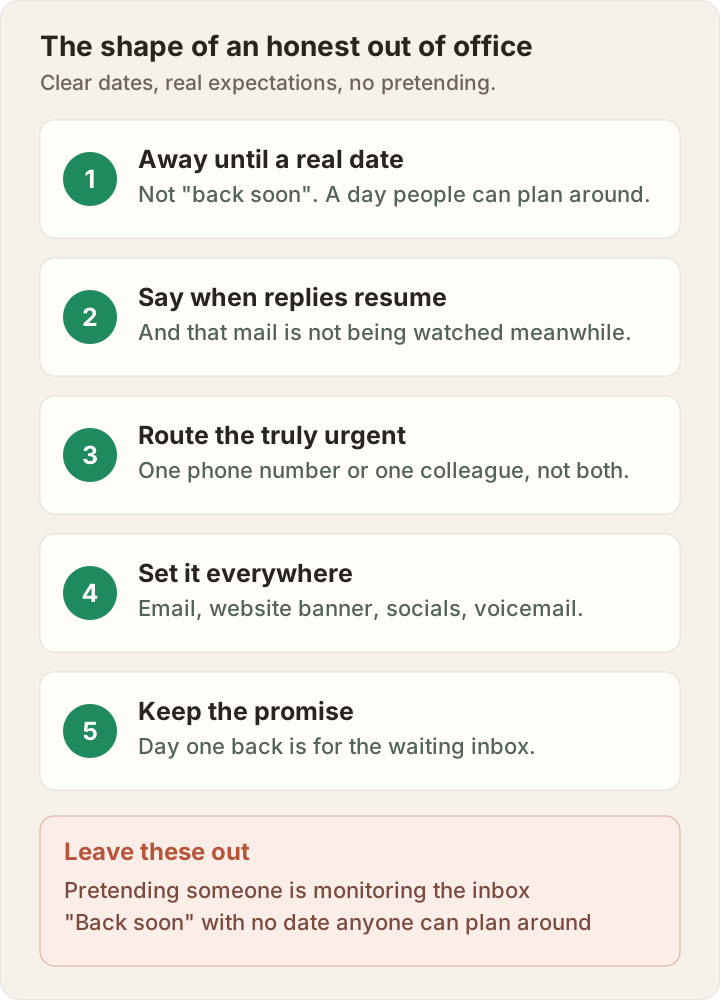
Strip away the style and a working out of office says four things. That you are away and until when, with a real date rather than "shortly", because a date lets people plan around you and vagueness invites the follow-up email. When a reply will actually come, which for a solo operation is honestly "in the days after I return", not the moment you land. What counts as urgent and where it goes, a single narrow escape hatch you are willing to defend. And one human line, because you are a person going on holiday, not an autoresponder apologising for existing.
The escape hatch deserves a moment of thought. Three designs work: a phone number for true emergencies only, with "emergency" defined in the message so the word means something; a ten-minutes-a-day rule where you scan for problems with existing bookings and nothing else; or a swap with a trusted peer in your trade who covers your emergencies this week while you cover theirs in October. What fails is both extremes, offering nothing and offering everything. The first turns your return into a wall of fires. The second means the holiday never happened.
The shape of it
Out of office templates for the one-person business
Seven versions for the situations that actually happen. Swap the brackets and keep whichever human line sounds like you.
Subject: Away until [date]
Hello and thanks for your email. I am away from [date] to [date] and because I run [business] personally, nobody is reading this inbox while I am gone. I will reply to everything in the order it arrived once I am back. You can expect to hear from me by [return date plus a buffer day or two]. If your message concerns an existing order or booking that cannot wait, call or text [number] and I will help. Everything else, I promise it is not being ignored, just queued.
[Your name], [business]
Subject: Away until [date]
Hello, thanks for getting in touch. I am on holiday until [date]. For anything urgent, [name] is looking after things while I am away and you can reach them at [email or number], they have everything they need to help you. For everything else I will pick your message up personally when I am back and reply within a couple of days of returning. Thanks for your patience.
[Your name], [business]
Subject: Mostly away until [date]
Hello, thanks for your email. I am away until [date] and only checking messages briefly each day for problems with existing orders. If that is you, mark your subject URGENT and I will see it. New enquiries, quotes and everything else will get my full attention from [return date]. I would rather answer you properly then than badly from a beach now. Thank you for understanding.
[Your name], [business]
Subject: Unexpected closure until [date]
Hello, thanks for your message. Due to unforeseen circumstances, [business] is closed until [date] and I am not able to respond to email before then. All orders and bookings already in progress are safe and I will update everyone affected personally as soon as I am back. If your matter truly cannot wait, text [number] and I will do my best. Thank you for bearing with me.
[Your name], [business]
Subject: Re: your message, replies running slower than usual
Hello, thanks for your email, it has arrived safely. A quick heads-up: this is our busiest stretch of the year, meaning replies are currently taking up to [number] working days instead of the usual same-day. Orders and bookings already confirmed are completely unaffected. If your question is about an existing order, include the order number and you will jump the queue. Thanks for your patience, it is genuinely appreciated.
[Your name], [business]
Subject: [Business] closed for [the break] until [date]
Hello and thanks for writing. [Business] is closed for [the break, e.g. the Christmas period] from [date] to [date]. Orders placed now will be [what actually happens, e.g. made and dispatched in the order received from the reopening date]. I will answer every email personally in the first days back. Wishing you a lovely [season] and thank you for a great year.
[Your name], [business]
Subject: Re: [their subject], sorry for the wait
Hi [name], thanks for your patience while I was away, I am back as of [day] and working through everything in order. Straight to your question: [the actual answer]. If anything changed on your side while I was gone, tell me and I will sort it as a priority. Thanks again for waiting.
[Your name], [business]
Set it everywhere, not just email
Customers do not know which of your channels is monitored and they do not care. The email auto-reply is step one of five: a banner or notice on the website, an auto-reply or pinned note on whichever social accounts customers actually message, the voicemail greeting and, if you have premises, the Google Business Profile holiday hours. Ten minutes of setup prevents the worst version of the problem, where the email side is handled perfectly while the Instagram inbox quietly fills with "hello?? is this shop still open???".
The real work is the week after
An honest auto-reply buys you the holiday. What it cannot do is answer the forty emails waiting when you return, each needing a personal reply that starts with some version of template seven. That first day back is where good intentions go to die: you reply to five properly, skim ten and the rest quietly age into sorry-for-the-late-reply territory. That is the job ReciteMail does: it learns your voice from emails you have already sent, then turns "answer this one, apologise for the wait, quote her 300 for the repair, warm" into a finished reply in seconds and the backlog is cleared in an afternoon instead of a guilty week. It runs on your PC, never connects to your inbox and nothing sends without you. See who ReciteMail is for.
An out of office is a promise with a date on it. The message matters less than the keeping of it. Reply on the day you said, in the order things arrived. The week away becomes proof your business is dependable, absence included.
Common questions
What should a small business out of office message say?
Four things: that you are away, the date you are back, when the sender can realistically expect a reply and what to do if the matter genuinely cannot wait. The return date is the part that matters most. A concrete day lets customers plan around you, while back soon just breeds a second email two days later. If nobody is watching the inbox while you are gone, say exactly that. Customers handle an honest closed sign far better than an unexplained silence.
Should a sole trader admit nobody is answering emails while they are away?
Yes. The corporate template with for urgent matters contact my colleague only works when a colleague exists. Pretending otherwise sets an expectation you cannot meet, which is worse than the absence itself. Small business customers are more loyal than corporate ones precisely because they deal with a person. People take holidays. A warm honest line, I run this shop personally so emails wait until I am back on the 2nd, reads as charming and trustworthy rather than unprofessional.
How do you handle urgent enquiries when there is no one to cover?
Pick one narrow escape hatch and guard it. Either a phone number for true emergencies only, an existing-booking-problems address you check once a day for ten minutes or a trusted peer in your trade who takes overflow while you return the favour. What fails is offering nothing, which turns every issue into a doorstep surprise on your return. Offering everything means you never actually left. Define urgent in the message itself so the word means something.
Where should you set your out of office besides email?
Everywhere a customer can start a conversation: the auto-reply in your email client, a banner or notice on your website, pinned posts or auto-replies on the social accounts customers message, your voicemail greeting and your Google Business Profile hours if you have a physical location. Customers do not know or care which channel is monitored. A perfect email auto-reply next to a silent Instagram inbox still produces the where-are-you messages you were trying to prevent.
Come back to a backlog that clears itself
ReciteMail drafts the catch-up replies, the apologies and every repeating customer email in your own voice, learned from mail you have already sent. It runs on your PC, never connects to your inbox and nothing sends without you. Free for 7 days, no card needed.
Start your free trial