Comparison
ReciteMail vs Cora
Cora screens what arrives, holds back the noise and sends you a brief twice a day. ReciteMail never sees your inbox and writes the replies you decide to send. One reduces the pile. The other clears it faster.

In one paragraph
The short answer
These tools address opposite halves of the same complaint. Cora connects to your mail, decides what genuinely needs you, keeps the rest back and delivers a summary twice a day. It costs $15 a month. If your problem is that four hundred messages arrive and you cannot see which matter, that is the right medicine. ReciteMail has no view of your inbox at all. It takes one message you have already decided to answer and writes the reply in your voice. The answering takes a minute instead of ten. 29.99 euro a month. Work out which half of the problem is actually yours before choosing, because neither tool does the other one's job.
Cora
A filter and a twice daily brief. Connects to your mail, screens what arrives and surfaces only what needs a person. Everything else is summarised into a short brief delivered twice a day. The inbox stops interrupting and becomes something you read on a schedule.
ReciteMail
A writer for the replies you choose to send. No connection and no view of what is arriving. You bring one message across by pasting it or snipping it from the screen, read the draft it wrote in your voice and send it from your own mail app.
The structural difference
What each one is allowed to see
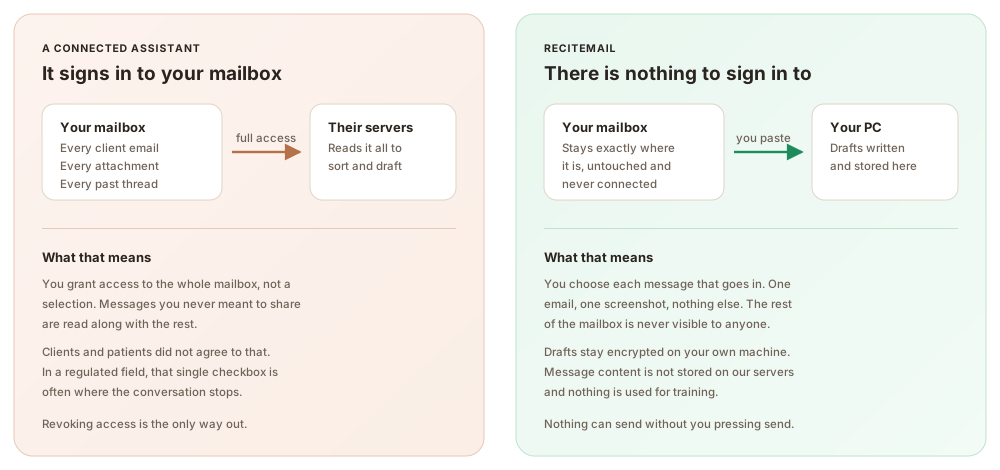
Cora cannot triage a mailbox it cannot read. The connection is not optional for what it does. ReciteMail never needs to know what arrived, only what you decided to answer, which is why it can work without any access at all.
Side by side
ReciteMail and Cora compared
Cora wins several rows outright. The table marks them the same way as ours.
| Cora | ReciteMail | |
|---|---|---|
| What it is | An inbox screen and a twice daily brief | A drafting tool for replies |
| Price | $15 a month, $20 with an Every subscription | €29.99 a month or €299 a year |
| Reduces what reaches you | Yes, that is the product | No, it never sees your inbox |
| Writes the reply | Assists a little. Replying is not the focus | Yes, a full draft in your voice |
| Mailbox connection | Required to triage at all | None, there is nothing to connect |
| Learns how you write | Not its purpose | Learns from sent emails you import |
| Handles mail from outside an inbox | No | Yes, any text on screen |
| Dictate the reply | No | Yes, say one line and read the draft |
| Where your mail sits | With the vendor, as triage requires | Encrypted on your own PC |
| Platforms | Web and mobile | Windows 10 and 11 only |
← Swipe → the table to see every column
Cora pricing checked on 3 August 2026 from publicly listed rates. It is $15 a month standalone. With an Every subscription it is $20 a month.
Three practical differences
What you actually notice day to day
Two different complaints
People describe both problems with the same sentence, which is that email is eating the day. Underneath they are different. If you open the inbox and cannot tell what matters, the fix is triage and Cora does that well. If you already know exactly which six emails need answering and you dread writing them, triage changes nothing. That is the gap ReciteMail fills. It is worth being honest that we do nothing whatsoever about volume.
A schedule against an interruption
Cora's real idea is not filtering but rhythm. Twice a day you read a brief instead of glancing at a notification forty times. That is a genuinely good habit and no drafting tool provides it. ReciteMail assumes you have already decided what to answer and simply removes the part where you stare at a blank reply box at seven in the evening.
Reading your mail against never seeing it
To decide what matters, Cora has to read everything that arrives. There is no way around that and it is not a criticism, it is arithmetic. ReciteMail is only ever shown the single message you hand over. Everything you import for style stays in an encrypted database on your own machine. If the idea of a service reading every incoming message is the sticking point, that difference is the whole answer.
Being straight with you
When Cora is the better choice
Pick Cora if the volume arriving is the problem. If you open your inbox in the morning and feel the pile before you feel any single message, Cora is aimed exactly at that and ReciteMail will not help you. Screening plus a twice daily brief is a real change to how the day feels, it is cheaper than us at $15 and it runs on the web and on your phone where we are Windows only. Choose ReciteMail when the problem is not what arrives but what it costs you to answer it, when the replies need to sound like you rather than be summarised. And when you would rather nothing at all had a connection to your mail.
Beyond one inbox
Who chooses the no-access option
Stores, accountants, clinics, solicitors, compliance teams, property managers, agencies and trades. Anywhere handing an app your whole mailbox is the sticking point, drafting beside it is the answer.
Questions
Common questions
What is the difference between Cora and ReciteMail?
Cora reduces how much email reaches you by screening the inbox and sending a brief twice a day. ReciteMail does not look at your inbox at all. It writes the reply for a message you have already decided to answer, in your own voice. One shrinks the pile and the other clears it faster.
Can I use Cora and ReciteMail together?
Yes. It is a sensible pairing because they never touch the same thing. Cora decides what deserves your attention. ReciteMail writes the answers to the ones that do. Since ReciteMail has no connection to your mail account there is nothing for Cora to conflict with.
Does Cora write my replies for me?
Replying is not what Cora is built around. Its focus is screening what arrives and summarising it into a brief you read twice a day. If your main frustration is the time spent writing rather than the time spent sorting, a drafting tool is the closer fit.
Which one is more private?
Cora has to read every message that arrives in order to decide what matters, which is inherent to triage rather than a shortcoming. ReciteMail only ever sees the single message you hand it and stores everything you import in an encrypted database on your own PC. If you want nothing reading your incoming mail, that is the clearer answer.
Which is cheaper?
Cora at $15 a month is cheaper than ReciteMail at 29.99 euro. It also solves a different problem. The honest comparison is not price but which half of the email problem is actually costing you time.
What does ReciteMail cost?
29.99 euro a month or 299 euro a year, unlimited drafting under fair use. One account covers two computers. The trial runs 7 days with no card needed.
For the replies you have already decided to send
Nothing to connect and nothing reading your inbox. Import a few sent emails so it learns how you write, then answer this week's replies in minutes. Free for 7 days, no credit card.
Start your free trial€29.99 a month or €299 a year after the free week. Windows 10 and 11. Reads and replies in 60+ languages.