What Happened to Flowrite? And What to Use Instead
Published 15 August 2026 · 6 minute read · The ReciteMail Blog
The short answer: Flowrite no longer exists as a standalone product. Maestro Labs acquired its email writing business in January 2025 and folded it into MailMaestro. Flowrite.com now redirects to an acquisition notice and the browser extension is gone. If you relied on it, here is the full story, the three paths former users are taking and an honest look at which one fits you.
The short version
- Flowrite was a Finnish startup whose tool turned short instructions into full emails that sounded like you. It earned a place in nearly every "best email tools" roundup of its era.
- January 2025: Maestro Labs, the company behind MailMaestro, acquired Flowrite's email writing division. The product was retired as a standalone tool and its technology merged into MailMaestro.
- The founders moved on. The original team did not join Maestro Labs. They now build Flow AI, a platform for evaluating language model systems, which has nothing to do with email.
- Today: flowrite.com redirects to the Maestro Labs acquisition page, the extension can no longer be installed and former subscribers are pointed at MailMaestro.
For users the distinction between "acquired" and "shut down" is academic. The tool you installed stopped existing and something else wants your subscription. The real question is what to do about the job Flowrite used to do.

Why people are still searching for it
Flowrite got one thing memorably right: you typed a couple of bullet points and it produced a complete email in your register, not a robot's. People who used it daily built their whole reply workflow around that. When it disappeared, the workflow disappeared with it, which is why "what happened to Flowrite" is still being typed into Google a year and a half later. The product died. The need did not.
The three exits
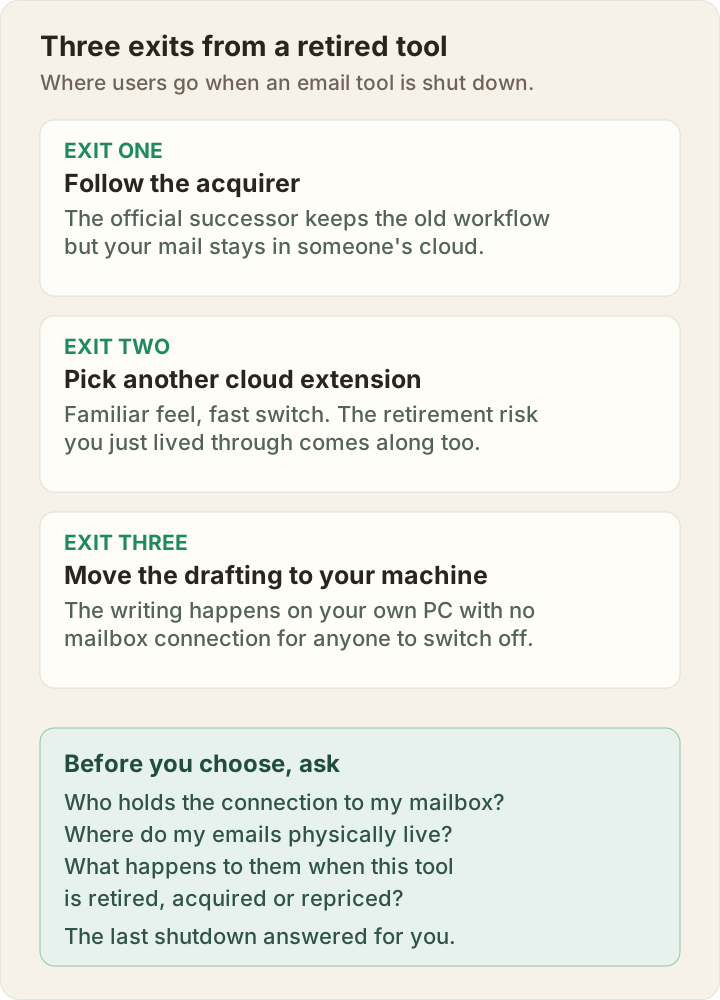
Exit one: follow the acquirer to MailMaestro
MailMaestro is the official successor and the honest first option. It inherited Flowrite's technology and wraps it in a bigger product: drafting plus inbox triage, thread summaries and Gmail and Outlook add-ins, with a free tier and a paid plan around the mid-teens per month. If what you want is the old experience inside your inbox with more features on top, this is the closest thing and the migration is designed to be easy.
The trade-off is structural rather than a flaw in the product: it is another cloud tool with a connection into your mailbox, owned by a company that buys and merges products. That is exactly the arrangement that just ended once.
Exit two: another cloud writing extension
Grammarly, Compose AI, Gemini inside Gmail and a dozen others will draft emails in your browser. They are quick to adopt and fine at generic prose. Two things to know before rebuilding on one: few of them learn your personal voice the way Flowrite did and every one of them carries the same retirement risk you just lived through. Extensions are the most frequently acquired, repriced and sunsetted category in software. Anyone rebuilding a daily workflow on one is betting it outlives their patience for migrating again.
Exit three: move the drafting onto your own machine
This is the path for people whose takeaway from the Flowrite story is "I do not want my email workflow living in someone else's cloud again." It is the one ReciteMail was built for. Consider the source accordingly. The differences that follow are factual. ReciteMail is a Windows desktop app. It learns how you write from emails you have already sent, then turns a one-line note like "quote is 450, can start Tuesday, need the samples back first" into a full reply in your voice. It never connects to your inbox: you import the mail you choose, your messages live in an encrypted database on your own PC and nothing is stored on our servers. There is no mailbox connection for an acquirer to switch off and no bulk copy of your correspondence sitting in a cloud that can change hands.
The honest limits: it is import-only by design, it drafts rather than manages your inbox and it will not sort or summarise your mail the way MailMaestro will. It does the one job Flowrite users actually miss and does it privately.
The lesson worth keeping
Flowrite was good software run by capable people and it still vanished, because that is what the category does. Tools get acquired, merged and repriced. The question the diagram above asks is the durable one: who holds the connection to your mailbox and what happens to your data when the answer changes? If the tool holds it, every acquisition is your problem. If nothing ever connects, an acquisition somewhere else is just news. That reasoning applies well beyond this one product, which is why we wrote it up more generally in email automation vs writing the reply yourself.
Former Flowrite user? The workflow translates almost one to one: your short instruction becomes the one-line note, the draft comes back in your voice and you paste it into any email client you like. Nothing connects to your mailbox, which means there is nothing to unwind next time a company gets acquired. See how ReciteMail works or the wider field guide to email drafting tools.
Common questions
Is Flowrite still available?
No, not as a standalone product. Maestro Labs acquired Flowrite's email writing business in January 2025 and folded it into MailMaestro. Flowrite.com now redirects to the Maestro Labs acquisition page and the original browser extension is no longer available to install.
Was Flowrite shut down or acquired?
Acquired, then retired as a standalone product. The Finnish team behind Flowrite moved on to build Flow AI, a platform for evaluating language model systems, while Maestro Labs took over the email writing product and merged it into MailMaestro. For users the practical effect is the same as a shutdown: the tool you installed no longer exists.
What is the closest replacement for Flowrite?
It depends on what you valued. If you want the same cloud experience with inbox integration, MailMaestro is the official successor and inherited Flowrite's technology. If the part you valued was drafts that sound like you and the acquisition left you wary of cloud tools that can vanish, ReciteMail does the in-your-voice drafting on your own PC without ever connecting to your inbox.
What happened to the Flowrite Chrome extension?
It was withdrawn after the acquisition and can no longer be installed. Former extension users are pointed to MailMaestro's own Gmail and Outlook add-ins. Any workflow built on the old extension has to be rebuilt on whichever replacement you choose.
The in-your-voice part, without the cloud
ReciteMail drafts replies in your own voice, learned from mail you have already sent. It runs on your PC, never connects to your inbox and your messages never sit on anyone's servers. Free for 7 days, no card needed.
Start your free trial